US Diplomatic Engagement and Secondary Sanctions Pressure on Moscow
Source:The Hindu ↗
Why It Matters
The imposition of secondary tariffs on nations trading with Russia would severely test India's strategic autonomy, forcing it to navigate complex trade relations while mitigating geopolitical pressure from the U.S. The broader East-West confrontation also has immense implications for global supply chains and nuclear stability.
Summary
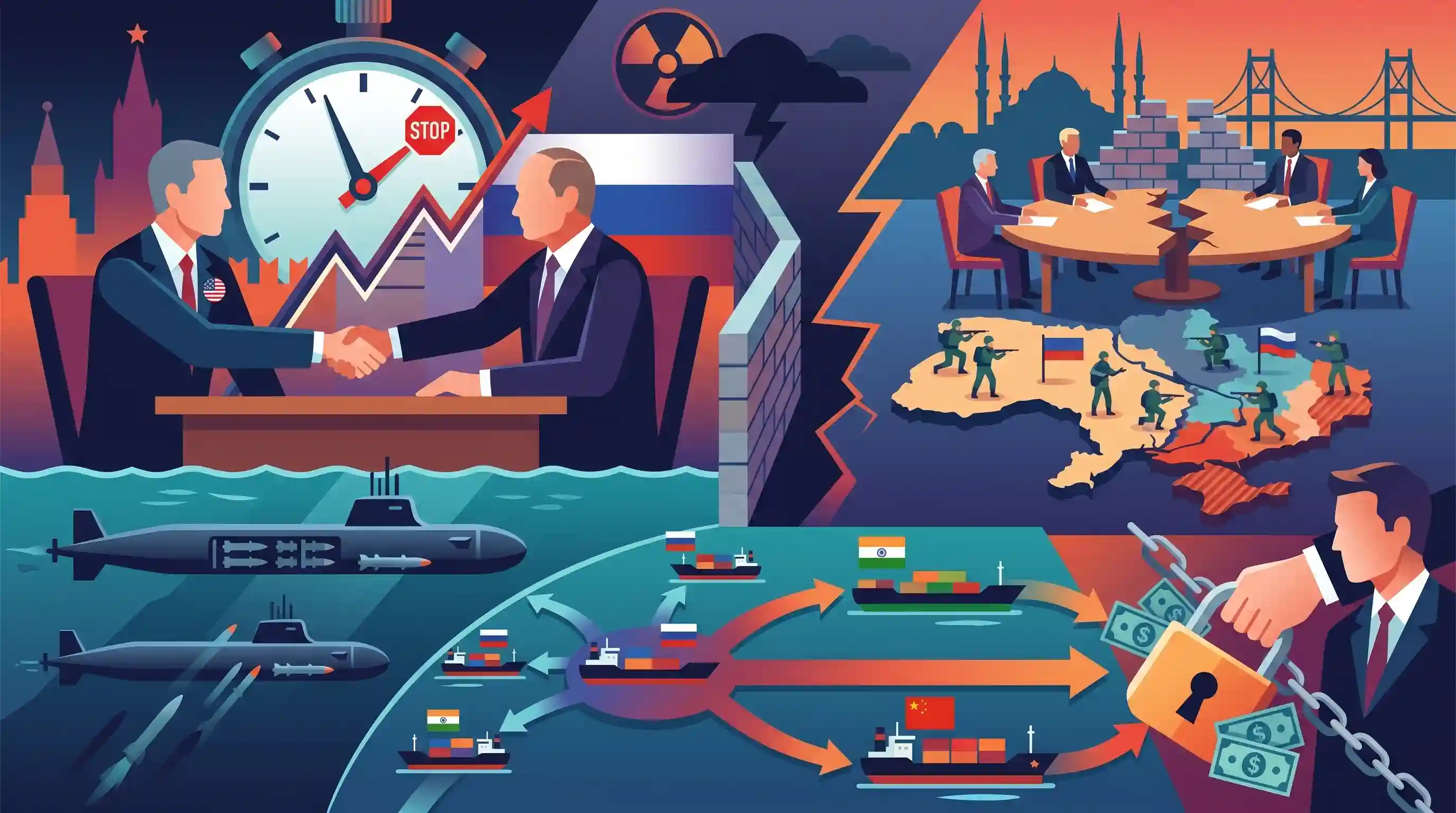
U.S. Special Envoy Steve Witkoff has traveled to Moscow for high-level meetings ahead of President Donald Trump’s deadline for Russia to halt its war in Ukraine. Without a cessation of hostilities, the U.S. threatens new penalties, including 'secondary tariffs' on countries continuing to trade with Russia, such as India and China. While Istanbul peace talks have stalled due to vast differences over territorial and NATO demands, escalating nuclear rhetoric and U.S. submarine deployments add immense pressure to the diplomatic negotiations.
Key Points
- U.S. Envoy Steve Witkoff is in Moscow ahead of an August 8, 2025 deadline set by Donald Trump for Russia to halt its offensive in Ukraine.
- Failure to comply could lead to new U.S. penalties, including 'secondary tariffs' potentially targeting major Russian trade partners like India and China.
- Multiple rounds of peace talks in Istanbul have failed, with Russia demanding territorial concessions and an end to Ukraine's NATO ambitions, while Kyiv demands a ceasefire.
- Trump's recent deployment of nuclear submarines following tensions with Russian officials has escalated nuclear rhetoric, prompting caution from the Kremlin.
Important Terms
Secondary Sanctions

Penalties targeting third-party nations or companies that conduct business with a primary sanctioned entity, forcing a choice between the sanctioned market and the sanctioning country's financial system.
UPSC context
GS Paper 2 (International Relations); tests understanding of extraterritoriality and its impact on India's energy trade with Russia.
NATO
An intergovernmental military alliance of 32 North American and European countries committed to collective defense under Article 5.
UPSC context
GS Paper 2 (International Institutions); crucial for analyzing the security architecture of Europe and root causes of the Russia-Ukraine conflict.
Secondary Tariffs
Retaliatory levies imposed on a country's total exports to the U.S. as a penalty for that country purchasing specific sanctioned goods from a third nation.
UPSC context
GS Paper 3 (Economy); relevant for trade policy and the use of economic statecraft as a tool of foreign policy.
Nuclear Deterrence
A strategic doctrine that uses the threat of nuclear retaliation to prevent an enemy from using nuclear weapons or initiating large-scale conventional aggression.
UPSC context
GS Paper 3 (Internal Security); involves understanding global strategic stability and India's 'No First Use' nuclear doctrine.
Strategic Autonomy
The ability of a nation to maintain an independent foreign policy and make decisions based on national interest without being coerced by foreign powers or alliances.
UPSC context
GS Paper 2 (Bilateral Relations); core to India's stance in a multipolar world, especially regarding the U.S.-Russia-India triangle.
Special Envoy
A senior diplomat designated by a government to handle specific, often urgent, diplomatic tasks or to represent the country in a particular region or conflict.
UPSC context
GS Paper 2 (International Relations); reflects the role of personal diplomacy and executive-led negotiations in resolving global crises.
Prelims Trap
Secondary sanctions or tariffs imposed by the US are legally binding on third-party nations under UN Security Council mandates.
Unilateral US measures (like CAATSA or secondary tariffs) lack UN Security Council backing. UPSC frequently tests the legal distinction between binding UN sanctions and unilateral coercive measures.
Static Concepts Connected
What is the 1936 Montreux Convention?
- Control of Straits: Grants Turkey sovereign control over the Bosphorus and Dardanelles straits.
- Warship restriction: Empowers Turkey to regulate, and during wartime block, the transit of naval warships belonging to belligerent nations.
- Civilian passage: Guarantees the free passage of civilian and merchant vessels through the straits during peacetime.
How do US Secondary Sanctions (like CAATSA) operate?
- Targeting third parties: They penalize third-party countries or entities that engage in significant transactions with US adversaries (e.g., Russian defense sector).
- Impact on India: Creates severe friction for India's policy of strategic autonomy, specifically regarding vital Russian defense hardware (like the S-400).
- Presidential waiver: While CAATSA contains a waiver mechanism for allies like India, it relies heavily on US presidential discretion.
Cross-Topic Patterns
Secondary tariffs & weaponization of trade
The shift from targeted CAATSA sanctions to blanket 'secondary tariffs' blends geopolitical coercion with trade protectionism, threatening Indian export sectors like textiles, pharma, and IT.
New START suspension & nuclear signaling
The suspension of the New START treaty, combined with active US submarine deployments in response to the war, reflects a perilous shift from strategic deterrence to active nuclear signaling.

Expect a 2026 prelims question pairing the Montreux Convention's geography with the legal distinction of unilateral US secondary tariffs.
Linked PYQs · 3
Linked PYQs · 3
- 2012MainsGS2
How have the US sanctions against Iran affected India's bilateral relations with Iran?
- 2025MainsGS2
"The reform process in the United Nations remains unresolved, because of the delicate imbalance of East and West and entanglement of the USA vs. Russo-Chinese alliance.” Examine and critically evaluate the East-West policy confrontations in this regard.
- 2023MainsGS2
‘The expansion and strengthening of NATO and a stronger US-Europe strategic partnership works well for India.’ What is your opinion about this statement ? Give reasons and examples to support your answer.
