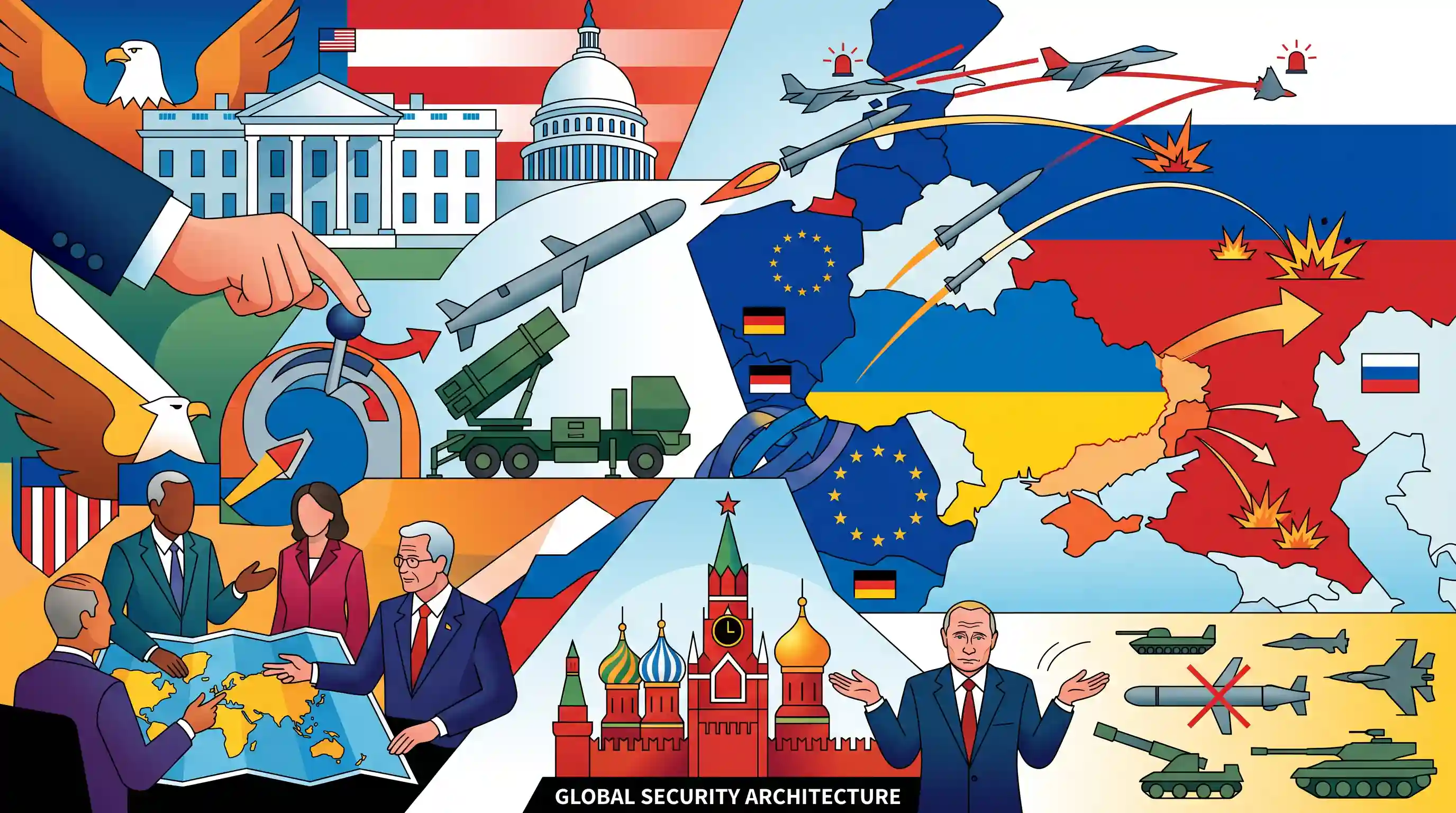
US considers authorizing Ukraine for long range strikes inside Russia
Source:The Hindu ↗
Why It Matters
Changes in U.S. military support for Ukraine, such as providing Tomahawk cruise missiles for deep strikes into Russia, carry profound implications for the trajectory of the war, European security, and the broader East-West geopolitical balance. It also highlights the strategic utility of advanced cruise missiles in modern asymmetric and symmetric warfare.
Summary
The U.S. administration is contemplating a major policy shift that would authorize Ukraine to launch long-range strikes deep into Russian territory using American weapons. U.S. Envoy Keith Kellogg and Vice President J.D. Vance indicated that discussions are ongoing regarding the provision of long-range Tomahawk cruise missiles to Kyiv. This marks a strategic reversal for President Donald Trump, who now asserts that Ukraine, with European Union support, can reclaim all its pre-2014 territory. The policy review comes in the wake of Russian airspace violations over European nations. However, the Kremlin dismissed the development, stating that no single weapon system can fundamentally change the war's dynamics.
Key Points
- The U.S. administration is considering allowing Ukraine to conduct long-range strikes deep into Russian territory using American weapons.
- Discussions are actively underway to potentially supply Ukraine with long-range Tomahawk cruise missiles, reflecting a significant policy pivot by President Donald Trump.
- President Trump recently indicated that with European Union support, Ukraine could win back all of its original territory, including areas annexed since 2014.
- The shift in U.S. stance follows accusations that Russian fighter jets and drones violated the airspace of several European nations.
- The Kremlin dismissed the potential impact of Tomahawk missiles, asserting that no "magic weapon" can alter the fundamental dynamics of the ongoing conflict.
Important Terms
Tomahawk Cruise Missiles

Advanced American long-range, all-weather, subsonic cruise missiles. They are capable of precision deep-strikes over 1,500 km, flying at low altitudes to evade radar and air defense systems.
UPSC context
GS Paper III (Defense Technology); critical for comparing missile systems and understanding the strategic escalation in modern warfare.
Kremlin
The historic fortified complex in Moscow; metonymically used to refer to the central government and executive political authority of the Russian Federation.
UPSC context
GS Paper II (International Relations); represents the primary state actor in the Russia-Ukraine conflict and global geopolitical shifts.
European Union (EU)
A political and economic union of 27 European member states. In the current conflict, it acts as a major provider of security assistance and economic sanctions.
UPSC context
GS Paper II (International Relations); tests understanding of regional blocs and their role in upholding the rules-based international order.
Strategic Reversal
A fundamental pivot in a country’s foreign policy or military doctrine. In this context, it refers to the US transitioning toward authorizing Ukrainian deep-strikes into Russia.
UPSC context
GS Paper II (International Relations); analyzes changes in Great Power politics and their implications for global security architecture.
Territorial Integrity
The principle under international law that a sovereign state's borders should not be forcibly altered. Here, it refers to Ukraine’s borders prior to the 2014 annexation of Crimea.
UPSC context
GS Paper II (International Relations/International Law); a core concept regarding sovereignty and the UN Charter in border disputes.
Prelims Trap
"Tomahawk missiles are advanced long-range ballistic missiles provided by the US to strike Russian territory."
Tomahawks are subsonic cruise missiles, not ballistic. They fly low within the Earth's atmosphere to evade radar, whereas ballistic missiles follow a high parabolic trajectory and can exit the atmosphere.
Static Concepts Connected
How do cruise missiles technically differ from ballistic missiles?
- Cruise Missiles: Self-propelled by jet engines throughout their entire flight, remaining within the atmosphere.
- Low Altitude: Fly at very low altitudes to evade radar detection (often subsonic).
- Ballistic Missiles: Powered initially but follow an unpowered, parabolic trajectory, often exiting the Earth's atmosphere.
What is the geographic significance of Ukraine's pre-2014 borders?
- Crimean Peninsula: Annexed by Russia in 2014, it dominates the northern coast of the Black Sea.
- Kerch Strait: A strategic chokepoint connecting the Black Sea to the Sea of Azov, separating Crimea from Russia.
- Donbas Region: The eastern regions (Donetsk and Luhansk) where Russian-backed separatist conflicts began after 2014.
Cross-Topic Patterns
NATO Article 5 and Airspace Violations
Russian airspace violations in Europe risk triggering NATO's Article 5 (collective defense), potentially transforming a localized proxy war into a direct regional conflict.
Long-range Missiles and MTCR Limits
Supplying Tomahawk missiles (range >300km) touches upon global non-proliferation norms like the Missile Technology Control Regime (MTCR), a favorite UPSC area for export control groups.

Map questions on the Black Sea/Kerch Strait paired with S&T statements on Cruise vs Ballistic missiles are highly probable in 2026 prelims.
Linked PYQs · 3
Linked PYQs · 3
- 2025MainsGS2
"The reform process in the United Nations remains unresolved, because of the delicate imbalance of East and West and entanglement of the USA vs. Russo-Chinese alliance.” Examine and critically evaluate the East-West policy confrontations in this regard.
- 2023MainsGS2
‘The expansion and strengthening of NATO and a stronger US-Europe strategic partnership works well for India.’ What is your opinion about this statement ? Give reasons and examples to support your answer.
- 2023PrelimsGS1
Consider the following statements: 1. Ballistic missiles are jet-propelled at subsonic speeds throughout their flights, while cruise missiles are rocket-powered only in the initial phase of flight. 2. Agni-V is a medium-range supersonic cruise missile, while BrahMos is a solid-fuelled intercontinental ballistic missile. Which of the statements given above is/are correct?
