US and Russian diplomatic talks on Ukraine conflict resolution
Source:The Hindu ↗
Why It Matters
The article highlights the shifting geopolitical landscape and diplomatic efforts surrounding the Russia-Ukraine war. Understanding these negotiations is crucial for GS-II (International Relations), as it reflects on the role of major powers (like the USA) in conflict mediation, changes in East-West relations, and how such global stability or instability indirectly impacts India's strategic and economic interests. It also has Prelims relevance for tracking conflict zones and summit locations.
Summary
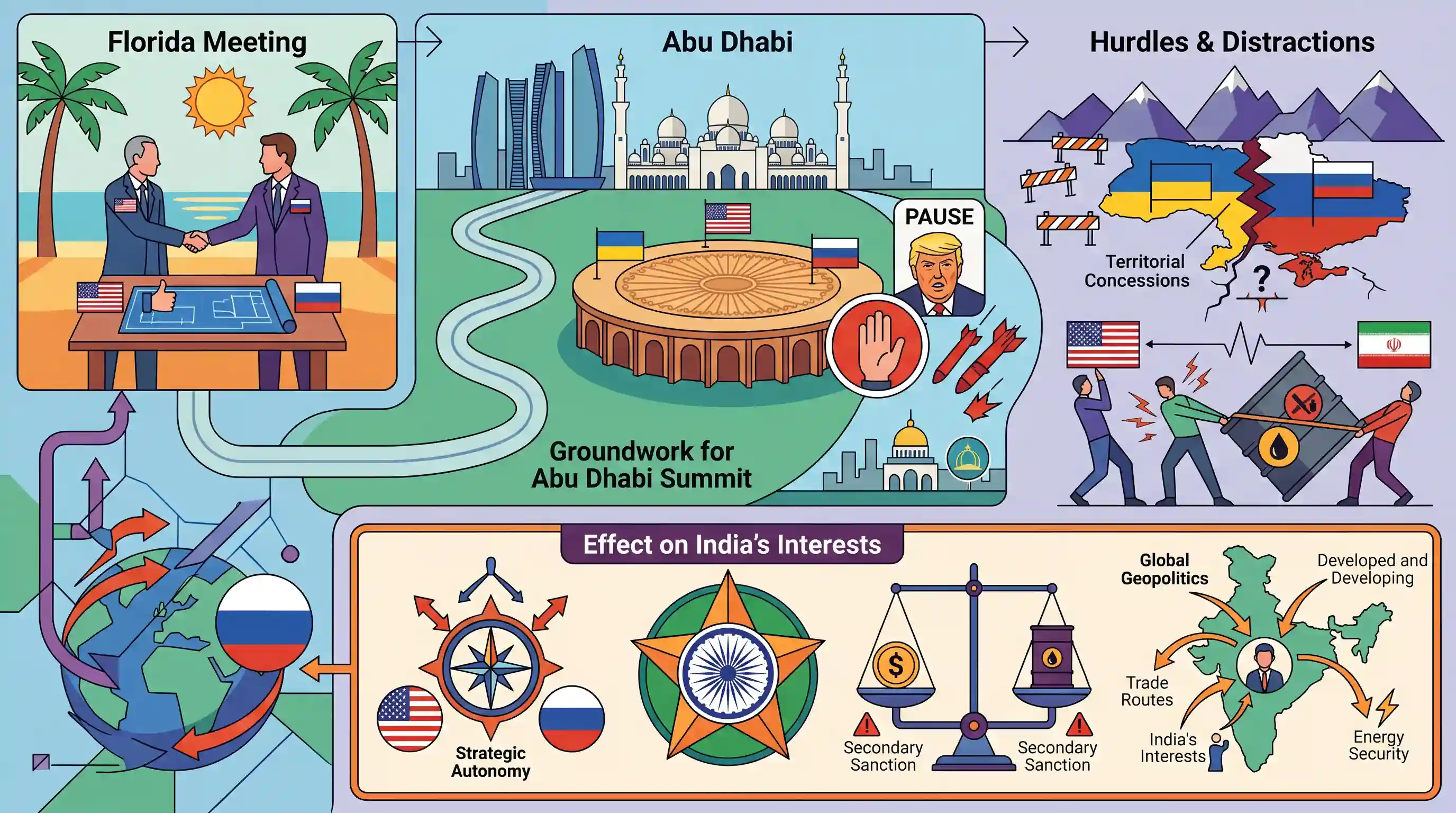
U.S. and Russian envoys have held "constructive" preliminary discussions in Florida, laying the groundwork for an upcoming U.S.-backed peace summit between Ukraine and Russia in Abu Dhabi. The diplomatic push involves key American figures and has already yielded a pause in Russian strikes on Kyiv at Donald Trump's behest. However, substantial hurdles remain, including the contentious issue of territorial concessions in a post-war settlement and the distracting influence of other global crises, such as ongoing U.S.-Iran tensions.
Key Points
- U.S. envoy Steve Witkoff and Russian envoy Kirill Dmitriev held constructive talks in Florida regarding a potential peace plan for the Ukraine war.
- These discussions precede direct negotiations between Ukrainian and Russian representatives scheduled to take place in Abu Dhabi.
- The inclusion of high-profile U.S. figures like Scott Bessent and Jared Kushner underscores significant American involvement in mediating the conflict.
- Russian President Vladimir Putin agreed to pause strikes on Kyiv following a request from Donald Trump, serving as a preliminary confidence-building measure.
- Major sticking points remain, primarily the status of Ukrainian territory seized by Russia, while broader geopolitical tensions like the U.S.-Iran crisis also complicate the diplomatic environment.
Important Terms
Abu Dhabi Peace Summit

A 2026 high-level diplomatic forum in the UAE facilitating trilateral talks between the U.S., Russia, and Ukraine to negotiate an end to the nearly four-year invasion.
UPSC context
GS Paper II: International Relations. Tests understanding of third-party mediation and global diplomatic initiatives to resolve major conflicts.
Territorial Concessions
The surrender of sovereignty over specific regions (e.g., Donbas, Crimea) as part of a peace settlement. It pits 'territorial integrity' against 'political realism' in international law.
UPSC context
GS Paper II: International Relations. Relates to state sovereignty and the challenges of post-war borders in global geopolitics.
Security Guarantees
Formal pledges by major powers to protect a state's sovereignty and prevent future aggression. Ukraine views these as non-negotiable prerequisites for any lasting peace treaty.
UPSC context
GS Paper II: International Relations. Tests knowledge of collective security arrangements and bilateral defense commitments.
Trilateral Negotiations
Diplomatic engagement involving three parties—here the U.S. as mediator with Russia and Ukraine. It shifts conflict resolution from binary deadlock to mediated dialogue.
UPSC context
GS Paper II: International Relations. Relevant for studying different formats of international diplomacy and mediation strategies.
Buffer Zone
A neutral, often demilitarized area established between hostile forces to freeze front lines and allow for a transition from active combat to peace.
UPSC context
GS Paper II: International Relations. Pertains to conflict management, peacekeeping mechanisms, and border security.
Special Envoy
A high-ranking diplomat appointed for a specific mission or region. In this context, Steve Witkoff facilitates flexible, high-stakes negotiations outside traditional embassy channels.
UPSC context
GS Paper II: International Relations. Understanding the role of specialized diplomatic appointments in modern global governance.
US Treasury
The U.S. executive department managing international sanctions and financial aid, acting as an economic lever to incentivize or penalize states during peace negotiations.
UPSC context
GS Paper II: Effect of policies of developed countries. Specifically, how economic sanctions are used as foreign policy tools.
Prelims Trap
"The UAE is formally mediating the Russia-Ukraine war as a member of the Normandy Format."
The Normandy Format was created in 2014 comprising France, Germany, Russia, and Ukraine. The UAE acts as an independent mediator outside traditional European security architectures.
Static Concepts Connected
What is the geographical and economic significance of the Donbas region?
- Geographic Location: Located in eastern and southeastern Ukraine, it primarily consists of the Donetsk and Luhansk oblasts sharing a long border with Russia.
- Economic Core: It is historically a massive coal mining and heavy metallurgy hub, making it crucial to Ukraine's pre-war industrial output and energy security.
- Strategic Access: The broader region relies heavily on access to the Sea of Azov (via ports like Mariupol) for maritime trade and logistics.
What role do 'Confidence-Building Measures' (CBMs) play in diplomacy?
- Risk Reduction: Actions taken to reduce mutual fear, misunderstanding, or the likelihood of accidental escalation between conflicting states.
- Examples: Military pauses (like halting strikes on Kyiv), establishing direct hotlines, and sharing military exercise schedules.
- Stepping Stones: They are not final treaties but are crucial preliminary steps to transition from active hostility to formal negotiations.
Cross-Topic Patterns
Rise of Gulf states as global mediators
The Abu Dhabi summit highlights how nations like the UAE leverage multi-aligned foreign policies to replace traditional European peace-building venues like Geneva or Oslo.
Interconnectedness of multi-theatre global crises
The distracting effect of US-Iran tensions on Ukraine talks illustrates how regional security architectures in the Middle East and Eastern Europe are now deeply intertwined.

Expect a 2026 prelims map question on the Azov/Black Sea or a mains question on the rise of West Asian states as global mediators.
Linked PYQs · 4
Linked PYQs · 4
- 2025MainsGS2
"The reform process in the United Nations remains unresolved, because of the delicate imbalance of East and West and entanglement of the USA vs. Russo-Chinese alliance.” Examine and critically evaluate the East-West policy confrontations in this regard.
- 2012MainsGS2
Does Putin's return as President of Russia mark a shift to a confrontationist stance in international diplomacy towards the West?
- 2023PrelimsGS1
Consider the following pairs: Regions often mentioned in news Reason for being in news 1. North Kivu and Ituri : War between Armenia and Azerbaijan 2. Nagorno-Karabakh : Insurgency in Mozambique 3. Kherson and Zaporizhzhia : Dispute between Israel and Lebanon How many of the above pairs are correctly matched?
- 2023PrelimsGS1
Consider the following pairs: Area of conflict mentioned in news Country where it is located 1. Donbas : Syria 2. Kachin : Ethiopia 3. Tigray : North Yemen How many of the above pairs are correctly matched?
