US Energy Secretary Demands IEA Abandon Climate Focus
Source:The Hindu ↗
Why It Matters
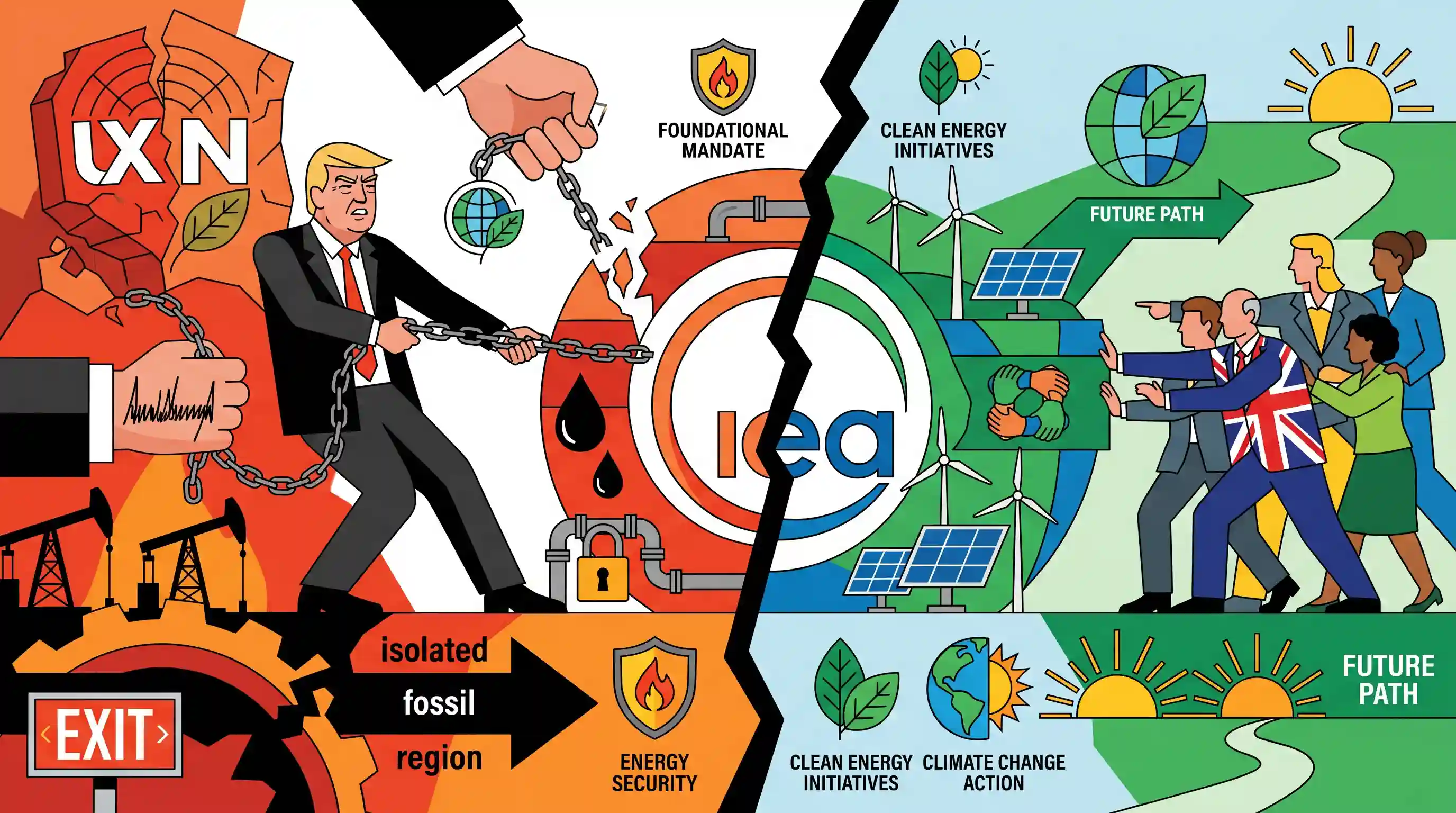
Highlights the evolving role and mandates of international organizations like the IEA, the geopolitical tensions between traditional energy security and clean energy transitions, and the implications of major powers withdrawing from global climate commitments.
Summary
US Energy Secretary Chris Wright has criticized the International Energy Agency (IEA) for prioritizing climate change over its foundational mandate of energy security, threatening US withdrawal from the agency. This development reflects a major shift in US climate diplomacy under President Donald Trump, which has already seen the US exit the UN climate treaty. Conversely, the UK and other nations continue to support the IEA's clean energy initiatives, highlighting a growing geopolitical divide over global climate action and energy transition strategies.
Key Points
- US Energy Secretary Chris Wright urged the International Energy Agency (IEA) to abandon its climate change focus and return to its core mission of energy security.
- The US threatened to withdraw its funding and participation in the IEA if the agency does not shift its priorities.
- The move aligns with broader US policy under President Donald Trump, which includes withdrawing from the UN climate treaty and dismantling domestic climate regulations.
- In contrast, the UK has pledged continued support and additional funding for the IEA's Clean Energy Transitions Programme.
Important Terms
International Energy Agency (IEA)

An autonomous intergovernmental organization within the OECD framework founded in 1974 to ensure energy security. It provides global energy data and policy advice focusing on security, economic development, and environmental sustainability.
UPSC context
GS Paper 2 (International Institutions) and GS Paper 3 (Energy); crucial for understanding global energy governance and India's 'Associate Member' status.
Energy Security
The uninterrupted availability of energy sources at an affordable price. It encompasses long-term investments for economic development and short-term resilience against sudden supply-demand disruptions or geopolitical risks.
UPSC context
GS Paper 3 (Energy/Security); a core pillar of national policy and a major theme in international climate-energy debates.
Clean Energy Transitions Programme (CETP)
The IEA’s flagship initiative (established 2017) providing technical support and capacity building to emerging economies to accelerate clean energy transitions in line with global climate goals.
UPSC context
GS Paper 3 (Environment/Energy); relevant for questions on international cooperation for technology transfer and sustainable development.
Paris Agreement
A 2015 legally binding international treaty under the UNFCCC aiming to limit global warming to well below 2°C. It relies on non-binding, country-specific Nationally Determined Contributions (NDCs).
UPSC context
GS Paper 3 (Environment/Climate Change); a foundational topic for prelims and mains regarding global environmental governance.
Net Zero Emissions
The balance between man-made greenhouse gas emissions and their removal from the atmosphere. Achieving this by 2050 is a primary goal of the IEA’s most ambitious energy scenario.
UPSC context
GS Paper 3 (Environment); tests understanding of mitigation strategies and the geopolitical friction between development and decarbonization.
Prelims Trap
"India is a full member of the International Energy Agency (IEA)."
India is only an "Association" country, not a full member. Full IEA membership strictly requires a country to first be a member of the OECD, which India is not.
Static Concepts Connected
What is the foundational mandate and membership criteria of the IEA?
- Origin: Established in 1974 within the OECD framework as a direct response to the 1973 global oil crisis.
- Core Mandate: Originally focused on ensuring energy security and coordinating collective responses to major disruptions in oil supply.
- Membership Rule: To become a full member of the IEA, a candidate country must first be a member of the OECD.
Which major global energy and environment reports are frequently tested?
- World Energy Outlook: Published annually by the IEA, providing critical analysis and projections on global energy trends.
- World Economic Outlook: Published by the IMF, focusing on global macroeconomic projections. (Often confused with the IEA's energy report).
- Global Environment Outlook: Published by the UN Environment Programme (UNEP), assessing the comprehensive state of the global environment.
Cross-Topic Patterns
Energy security vs. Net-Zero mandates
The US-IEA rift highlights the rising GS2/GS3 tension between traditional energy security (oil/gas supply resilience) and climate-driven net-zero transition mandates.
US isolationism and climate governance architectures
The US exiting the 1992 UNFCCC mirrors past isolationist moves (like leaving the Paris Agreement or WHO), testing the financial and diplomatic resilience of UN-led global environmental governance.

Expect a 2026 Prelims multi-statement question mixing IEA’s OECD-membership rule, India’s Association status, and its founding mandate.
Linked PYQs · 4
Linked PYQs · 4
- 2016PrelimsGS1
With reference to the Agreement at the UNFCCC Meeting in Paris in 2015, which of the following statements is/are correct? 1. The Agreement was signed by all the member countries of the UN and it will go into effect in 2017. 2. The Agreement aims to limit the greenhouse gas emissions so that the rise in average global temperature by the end of this century does not exceed 2°C or even 1.5°C above pre-industrial levels. 3. Developed countries acknowledged their historical responsibility in global warming and committed to donate $ 1000 billion a year from 2020 to help developing countries to cope with climate change. Select the correct answer using the code given below.
- 2022MainsGS2
‘Clean energy is the order of the day.’ Describe briefly India's changing policy towards climate change in various international fora in the context of geopolitics.
- 2021MainsGS3
Describe the major outcomes of the 26th session of the Conference of the Parties (COP) to the United Nations Framework Convention on Climate Change (UNFCCC). What are the commitments made by India in this conference?
- 2014PrelimsGS1
Which of the following organizations brings out the publication known as 'World Economic Outlook'?
