Caribbean Maritime Security and US Venezuela Regional Tensions
Source:Indian Express ↗
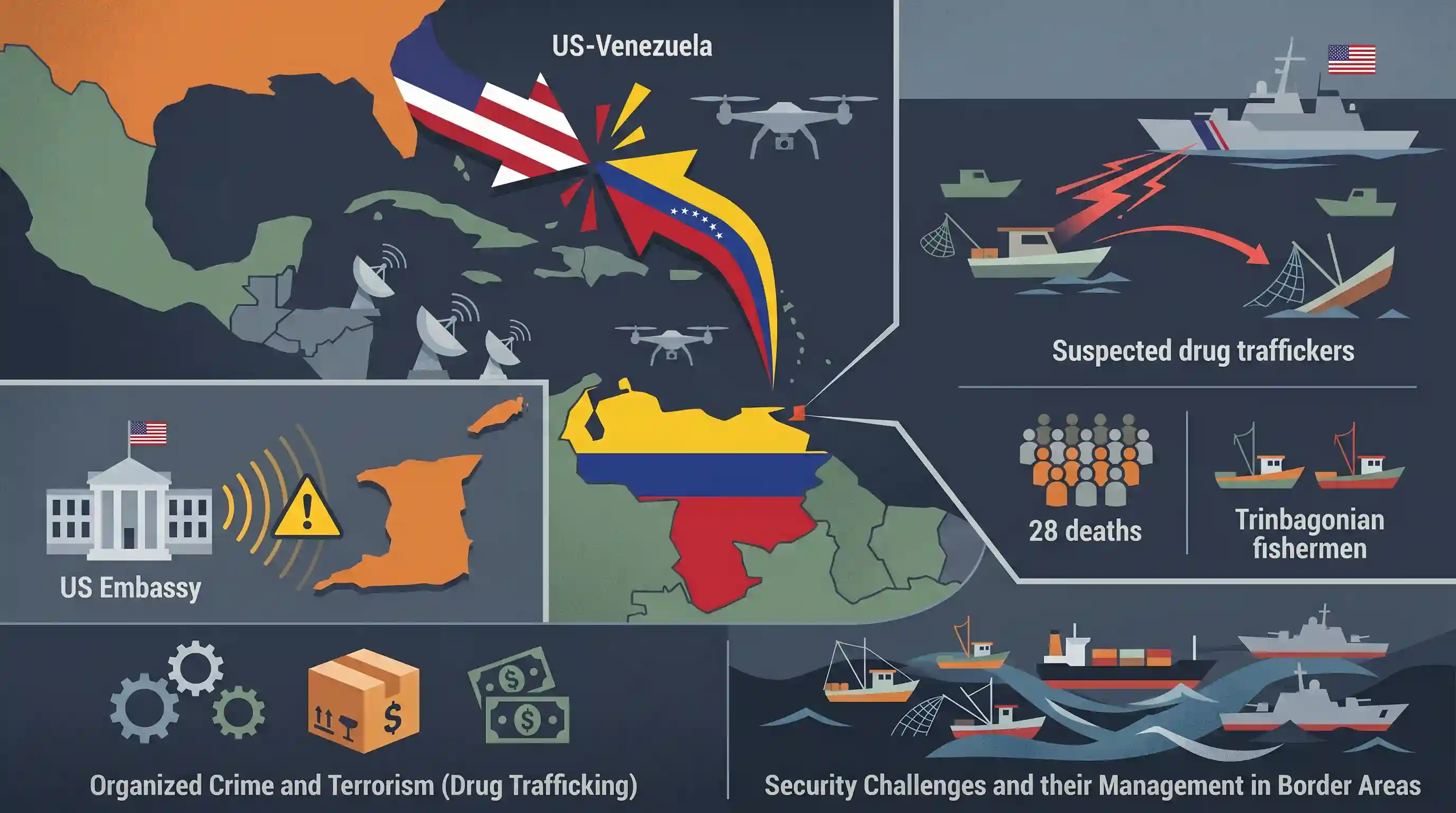
Why It Matters
This event is crucial for understanding the geopolitical dynamics of Latin America and the Caribbean, particularly the ongoing US-Venezuela standoff. It also raises significant international law questions regarding sovereignty and the US use of the "unlawful combatants" doctrine to conduct extraterritorial military strikes against non-state actors like drug traffickers, which ties into UPSC themes of global security and international relations.
Summary
The US embassy in Trinidad and Tobago has issued a security warning to American citizens following heightened geopolitical tensions with neighboring Venezuela. The alert was triggered by recent US military strikes in the Caribbean Sea that targeted suspected drug traffickers, resulting in 28 deaths, including two Trinbagonian fishermen. The US justified the operations by classifying the suspects as "unlawful combatants," a controversial legal doctrine allowing the extraterritorial use of military force. The incident underscores escalating US-Venezuela hostilities, the complex maritime security challenges posed by drug trafficking, and the diplomatic strain on Caribbean nations caught in the crossfire.
Key Points
- The US embassy in Trinidad and Tobago issued a security alert warning American citizens to avoid US government buildings amidst rising regional tensions.
- The friction is driven by recent US military strikes in Caribbean waters targeting suspected drug traffickers linked to the broader US-Venezuela geopolitical standoff.
- The US administration justified the lethal strikes by designating the suspected traffickers as "unlawful combatants", a controversial extraterritorial application of military force under international law.
- The operations resulted in 28 deaths, including two fishermen from Trinidad and Tobago, which has escalated diplomatic tensions and concerns over sovereignty in the Caribbean Basin.
- The events highlight the intersection of maritime security, international drug trafficking, and the geopolitical fallout of aggressive US foreign policy in Latin America and the Caribbean.
Important Terms
Unlawful combatants doctrine

A legal classification for individuals who engage in hostilities without meeting the criteria for lawful combatants (e.g., wearing uniforms), thereby denying them Prisoner of War (POW) status under the Geneva Conventions.
UPSC context
Relevant for GS Paper-II (International Relations) and GS Paper-III (Security); tests understanding of international law, human rights, and state sovereignty.
Narcoterrorism
The nexus between drug trafficking and terrorist activities, where criminal organizations use violence and terror to further their illicit trade or gain political leverage.
UPSC context
GS Paper-III (Internal Security); tests knowledge of organized crime, its links to terrorism, and global security management.
Extraterritorial use of force
The legal exercise of power or military action by a state outside its own territory, often debated under the UN Charter and principles of state sovereignty.
UPSC context
GS Paper-II (IR); explores the limits of national power and the role of international agencies like the UN.
International Humanitarian Law (IHL)
A set of rules (e.g., Geneva Conventions) that seek to limit the effects of armed conflict for humanitarian reasons, protecting non-combatants and restricting means of warfare.
UPSC context
GS Paper-II/Ethics; essential for understanding legal frameworks governing global conflicts and human rights.
Operation Southern Spear
A 2025-26 US military campaign targeting drug trafficking vessels in the Caribbean and Pacific, justified by labeling cartels as non-state armed groups in a non-international armed conflict.
UPSC context
Current Affairs/GS Paper-II; illustrates the impact of US foreign policy on developing nations and regional maritime security.
Maritime Security
Measures taken to protect the maritime domain against security threats like piracy, smuggling, and unlawful use of force in territorial or international waters.
UPSC context
GS Paper-III (Security); key for understanding border management and the protection of national interests at sea.
Prelims Trap
"Unlawful combatants are granted protected Prisoner of War (POW) status under the Geneva Conventions."
This doctrine is not part of the Geneva Conventions; it was explicitly adopted by the US to deny POW status and standard protections to non-state armed actors.
Static Concepts Connected
What distinguishes an 'unlawful combatant' under International Humanitarian Law?
- Geneva criteria: Lawful combatants must have a command structure, fixed distinctive signs, carry arms openly, and follow the laws of war to receive POW status.
- Unlawful combatants: A US-coined category for non-state actors (e.g., terrorists, cartels) who take part in hostilities but do not meet the criteria for lawful combatants.
- Customary protections: Though denied POW status, they are still entitled to fundamental humanitarian protections and humane treatment under Common Article 3 of the Geneva Conventions.
What are the rules for maritime interception under UNCLOS?
- Flag State jurisdiction: Vessels on the high seas are generally subject to the exclusive jurisdiction of the state whose flag they fly.
- Right of Visit: Warships can board foreign ships on the high seas if suspected of piracy or slave trade, but generally need consent for drug trafficking.
- Sovereignty limits: Unilateral military strikes on civilian or smuggling vessels in shared waters without immediate self-defense justifications raise severe international law and sovereignty concerns.
Cross-Topic Patterns
Extraterritorial Force + Law of the Sea
The US military strikes highlight the friction between unilateral security actions and UNCLOS frameworks, mirroring global maritime security debates seen in the South China Sea or Red Sea.
Golden Crescent + Caribbean maritime smuggling
The maritime convergence of drug trafficking and armed violence in the Caribbean parallels India's internal security challenges with sea-based narco-smuggling along the Arabian Sea from the Golden Crescent.

The 'unlawful combatant' doctrine + UNCLOS limits on high-seas interceptions is a prime candidate for a difficult IR prelims question.
Linked PYQs · 3
Linked PYQs · 3
- 2025PrelimsGS1
Consider the following countries : I. Bolivia II. Brazil III. Colombia IV. Ecuador V. Paraguay VI. Venezuela Andes mountains pass through how many of the above countries?
- 2018MainsGS3
India's proximity to two of the world's biggest illicit opium-growing states has enhanced her internal security concerns. Explain the linkages between drug trafficking and other illicit activities such as gunrunning, money laundering and human trafficking. What counter-measures should be taken to prevent the same?
- 2025MainsGS3
Why is maritime security vital to protect India's sea trade? Discuss maritime and coastal security challenges and the way forward.
