US Military Destroys Iranian Drones Threatening Strait of Hormuz
Source:Indian Express ↗
Why It Matters
Tensions in the Strait of Hormuz directly threaten India's energy security and macroeconomic stability due to its heavy reliance on Gulf oil imports. Furthermore, the rising use of drones in asymmetric warfare presents a critical modern security challenge.
Summary
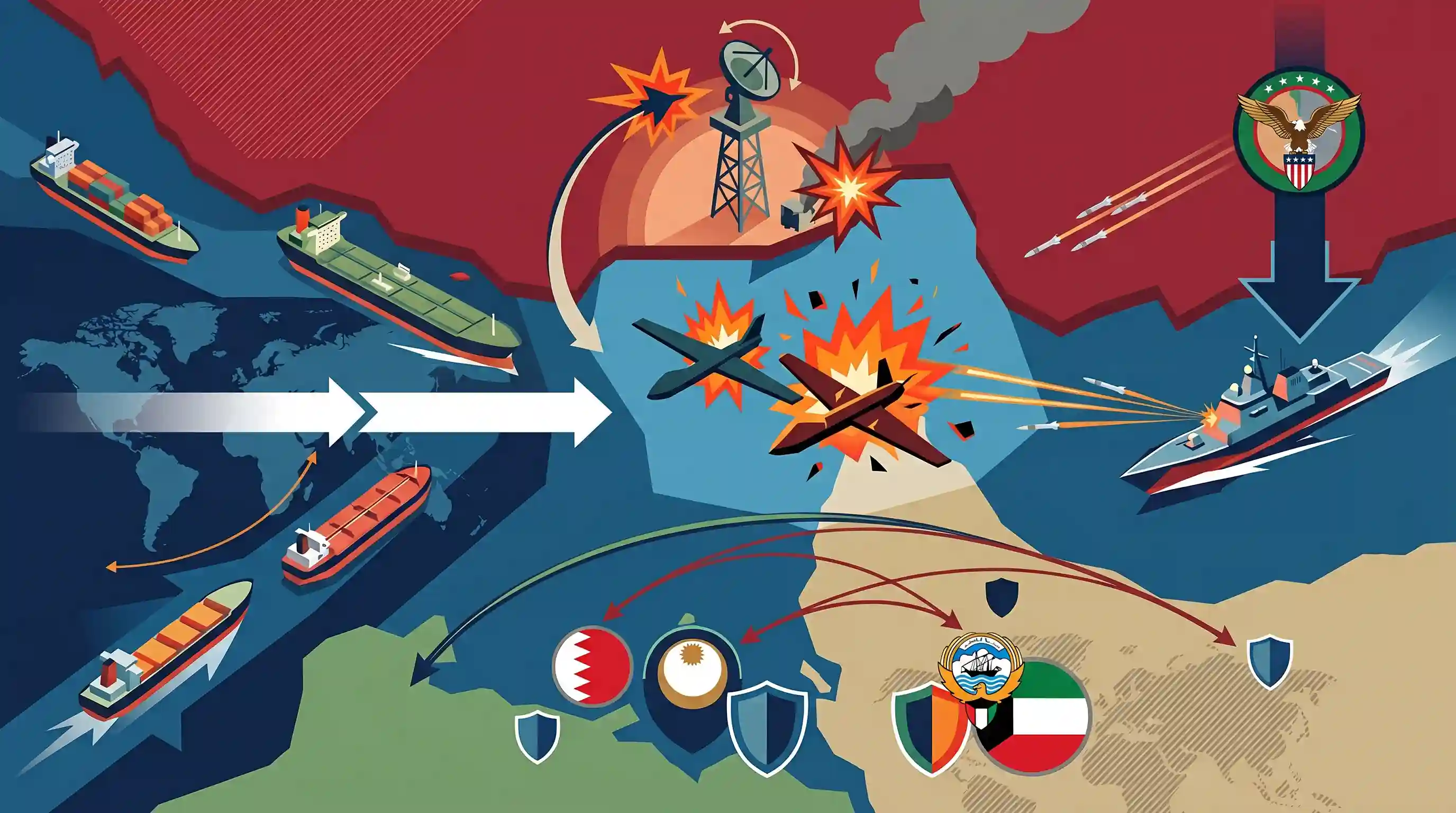
The US military, via CENTCOM, destroyed two Iranian attack drones and targeted coastal surveillance radar sites in response to threats against international maritime traffic in the Strait of Hormuz. The incident highlights escalating US-Iran tensions in the Persian Gulf, a critical chokepoint for global energy supplies. The conflict also involves Iranian missile threats against US allies like Bahrain and Kuwait, emphasizing the growing role of drone warfare and asymmetric tactics in Middle Eastern geopolitics.
Key Points
- US Central Command (CENTCOM) destroyed two Iranian attack drones and coastal radar sites on Qeshm Island and in Goruk to protect maritime traffic.
- The conflict centers around the Strait of Hormuz, a vital global chokepoint for oil transit, directly impacting global energy security.
- US-Iran geopolitical friction has spilled over to affect regional stability, with Iran reportedly threatening US allies in the Gulf, such as Bahrain and Kuwait.
- The events underscore the increasing use of Unmanned Aerial Vehicles (UAVs) in modern asymmetric warfare and maritime security threats.
Important Terms
Strait of Hormuz

A narrow waterway connecting the Persian Gulf and the Gulf of Oman; it is the world's most critical oil chokepoint, handling roughly 20% of global oil trade.
UPSC context
GS Paper 1 (Geography) and GS Paper 2 (International Relations); critical for energy security and West Asian geopolitics.
US Central Command (CENTCOM)
A U.S. Department of Defense unified combatant command responsible for military operations in the Middle East, Central Asia, and parts of South Asia.
UPSC context
GS Paper 2 (International Relations); relevant for studying U.S. military footprint and regional security dynamics in West Asia.
Maritime Chokepoint
Strategic, narrow maritime passages (e.g., straits or canals) through which high volumes of global shipping must pass, making them vulnerable to blockades or disruptions.
UPSC context
GS Paper 1 (World Geography) and GS Paper 3 (Infrastructure); tests understanding of global trade vulnerabilities and supply chain security.
Asymmetric Warfare
Conflict between belligerents with significantly unequal military power or tactics, often involving unconventional methods like drone strikes, guerrilla warfare, or cyberattacks to exploit vulnerabilities.
UPSC context
GS Paper 3 (Internal and External Security); focuses on modern threats, non-state actors, and evolving military doctrines.
Maritime Security
The measures taken to protect sea-borne trade, coastal regions, and national interests from threats such as piracy, terrorism, and state-sponsored maritime aggression.
UPSC context
GS Paper 3 (Security) and GS Paper 2 (Bilateral Relations); vital for India's Indian Ocean Region (IOR) strategy and trade protection.
Energy Security
The uninterrupted availability of energy sources at an affordable price, largely dependent on secure transit routes for oil and gas imports.
UPSC context
GS Paper 3 (Environment and Infrastructure); essential for evaluating India’s economic resilience and dependence on West Asian oil.
Prelims Trap
"The Strait of Hormuz connects the Red Sea to the Gulf of Aden."
UPSC often swaps chokepoint geographies. Hormuz connects the Persian Gulf to the Gulf of Oman; it is Bab-el-Mandeb that links the Red Sea to the Gulf of Aden.
Static Concepts Connected
What are the key maritime chokepoints in the Middle East?
- Strait of Hormuz: Connects the Persian Gulf to the Gulf of Oman and Arabian Sea. A critical passage for over 20% of global oil consumption.
- Bab-el-Mandeb: Links the Red Sea to the Gulf of Aden and the Arabian Sea. Acts as the southern gate to the Suez Canal.
How do modern navies counter asymmetric drone threats (C-UAS)?
- Electronic Warfare: Disrupts command and control links or GPS signals via jamming, rendering drones blind or forcing them to crash.
- Directed Energy Weapons: Deploys high-energy lasers or microwaves to cost-effectively fry drone electronics without depleting expensive conventional missile stockpiles.
- Kinetic Interception: Uses Close-In Weapon Systems (CIWS) and surface-to-air interceptor missiles for physical destruction (hard kills) against incoming swarms.
Cross-Topic Patterns
Chokepoints & Macroeconomic Stability
India imports significant crude and LPG via Hormuz. Geopolitical friction here risks inflating India's import bill, widening the Current Account Deficit, and sparking imported inflation.
Asymmetric Warfare via UAVs
The use of cheap drones against multi-million dollar naval assets mirrors internal security challenges, linking global maritime geopolitics to India's own cross-border drone threats.

Map-matching questions on West Asian straits (Hormuz, Bab-el-Mandeb) with bordering nations will likely appear in Prelims 2026.
Linked PYQs · 4
Linked PYQs · 4
- 2025MainsGS2
"Energy security constitutes the dominant kingpin of India's foreign policy, and is linked with India's overarching influence in Middle Eastern countries.” How would you integrate energy security with India's foreign policy trajectories in the coming years?
- 2023MainsGS3
The use of unmanned aerial vehicles (UAVs) by our adversaries across the borders to ferry arms/ammunitions, drugs, etc., is a serious threat to the internal security. Comment on the measures being taken to tackle this threat.
- 2025MainsGS3
Why is maritime security vital to protect India's sea trade? Discuss maritime and coastal security challenges and the way forward.
- 2022MainsGS3
What are the maritime security challenges in India ? Discuss the organisational, technical and procedural initiatives taken to improve the maritime security.
