US Military Deployment in Middle East and Energy Security
Source:Indian Express ↗
Why It Matters
Tensions between the US and Iran directly impact the security of maritime routes (like the Strait of Hormuz) and global energy supplies. For India, which relies heavily on the Middle East for energy imports and has a large diaspora in the region, such geopolitical instability is a key determinant of its foreign policy and energy security strategies.
Summary
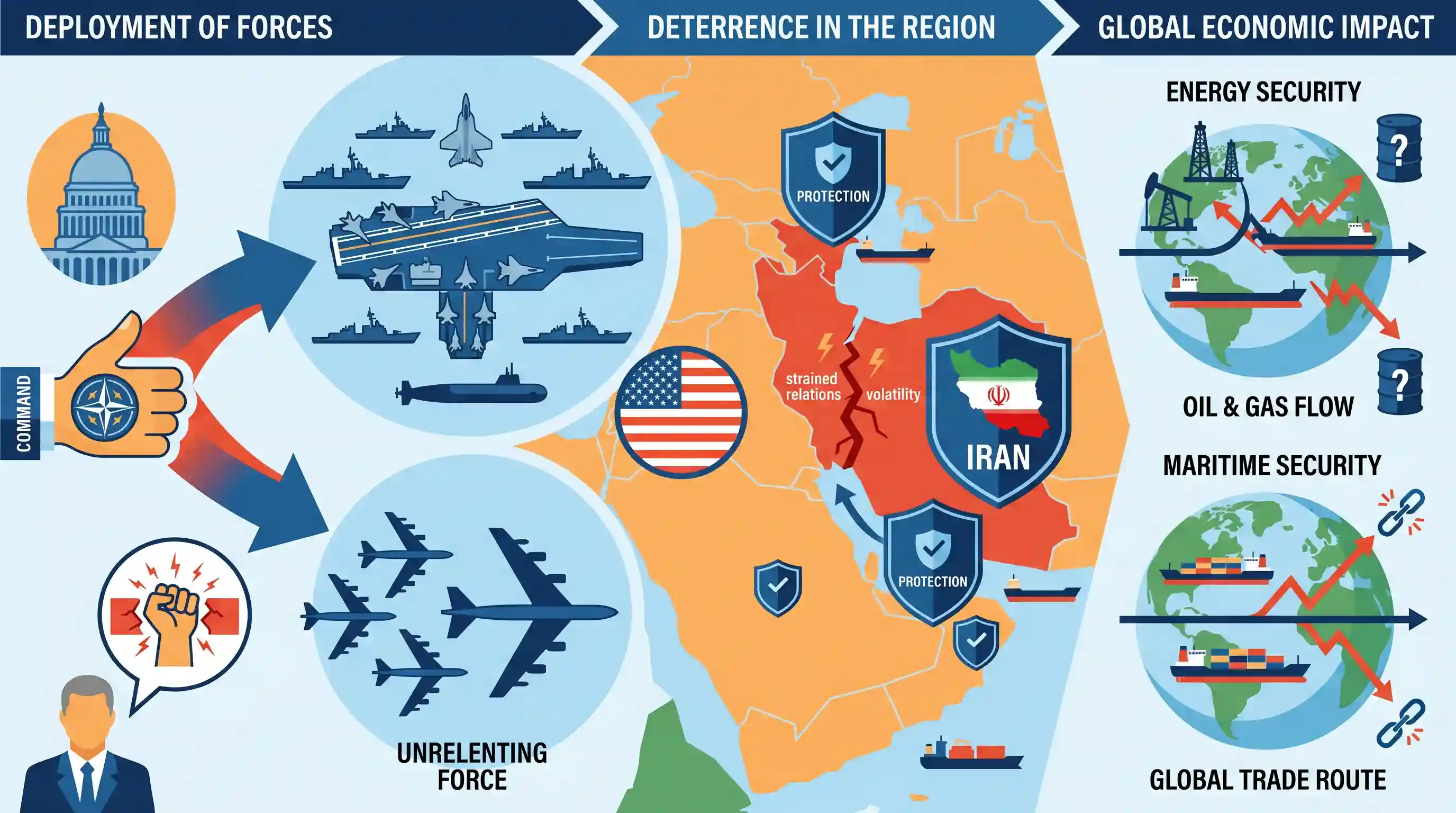
Amid escalating geopolitical friction, the United States has deployed an aircraft carrier strike group and a bomber task force to the Middle East region. Directed by the US Central Command, the USS Abraham Lincoln carrier group serves as a deterrent against potential Iranian threats to American interests or allies. National Security Advisor John Bolton highlighted the deployment as a clear message of 'unrelenting force' against any aggression. This military escalation further strains US-Iran relations, adding to the volatility in a region critical for global energy security and maritime trade.
Key Points
- The US has deployed the USS Abraham Lincoln carrier strike group and a bomber task force to the Middle East in response to escalating tensions with Iran.
- National Security Advisor John Bolton stated the deployment sends a clear message that any attack on US interests or allies will be met with 'unrelenting force'.
- The move marks a significant escalation in the US maximum pressure campaign aimed at countering Iran's regional influence and addressing concerns over its nuclear program.
- This military posturing underscores the geopolitical volatility of the Middle East, particularly around critical maritime chokepoints that are vital for global energy security.
Important Terms
US Central Command (CENTCOM)

A theater-level US military command responsible for operations in the Middle East, Central Asia, and parts of South Asia, managing regional security and counter-terrorism.
UPSC context
GS Paper 2: IR; important for analyzing West Asian security dynamics and US military influence near India’s borders.
Aircraft Carrier Strike Group (CSG)
A mobile naval task force comprising an aircraft carrier and several escort ships, designed to project air and sea power across long distances.
UPSC context
GS Paper 3: Internal Security; tests knowledge of maritime power projection and India’s own naval modernization.
Deterrence
A strategic doctrine intended to dissuade an adversary from taking hostile action by demonstrating that retaliation or costs would be unacceptably high.
UPSC context
GS Paper 2: IR; central to military strategy, nuclear doctrines, and regional power balances.
Energy Security
Ensuring the continuous availability of energy sources at an affordable price, mitigating risks of supply shocks caused by geopolitical instability.
UPSC context
GS Paper 3: Infrastructure; critical for India's growth given its high dependence on imported oil.
Maritime Security
Measures to safeguard the marine environment, maritime infrastructure, and trade routes against threats like piracy, terrorism, and interstate conflict.
UPSC context
GS Paper 3: Internal Security; relevant for India’s role as a "Net Security Provider" in the IOR.
Geopolitics
The study of how geographical factors—such as location, resources, and borders—influence the foreign policy and strategic relations of states.
UPSC context
GS Paper 2: IR; foundational for analyzing regional conflicts and strategic competition.
Prelims Trap
"India falls under the operational jurisdiction of the US Central Command (CENTCOM)."
India actually falls under the US Indo-Pacific Command (INDOPACOM). In South Asia, only Pakistan and Afghanistan fall under CENTCOM's geographic area of responsibility.
Static Concepts Connected
Why is the Strait of Hormuz a critical global maritime chokepoint?
- Geographic Location: It connects the Persian Gulf to the Gulf of Oman and the Arabian Sea.
- Energy Transit: Roughly 20% of global petroleum consumption passes through this strait, making it the world's most important oil transit chokepoint.
- Bordering Nations: Oman and Iran share territorial waters in the strait, giving both nations significant strategic leverage over global shipping.
How do crude oil price shocks affect India's macroeconomic indicators?
- Current Account Deficit: Higher oil import bills widen the trade deficit, directly increasing the CAD.
- Imported Inflation: Increased domestic fuel prices cascade into higher transportation and production costs across the economy.
- Currency Depreciation: Higher demand for dollars to pay for expensive oil puts downward pressure on the Indian Rupee.
Cross-Topic Patterns
Middle East Tensions & India's CAD
Escalations in the Strait of Hormuz directly threaten India's Current Account Deficit and inflation targeting, linking Middle Eastern geopolitics to domestic macroeconomic stability.
Chokepoints and IOR Naval Diplomacy
The US use of carrier strike groups mirrors broader strategies of securing Sea Lines of Communication (SLOCs), a concept vital to India's own naval posturing in the Indian Ocean.

Expect map-based questions matching Middle East chokepoints (Hormuz, Bab el-Mandeb) with bordering nations and current conflicts in 2026.
Linked PYQs · 4
Linked PYQs · 4
- 2025MainsGS2
"Energy security constitutes the dominant kingpin of India's foreign policy, and is linked with India's overarching influence in Middle Eastern countries.” How would you integrate energy security with India's foreign policy trajectories in the coming years?
- 2024MainsGS2
Discuss the geopolitical and geostrategic importance of Maldives for India with a focus on global trade and energy flows. Further also discuss how this relationship affects India's maritime security and regional stability amidst international competition ?
- 2022PrelimsGS1
The term "Levant" often heard in the news roughly corresponds to which of the following regions?
- 2024PrelimsGS1
Consider the following statements : Statement-I : Sumed pipeline is a strategic route for Persian Gulf oil and natural gas shipments to Europe. Statement-II : Sumed pipeline connects the Red Sea with the Mediterranean Sea. Which one of the following is correct in respect of the above statements?
