US Deploys Nuclear Submarines Amid Escalating Rhetoric With Russia
Source:The Hindu ↗
Why It Matters
Understanding the nuclear deterrence strategies and geopolitical posturing between superpowers is critical for International Relations (GS2) and Security (GS3). Additionally, India's inclusion in the elite group of nations operating nuclear submarines makes this highly relevant for defence technology and strategic affairs.
Summary
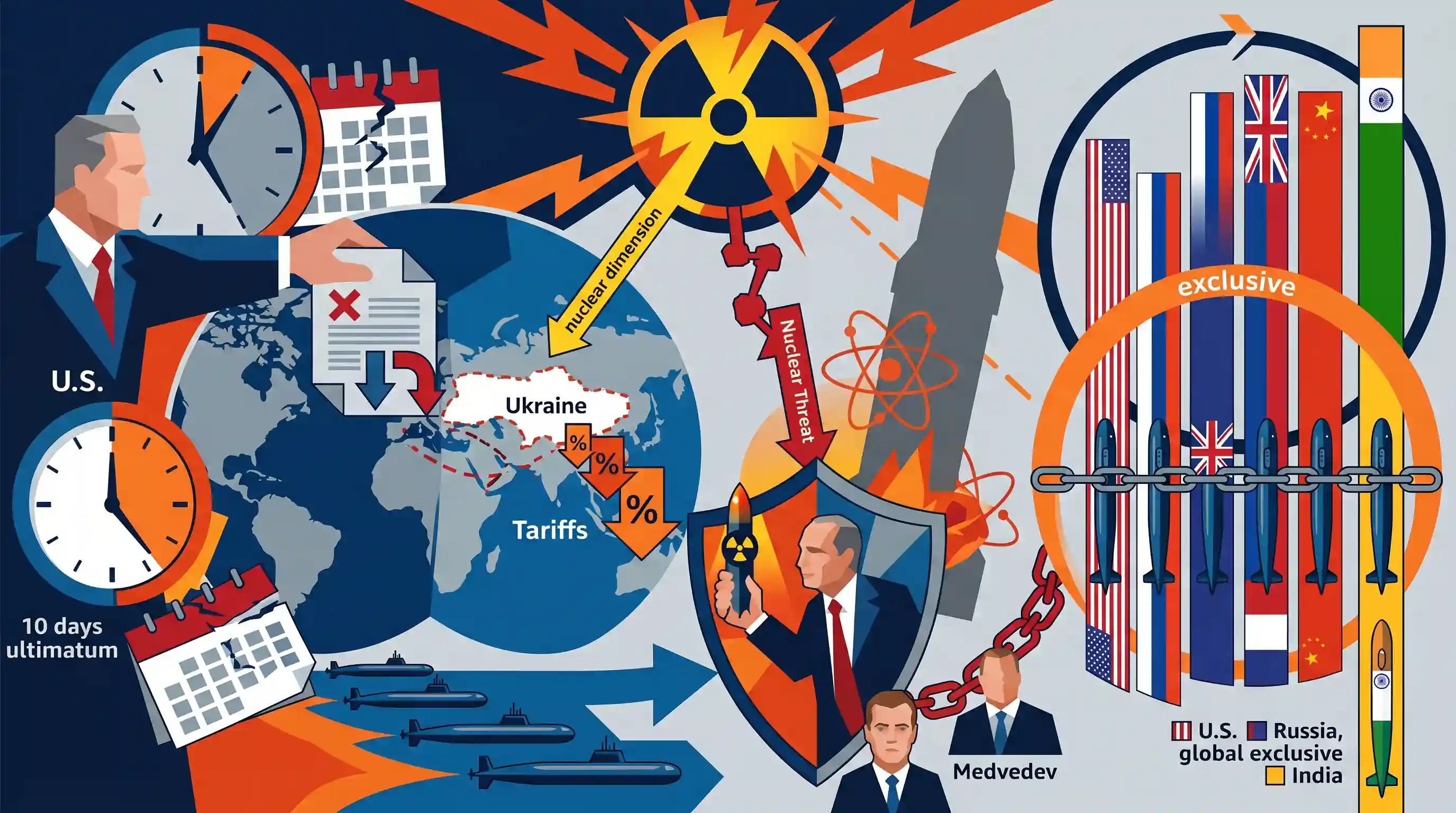
U.S. President Donald Trump has ordered the deployment of nuclear submarines in response to statements by former Russian President Dmitry Medvedev highlighting Moscow's nuclear strike capabilities. This exchange follows an ultimatum by Trump demanding Russia agree to a ceasefire in Ukraine within 10 days or face significant tariffs. The escalation underscores the nuclear dimension of the ongoing US-Russia tensions over the Ukraine war, while also highlighting the exclusive group of nations, including India, possessing nuclear submarine capabilities.
Key Points
- U.S. President Donald Trump announced the deployment of two nuclear submarines to unspecified regions amid escalating rhetoric with Russia.
- The move is a response to former Russian President Dmitry Medvedev reminding Trump of Moscow's 'last resort' nuclear strike capabilities.
- Trump had previously issued a 10-day ultimatum to Russia to agree to a ceasefire in the ongoing war in Ukraine or face severe tariffs.
- The U.S. Navy maintains a fleet of 71 commissioned nuclear-powered submarines, some of which are armed with nuclear ballistic missiles (SSBNs).
- Only six nations globally operate nuclear-powered submarines: the United States, the United Kingdom, Russia, China, France, and India.
Important Terms
Nuclear-powered Ballistic Missile Submarine (SSBN)

A nuclear-powered submarine (SSBN) capable of carrying and launching long-range nuclear ballistic missiles. They are designed for stealth and endurance, remaining submerged for months.
UPSC context
GS Paper 3: Science and Technology/Internal Security. Tests knowledge of India's maritime nuclear deterrent (INS Arihant class).
Nuclear Triad
A three-pronged military force structure consisting of land-based missiles, sea-based submarines, and air-based bombers, all capable of delivering nuclear weapons.
UPSC context
GS Paper 3: Internal Security. Crucial for understanding India's 'No First Use' doctrine and strategic stability.
Nuclear Deterrence
A military doctrine where the threat of retaliation with nuclear weapons prevents an adversary from attacking. It relies on 'Credible Minimum Deterrence' and 'Massive Retaliation.'
UPSC context
GS Paper 2: International Relations. Explains global power dynamics and India's security posturing with neighbors.
Strategic Autonomy
A nation's ability to make independent foreign policy and security decisions free from external pressure, while engaging flexibly with multiple global powers.
UPSC context
GS Paper 2: International Relations. Core principle of Indian diplomacy when navigating US-Russia or US-China rivalries.
Second Strike Capability
The assured ability of a nation to respond to a nuclear attack with a devastating counter-strike, even after sustaining a surprise first strike.
UPSC context
GS Paper 3: Defence Technology. Specifically tests why sea-based assets (SSBNs) are vital for India's defense.
Tariffs (Geopolitical Tool)
The use of trade duties and economic barriers as leverage to influence a country's political behavior, military actions, or diplomatic alignments.
UPSC context
GS Paper 2: IR/Economy. Examines 'weaponization of trade' and its impact on bilateral relations (e.g., US-India-Russia).
Prelims Trap
Only the five permanent members of the UN Security Council possess nuclear-powered submarines.
India is the 6th nation to operate nuclear-powered submarines. Aspirants also often confuse SSNs (nuclear propulsion) with SSBNs (nuclear-armed).
Static Concepts Connected
What is the difference between SSN and SSBN in a nuclear triad?
- SSN: Attack submarines with nuclear propulsion but conventional weapons. They offer unlimited endurance but do not carry nuclear ballistic missiles.
- SSBN: Ballistic missile submarines. They carry nuclear-tipped missiles and provide the most survivable 'second-strike capability' for nuclear deterrence.
- India's Triad: India's SSBNs (INS Arihant, Arighat) were developed under the Advanced Technology Vessel (ATV) project to fulfill its 'No First Use' doctrine.
What is the New START Treaty between the US and Russia?
- Warhead Limits: The last active bilateral arms control pact limiting both nations to 1,550 deployed strategic nuclear warheads.
- 2026 Expiration: The treaty expires in February 2026. Without a replacement or extension, there are global fears of an unconstrained nuclear arms race.
Cross-Topic Patterns
AUKUS proliferation vs indigenous SSBNs
Unlike India's indigenous development, Australia is acquiring nuclear-powered submarines via AUKUS, frequently raising NPT loopholes and non-proliferation debates in Mains.
Economic tariffs for security leverage
Trump using tariff threats to force a Ukraine ceasefire demonstrates the blurring lines between WTO trade policy and hard-power geopolitical negotiations.

Questions distinguishing SSN vs SSBN, coupled with India's indigenous ATV project and New START's 2026 expiry, are highly probable.
Linked PYQs · 2
Linked PYQs · 2
- 2025MainsGS2
"The reform process in the United Nations remains unresolved, because of the delicate imbalance of East and West and entanglement of the USA vs. Russo-Chinese alliance.” Examine and critically evaluate the East-West policy confrontations in this regard.
- 2023PrelimsGS1
Consider the following statements: 1. Ballistic missiles are jet-propelled at subsonic speeds throughout their flights, while cruise missiles are rocket-powered only in the initial phase of flight. 2. Agni-V is a medium-range supersonic cruise missile, while BrahMos is a solid-fuelled intercontinental ballistic missile. Which of the statements given above is/are correct?
