US Federal Government Shutdown Threat Looms Over Budget Battle
Source:The Hindu ↗
Why It Matters
A U.S. government shutdown serves as a prime real-world example for comparing the Presidential system's rigid separation of powers with the Parliamentary system's fusion of powers, a core syllabus area in GS Paper 2 (Comparison of Constitutional Schemes). It also has implications for global economic stability and governance.
Summary
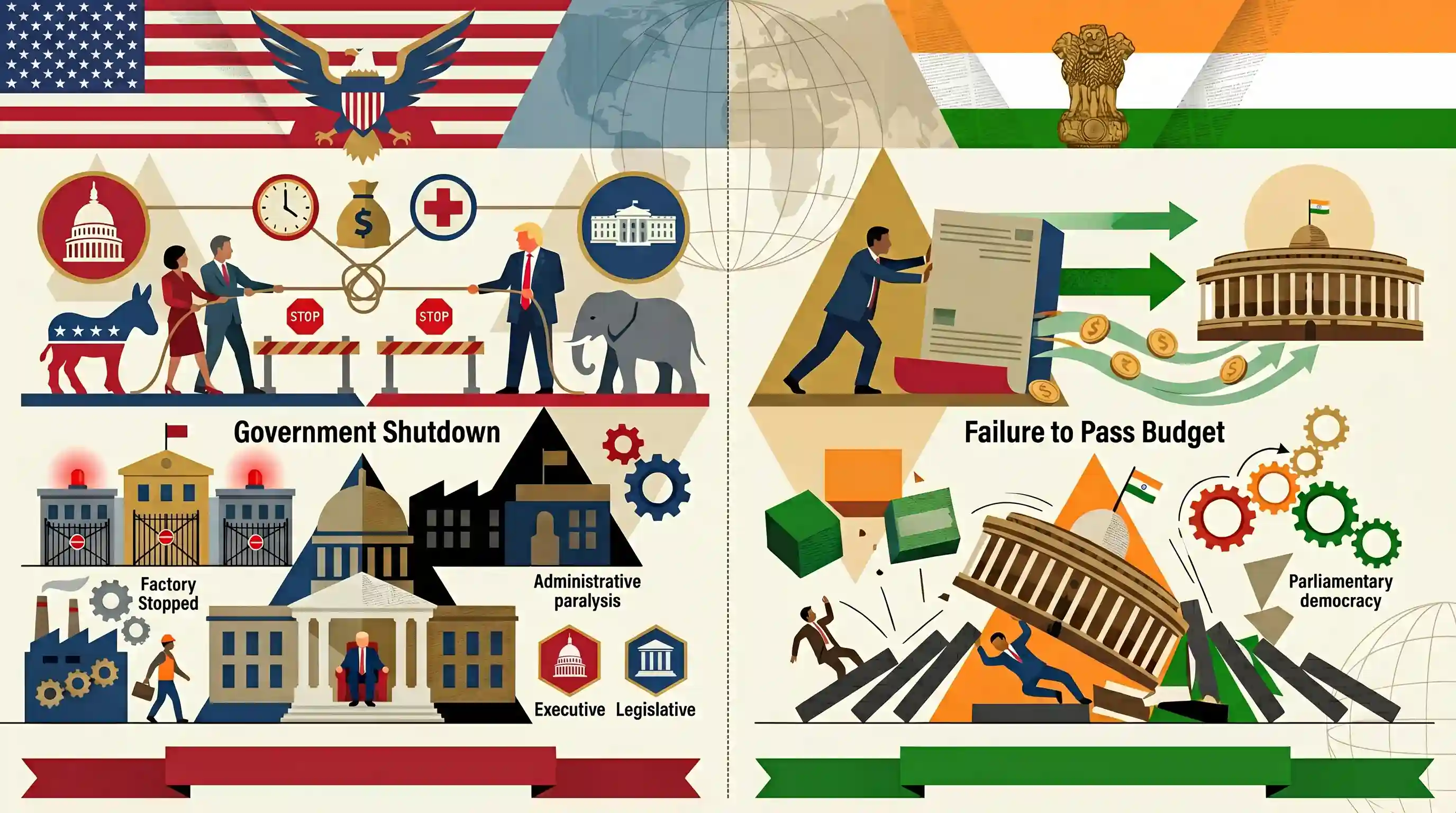
The United States is bracing for a potential government shutdown as a budget standoff escalates between the Republican-controlled executive under President Trump and congressional Democrats. The dispute centers on a temporary funding extension, with Democrats using the impasse as leverage to secure the extension of Affordable Care Act healthcare tax subsidies. Beyond the immediate economic and administrative impacts—such as furloughed federal workers and suspended services—the situation underscores the distinct separation of powers in the U.S. Presidential system. Unlike in India's Parliamentary democracy, where the failure to pass a budget results in the fall of the government, the U.S. system experiences administrative paralysis while the executive remains in office.
Key Points
- The U.S. faces a potential government shutdown as Democrats and Republicans deadlock over extending temporary funding for the federal budget.
- Democrats aim to leverage the shutdown threat to force Republicans to extend expiring healthcare tax subsidies under the Affordable Care Act.
- A shutdown would furlough hundreds of thousands of federal workers and pause key government operations, though essential services would continue.
- Both political parties are calculating the potential electoral fallout of a shutdown ahead of the 2026 midterm elections, recalling the record 35-day shutdown in 2018-2019.
- The crisis highlights a distinct feature of the U.S. Presidential system where a legislative failure to pass a budget paralyzes government services but does not topple the executive, unlike a Parliamentary system like India's.
Important Terms
Affordable Care Act (ACA)

A 2010 U.S. law (Obamacare) designed to increase health insurance coverage and affordability. It provides subsidies for low-income families and expanded Medicaid, though it remains a central point of U.S. partisan conflict.
UPSC context
GS II: Social Justice/Health. Useful for comparing global social welfare models with Indian schemes like Ayushman Bharat.
Democratic Party
One of the two major U.S. political parties, typically advocating for social safety nets, environmental protection, and government intervention in the economy to promote social equality.
UPSC context
GS II: Comparison of Constitutional Schemes. Tests understanding of the two-party system in the U.S. presidential model.
Republican Party
One of the two major U.S. political parties, generally favoring limited government, free-market capitalism, lower taxes, and a more conservative approach to social and healthcare policy.
UPSC context
GS II: Comparison of Constitutional Schemes. Essential for analyzing partisan gridlock and legislative-executive relations in the U.S. system.
Government Shutdown
A situation where non-essential U.S. federal offices close because Congress fails to pass funding. Unlike India, where this would collapse the government, the U.S. executive remains in power.
UPSC context
GS II: Separation of Powers. Highlights differences between U.S. Presidential and Indian Parliamentary systems regarding legislative accountability.
Federal Aviation Administration (FAA)
The U.S. federal authority regulating all aspects of civil aviation. During shutdowns, it faces staffing shortages in air traffic control and safety inspections, potentially disrupting global travel.
UPSC context
GS II: Effect of Policies of Developed Countries. Demonstrates how U.S. administrative paralysis affects international logistics and trade.
Centers for Disease Control and Prevention (CDC)
The leading U.S. national public health institute. It coordinates global health security and disease prevention, but its functions can be hampered by domestic budget impasses.
UPSC context
GS II: International Relations/Health. Relevant for global health governance and the impact of funding gaps on international security.
Prelims Trap
Failure to pass a budget triggers a temporary 'government shutdown' in India until a Vote on Account is passed.
In India, defeating the budget constitutes a loss of confidence. The Council of Ministers must resign immediately, unlike the US where the executive survives.
Static Concepts Connected
How does budget failure differ between US and Indian democratic systems?
- US System: Triggers administrative paralysis via the Antideficiency Act. The President remains in office due to a strict separation of powers.
- Indian System: Defeat of the Appropriation Bill implies a loss of majority, mandating the immediate resignation of the Council of Ministers.
What Indian constitutional provisions prevent US-style funding gaps?
- Article 114(3): Codifies the 'power of the purse,' mandating that no money leaves the Consolidated Fund of India without an enacted Appropriation Act.
- Vote on Account: Under Article 116, the Lok Sabha grants advance funds for estimated expenditures pending budget passage, averting administrative shutdowns.
Cross-Topic Patterns
Separation of Powers vs Accountability
The US shutdown illustrates strict separation where gridlock doesn't topple the executive. India prioritizes daily executive accountability to the legislature over absolute separation of powers.
US shutdowns and macroeconomic data
Prolonged US administrative paralysis delays essential economic data releases, complicating US Federal Reserve decisions and increasing volatility in emerging market capital flows.

Expect Prelims statements comparing Article 116 (Vote on Account) with US mechanisms, highlighting how India avoids government shutdowns.
Linked PYQs · 3
Linked PYQs · 3
- 2024MainsGS2
Discuss India as a secular state and compare with the secular principles of the US constitution.
- 2021MainsGS2
Analyze the distinguishing features of the notion of Right to Equality in the Constitutions of the USA and India.
- 2023MainsGS2
Compare and contrast the British and Indian approaches to Parliamentary sovereignty.
