US Strategic Concerns Over Chinese Influence in Panama Canal
Source:The Hindu ↗
Why It Matters
The control and surveillance of global maritime choke points, like the Panama Canal, are central to contemporary great power rivalry. Understanding these dynamics is essential for answering questions on international trade, maritime security, and US-China relations.
Summary
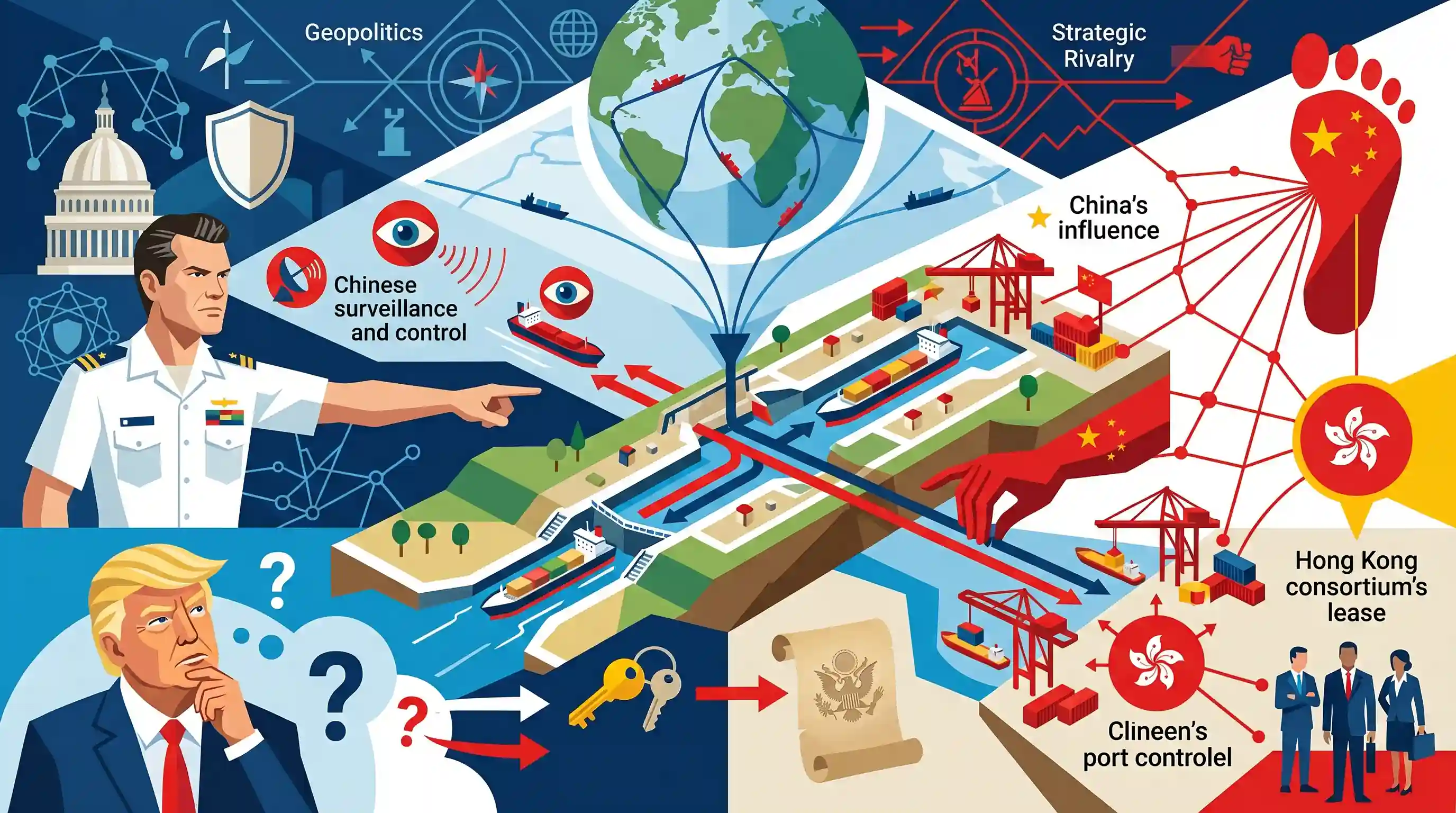
US Defense Secretary Pete Hegseth highlighted that China poses a threat to the Panama Canal due to its growing influence over the strategic waterway's ports. He raised concerns about potential Chinese surveillance and control over global maritime trade routes stemming from a Hong Kong consortium's lease of ports at both ends of the canal. The US seeks to counter Beijing's footprint in strategic global infrastructure, especially as US President Donald Trump questions the current management of the canal following its 1999 handover under the 1977 Carter treaty.
Key Points
- US Defense Secretary Pete Hegseth warned that China's growing presence around the Panama Canal poses a strategic and security threat.
- A Hong Kong-based consortium currently holds a 25-year lease on key ports at both ends of the canal, though it is in the process of selling its controlling stake (which involves US firm BlackRock Inc).
- Hegseth emphasized that Chinese investments in critical global infrastructure give Beijing the potential to monitor and disrupt maritime trade routes.
- President Donald Trump recently suggested taking back control of the canal, which the US handed over to Panama in 1999 under the 1977 Carter treaty.
Important Terms
Torrijos-Carter Treaties

Two 1977 agreements (signed by Jimmy Carter and Omar Torrijos) that ended U.S. control of the Panama Canal, transferring the waterway to Panamanian sovereignty on December 31, 1999.
UPSC context
GS Paper II (International Relations). Tests knowledge of historic bilateral agreements and the transition of strategic global chokepoints from colonial-era control to local sovereignty.
Treaty of Permanent Neutrality
A 1977 treaty declaring the Panama Canal a neutral waterway open to all nations, granting the U.S. the permanent right to defend it against threats to its neutrality.
UPSC context
GS Paper II/Geography. Critical for understanding the legal justification for U.S. military involvement in the canal and maritime security frameworks.
BlackRock Inc.
U.S. asset manager whose 2025 consortium acquired a 90% stake in the Panama Ports Company from a Hong Kong firm, effectively returning control of strategic canal ports to U.S.-based interests.
UPSC context
GS Paper II/III. Illustrates the use of private capital in "strategic infrastructure diplomacy" to counter adversarial (China's) influence in global trade routes.
CK Hutchison Holdings
A Hong Kong-based conglomerate that managed the Balboa and Cristobal ports until its 2025 divestment, often cited by the U.S. as a potential conduit for Chinese surveillance.
UPSC context
GS Paper II. Relevant to China's "Maritime Silk Road" and U.S. concerns regarding dual-use civilian infrastructure managed by entities with links to Beijing.
Panama Canal Authority (ACP)
The autonomous agency of the Government of Panama responsible for the operation, management, and modernization of the Panama Canal since the 1999 handover.
UPSC context
GS Paper II. Important for understanding the institutional governance of international waterways and the limits of external political influence over sovereign operations.
Prelims Trap
The United States retains joint operational and security control of the Panama Canal alongside Panama.
The US handed over full sovereignty and operational control to Panama on Dec 31, 1999, under the Torrijos-Carter Treaties. Panama exercises exclusive territorial and operational control.
Static Concepts Connected
Which major artificial canals act as critical global maritime chokepoints?
- Panama Canal: Connects the Atlantic Ocean (via the Caribbean Sea) to the Pacific Ocean across the Isthmus of Panama, operated exclusively by Panama.
- Suez Canal: Connects the Mediterranean Sea to the Red Sea in Egypt, offering the shortest maritime route between Europe and the lands lying around the Indian and western Pacific oceans.
- Kiel Canal: Connects the North Sea to the Baltic Sea across the Jutland Peninsula in Germany, bypassing the longer route around the Danish peninsula.
What is the international legal framework governing the Panama Canal?
- Torrijos-Carter Treaties: Signed in 1977, these treaties abolished the US Canal Zone and mandated the phased handover of full operational control to Panama by the end of 1999.
- Neutrality Treaty: A companion agreement guaranteeing the canal remains permanently neutral, secure, and open to peaceful transit by vessels of all nations on terms of entire equality.
Cross-Topic Patterns
BRI expansion in the US backyard
China's port investments in Latin America mirror its 'String of Pearls' strategy in the IOR, challenging historical US geopolitical dominance (Monroe Doctrine) in its immediate backyard.
Chokepoint vulnerabilities and Trade Corridors
Geopolitical tension at the Panama Canal, coupled with Houthi attacks in the Red Sea/Suez, highlights severe global supply chain fragility and accelerates the push for alternative trade routes like IMEC.

Mapping questions in 2026 will likely pair strategic maritime chokepoints (Panama, Suez, Malacca) with their controlling sovereign nations.
Linked PYQs · 4
Linked PYQs · 4
- 2024MainsGS2
‘The West is fostering India as an alternative to reduce dependence on China's supply chain and as a strategic ally to counter China's political and economic dominance.’ Explain this statement with examples.
- 2021MainsGS2
“The USA is facing an existential threat in the form of a China, that is much more challenging than the erstwhile Soviet Union.” Explain.
- 2014MainsGS2
With respect to the South China sea, maritime territorial disputes and rising tension affirm the need for safeguarding maritime security to ensure freedom of navigation and over flight throughout the region. In this context, discuss the bilateral issues between India and China.
- 2024MainsGS2
Discuss the geopolitical and geostrategic importance of Maldives for India with a focus on global trade and energy flows. Further also discuss how this relationship affects India's maritime security and regional stability amidst international competition ?
