US Courts and Judicial Constraints on Unilateral Tariffs
Source:Indian Express ↗
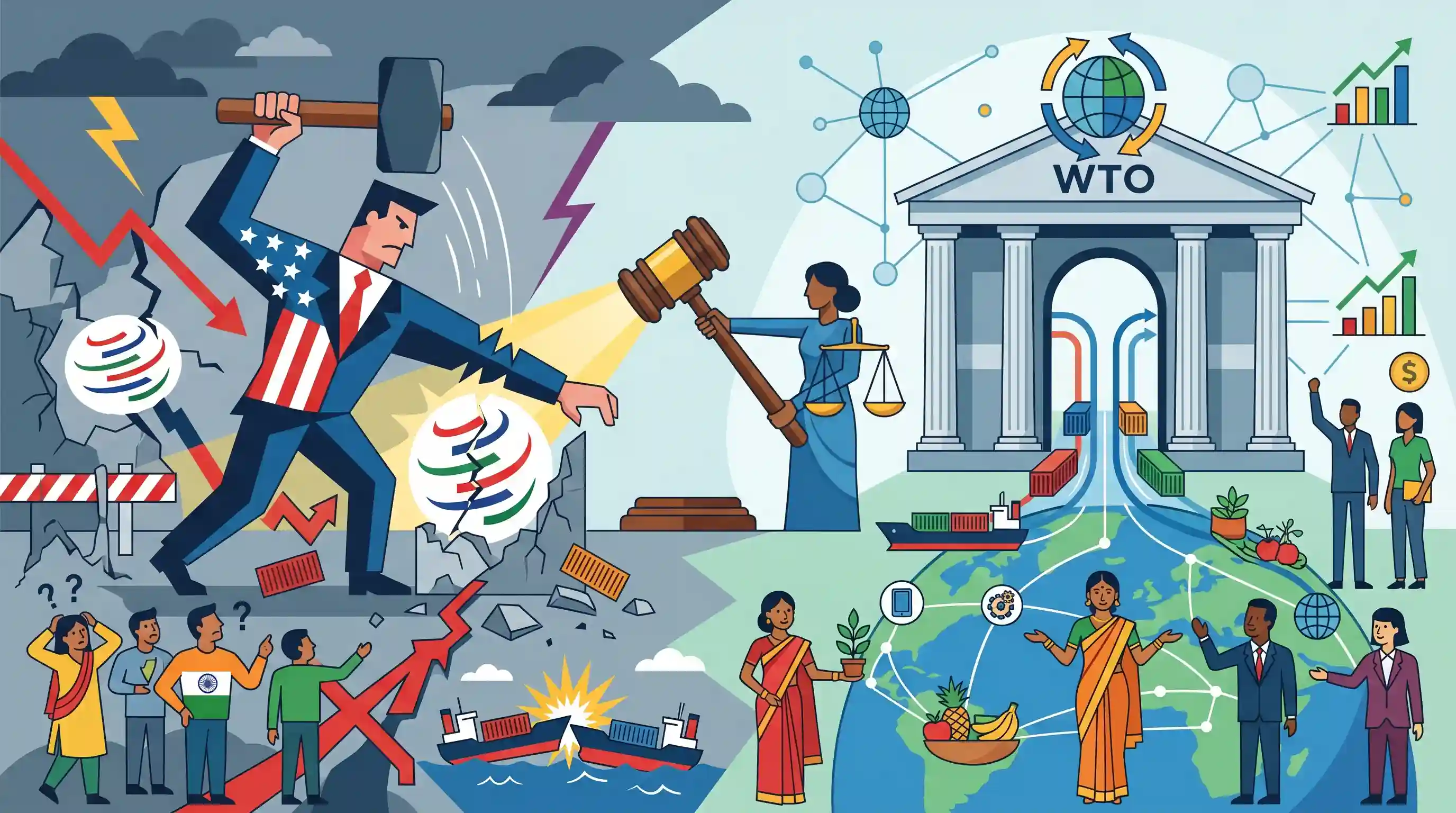
Why It Matters
The debate between unilateral protectionism and multilateralism is central to UPSC's focus on the global economic order. Understanding how domestic policies in major economies like the US impact global trade institutions is vital for analyzing India's macroeconomic stability and foreign trade strategies.
Summary
The article discusses the implications of US domestic courts constraining the executive branch's power to impose unilateral tariffs, suggesting this judicial check could herald a return to trade multilateralism. In recent years, the US has frequently bypassed the World Trade Organization (WTO) to levy unilateral tariffs, sparking trade wars and undermining global trade rules. As courts demand stricter legal justifications for these measures, the US may be forced to rely more on multilateral institutions like the WTO for dispute resolution. This potential shift away from protectionism is significant for the global economy, offering a more stable and rules-based trading environment that is particularly beneficial for developing countries such as India.
Key Points
- A recent judicial pushback from US domestic courts constraining the executive branch's ability to unilaterally impose tariffs signals a check on unchecked trade protectionism.
- Over recent years, the US’s reliance on unilateral tariffs (such as Section 301) has undermined the rules-based multilateral trading system championed by the World Trade Organization (WTO).
- Domestic constraints on arbitrary tariff impositions could incentivize the US to re-engage with the WTO’s dispute settlement processes, thereby aiding the revival of trade multilateralism.
- For developing nations like India, a global pivot away from unilateral trade wars back to multilateralism provides a more equitable, predictable framework to manage international trade relations and disputes.
Important Terms
Section 301 of the US Trade Act of 1974

A US law authorizing the executive to investigate and unilaterally retaliate against foreign trade practices deemed unfair, discriminatory, or restrictive to American commerce.
UPSC context
GS II/III; tests understanding of trade unilateralism, barriers, and their impact on India’s export sectors like steel and electronics.
World Trade Organization (WTO)
A global organization (est. 1995) regulating trade rules between nations, facilitating negotiations, and settling disputes to ensure smooth and predictable global commerce.
UPSC context
GS II/III; critical for understanding multilateral economic governance, dispute resolution, and India’s role in the global rules-based order.
US Court of International Trade (CIT)
A US federal court that adjudicates civil actions related to customs and trade laws, including challenges to the legality of executive-imposed tariffs.
UPSC context
GS II; illustrates judicial oversight of executive power in trade policy and the intersection of domestic and international law.
US Trade Representative (USTR)
The US cabinet-level agency responsible for developing trade policy, conducting negotiations, and enforcing trade laws like Section 301 investigations.
UPSC context
GS II; key entity for India-US bilateral trade relations and international trade diplomacy.
General Agreement on Tariffs and Trade (GATT)
A multilateral agreement (1948-1994) aimed at reducing trade barriers; it laid the foundation for modern global trade rules before being replaced by the WTO.
UPSC context
GS II/III; essential for the historical evolution of global trade governance and the shift from provisional to permanent institutions.
Prelims Trap
"Section 301 is a retaliatory safeguard mechanism authorized and regulated by the World Trade Organization."
Section 301 is a US domestic law (Trade Act of 1974), not a WTO tool. It bypasses and often violates the WTO's Dispute Settlement Understanding.
Static Concepts Connected
What is the Most-Favoured-Nation (MFN) principle under the WTO?
- Definition: A core GATT/WTO rule (Article I) requiring a country to extend the best trade terms granted to one nation to all other WTO members equally, preventing discrimination.
- Exceptions: Free Trade Agreements (FTAs) and special preferential treatment for developing nations (Generalized System of Preferences) are permitted exceptions under WTO rules.
- Relevance to Unilateralism: Unilateral tariffs applied selectively to specific nations (such as US Section 301 actions) directly violate the foundational MFN rule of non-discrimination.
Why is the WTO's Dispute Settlement Mechanism currently paralyzed?
- Appellate Body Crisis: Since 2019, the WTO's Appellate Body has lacked a quorum because the United States has consistently blocked the appointment of new judges.
- Appealing into the Void: Losing parties can appeal initial panel rulings "into the void," effectively freezing the dispute indefinitely and allowing countries to resort to unchecked unilateral retaliation.
- The MPIA Stopgap: In response to the crisis, several WTO members formed the Multi-Party Interim Appeal Arbitration Arrangement (MPIA) as a stopgap, though neither the US nor India are members.
Cross-Topic Patterns
WTO paralysis + Friend-shoring
The decline of WTO multilateralism has driven minilateral economic blocs (like IPEF) and "friend-shoring" policies, directly reshaping India's strategy for integrating into global value chains (GVCs).
Executive Trade Powers vs Judicial Review
The US court constraining executive tariff powers echoes Indian constitutional debates (Article 253) regarding parliamentary oversight versus executive autonomy in negotiating and enforcing international trade treaties.

Expect a 2026 Prelims question mixing WTO principles (MFN vs National Treatment) with unilateral domestic tools like US Section 301.
Linked PYQs · 4
Linked PYQs · 4
- 2025MainsGS3
What are the challenges before the Indian economy when the world is moving away from free trade and multilateralism to protectionism and bilateralism? How can these challenges be met?
- 2018MainsGS3
How would the recent phenomena of protectionism and currency manipulations in world trade affect macroeconomic stability of India?
- 2016MainsGS2
The broader aims and objectives of WTO are to manage and promote international trade in the era of globalization. But the Doha round of negotiations seem doomed due to differences between the developed and the developing countries." Discuss in the Indian perspective.
- 2020PrelimsGS1
With reference to Trade-Related Investment Measures (TRIMS), which of the following statements is/are correct? 1. Quantitative restrictions on imports by foreign investors are prohibited. 2. They apply to investment measures related to trade in both goods and services. 3. They are not concerned with the regulation of foreign investment. Select the correct answer using the code given below:
