US China Tariff War and Global Supply Chain Realignment
Source:Indian Express ↗
Why It Matters
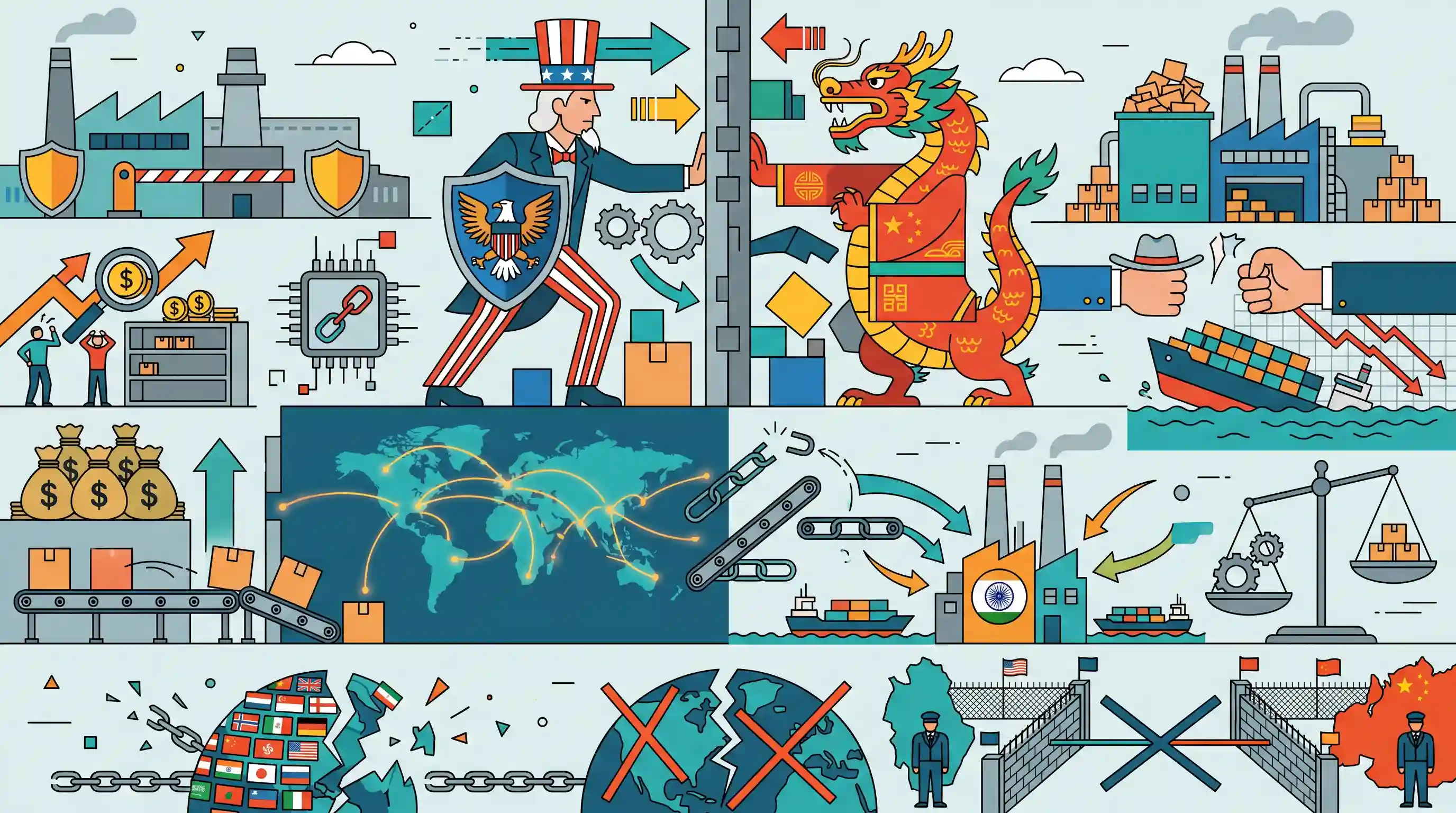
The US-China trade war fundamentally alters global trade dynamics, inflation trends, and supply chain dependencies. Understanding these geopolitical and economic shifts is crucial for analyzing India's strategic opportunities (like 'China Plus One') and the broader global transition from globalization to protectionism, highly relevant for GS2 (International Relations) and GS3 (Economy).
Summary
The article delves into the escalating US-China tariff war, evaluating the structural economic pressures facing both superpowers to predict who might concede first. While the US aims to protect domestic industries and limit Chinese technological dominance through strategic tariffs, it risks stoking domestic inflation and supply chain bottlenecks. Conversely, China, grappling with an internal economic slowdown and industrial overcapacity, relies heavily on exports but is increasingly squeezed by Western protectionism. This geopolitical rivalry is accelerating global supply chain realignments, such as the 'China Plus One' strategy, offering significant economic opportunities for countries like India. Ultimately, the trade war underscores a systemic global shift away from multilateral free trade towards sovereign nationalism and bilateral protectionism.
Key Points
- The article analyzes the escalating tariff war between the US and China, assessing the economic vulnerabilities and resilience of both nations in a prolonged trade conflict.
- The US is imposing steep tariffs on critical sectors like electric vehicles (EVs), semiconductors, and green technology to protect domestic industries and curb Chinese dominance, but risks fueling domestic inflation.
- China is grappling with internal economic challenges, including a property sector crisis and industrial overcapacity, making its export-driven model highly vulnerable to coordinated Western protectionism.
- The ongoing geopolitical friction is accelerating global supply chain realignments, particularly the 'China Plus One' strategy, which presents strategic manufacturing opportunities for emerging economies like India and Vietnam.
- The broader implication of this bilateral conflict is a definitive global shift away from multilateral free trade and the WTO framework toward sovereign nationalism and protectionist policies.
Important Terms
China Plus One Strategy

A business strategy where companies diversify supply chains by establishing manufacturing hubs outside China (e.g., in India) while maintaining Chinese operations, aiming to mitigate geopolitical risks and over-dependence.
UPSC context
GS Papers 2 & 3; tests understanding of global supply chain realignments and India’s potential as a global manufacturing alternative.
World Trade Organization (WTO)
An international organization regulating global trade and settling disputes. It currently faces a crisis of relevance due to rising protectionism and the paralysis of its dispute settlement mechanisms.
UPSC context
GS Paper 2 (International Institutions); crucial for analyzing multilateralism, trade wars, and the rules-based international order.
CHIPS and Science Act
A 2022 US law providing $280 billion to boost domestic semiconductor manufacturing and research, aiming to reduce technological dependence on China and secure critical technology supply chains.
UPSC context
GS Paper 3 (S&T, Economy); relevant for discussing industrial policy, technological sovereignty, and the US-China techno-geopolitical rivalry.
Inflation Reduction Act (IRA)
A landmark 2022 US federal law providing massive subsidies for clean energy and climate action, designed to incentivize domestic manufacturing and reduce supply chain reliance on China.
UPSC context
GS Papers 2 & 3; tests knowledge of international trade impacts, green industrial policy, and global economic competition.
European Union (EU)
A 27-member economic and political union currently pursuing a "de-risking" strategy to reduce strategic dependencies on China while navigating complex trade tensions with the United States.
UPSC context
GS Paper 2 (International Relations); important for analyzing the role of major blocs in global trade and multipolar diplomacy.
Prelims Trap
"China Plus One is an official plurilateral treaty led by Western nations."
It is a corporate business strategy adopted by multinational companies to diversify supply chains, not a formal inter-governmental treaty or geopolitical alliance.
Static Concepts Connected
What are the primary trade remedy measures permitted under the WTO?
- Anti-Dumping Duties: Imposed when foreign companies export goods at a price lower than their normal home-market value, causing material injury to domestic industries.
- Countervailing Duties: Levied to neutralize the negative effects of specific subsidies provided by foreign governments to their domestic manufacturers or exporters.
- Safeguard Measures: Temporary restrictions (tariffs or quotas) applied when a sudden, unforeseen surge in specific imports threatens serious injury to domestic producers.
What is the Most Favoured Nation (MFN) principle under the WTO?
- Core Principle: A WTO member must treat all other members equally; a trade favour, tariff reduction, or privilege granted to one must be granted to all.
- Permitted Exceptions: Exceptions are allowed for formal Free Trade Agreements (FTAs) and special preferential market access granted to developing/least developed countries.
Cross-Topic Patterns
China+1 & India's PLI Schemes
India's Production Linked Incentive (PLI) schemes directly capitalize on the 'China Plus One' corporate shift, attempting to absorb exiting global capital in electronics, semiconductors, and pharmaceuticals.
Tariffs as a driver of Cost-Push Inflation
The macroeconomic trade-off of protectionism: imposing steep tariffs on Chinese intermediate goods (like solar cells or critical minerals) risks driving 'cost-push inflation' and delaying the importing country's green transition.

Expect a GS3 question in 2026 linking the 'China Plus One' strategy to India's PLI schemes, or Prelims MCQs on WTO's paralyzed dispute body.
Linked PYQs · 3
Linked PYQs · 3
- 2018MainsGS2
What are the key areas of reform if the WTO has to survive in the present context of "Trade War', especially keeping in mind the interest of India?
- 2025MainsGS3
What are the challenges before the Indian economy when the world is moving away from free trade and multilateralism to protectionism and bilateralism? How can these challenges be met?
- 2025MainsGS2
"With the waning of globalization, post-Cold War world is becoming a site of sovereign nationalism.” Elucidate.
