US and China Resume Trade Negotiations Amid Tariff Escalation
Source:The Hindu ↗
Why It Matters
The article provides critical real-world context on how major global powers employ protectionist policies, tariffs, and technology restrictions as geopolitical tools. Understanding the specifics of the US-China trade dispute—such as state subsidies, intellectual property violations, and the shift from multilateral free trade to bilateral coercion—is essential for analyzing broader global economic trends, supply chain vulnerabilities, and their implications for India's strategic autonomy and trade policies.
Summary
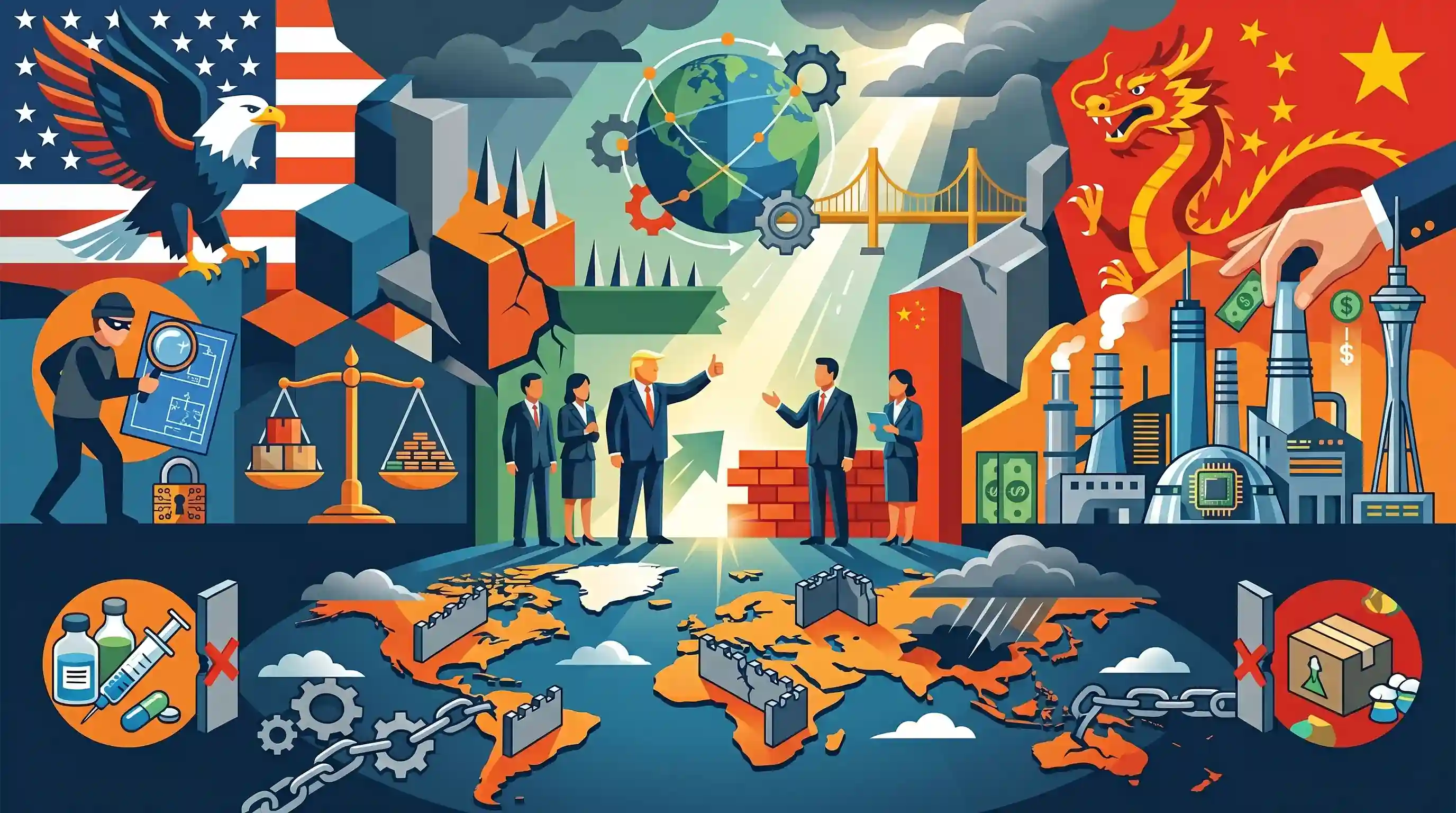
U.S.-China tariff negotiations have resumed in Geneva, with U.S. President Donald Trump citing "great progress" toward a potential reset in trade relations. The talks aim to address a severe trade war marked by U.S. tariffs on Chinese imports reaching up to 145% and China's retaliatory 125% levies. Underlying the current standoff are structural disputes left unresolved by the 2020 Phase One agreement, including China's heavy state subsidies for advanced technology, alleged theft of trade secrets, and a massive U.S. trade deficit, alongside new American tariffs penalizing fentanyl flows. The high-stakes negotiations remain crucial for stabilizing a global economy roiled by rising protectionism and supply chain disruptions.
Key Points
- High-level U.S.-China tariff negotiations resumed in Geneva between U.S. Treasury Secretary Scott Bessent, USTR Jamieson Greer, and Chinese Vice Premier He Lifeng to de-escalate the trade war.
- The trade conflict involves massive reciprocal levies, with the U.S. imposing tariffs up to 145% on Chinese goods (including a 20% penalty over fentanyl) and China retaliating with 125% tariffs.
- Core unresolved disputes revolve around China's structural economic practices, including state subsidies for advanced technologies, intellectual property theft, and forced technology transfers.
- The 2020 Phase One agreement temporarily paused tariff escalations but failed to resolve deep-seated issues like tech subsidies and the $263 billion U.S. trade deficit.
- The U.S. is concurrently using tariffs globally, temporarily reducing planned 31% tariffs on Swiss exports to 10%, while Switzerland maintains a cautious, non-retaliatory trade stance.
Important Terms
Phase One agreement

A 2020 bilateral deal where China agreed to increase U.S. imports by $200 billion and strengthen IP protections in exchange for reduced U.S. tariffs.
UPSC context
GS Paper II/III: Bilateral agreements and their impact on global trade stability and India's 'China Plus One' strategy.
Protectionism
Economic policies, such as tariffs and quotas, used by a government to restrict imports and shield domestic industries from foreign competition.
UPSC context
GS Paper III: Indian Economy; tests understanding of global trade barriers, 'America First' policies, and impacts on Indian exports.
Intellectual Property Rights (IPR)
Legal protections (patents, trade secrets) for mental creations. In trade talks, it refers to disputes over forced technology transfers and alleged corporate espionage.
UPSC context
GS Paper III: Science and Economy; essential for understanding TRIPS, structural trade barriers, and innovation-led growth.
Trade Deficit
A situation where a country's total value of imported goods and services exceeds the value of its exports, creating a negative balance of trade.
UPSC context
GS Paper III: Economy; fundamental for analyzing Balance of Payments (BoP) and macroeconomic stability.
State Subsidies
Financial aid provided by a government to domestic producers (e.g., in green tech) to lower costs and boost international competitiveness.
UPSC context
GS Paper III: Economy; relates to WTO compliance, industrial policy, and fair market competition debates.
Trade War
An economic conflict where nations impose retaliatory tariffs and trade barriers to pressure each other or protect domestic economic interests.
UPSC context
GS Paper II/III: International Relations; tests knowledge of global supply chain disruptions and geopolitical economic leverage.
Prelims Trap
"The U.S. tariffs on Chinese goods are authorized WTO countervailing duties."
These are unilateral tariffs imposed under domestic laws (like Section 301), outside the formal WTO framework, reflecting institutional bypass rather than WTO sanctions.
Static Concepts Connected
What are the key exceptions to the WTO's Most-Favored-Nation (MFN) principle?
- Trade Remedies: Anti-dumping, countervailing, and safeguard duties are permitted if specific WTO evidentiary rules are followed to protect domestic industries.
- National Security: GATT Article XXI allows members to breach MFN and impose unilateral restrictions to protect essential national security interests.
- Regional Agreements: Members can grant preferential tariff treatment to Free Trade Agreement (FTA) or Customs Union partners without extending it to all WTO members.
What is the WTO framework for addressing structural state subsidies?
- SCM Agreement: The Agreement on Subsidies and Countervailing Measures (SCM) regulates state subsidies that distort trade and harm domestic industries of trading partners.
- Countervailing Duties: Importing nations can launch investigations and levy countervailing duties (CVDs) to offset the price advantage created by foreign state subsidies.
- Material Injury: Actionable subsidies must be shown to cause material injury to the competing domestic industry of the importing country.
Cross-Topic Patterns
Fentanyl & Economic Statecraft
Using 20% tariffs to penalize fentanyl precursor flows blends internal security (narcotics) with international trade tools, illustrating the rising weaponization of tariffs for non-economic goals.
WTO Bypass & Multilateral Paralysis
Conducting critical bilateral trade negotiations in Geneva while completely ignoring the formal WTO dispute settlement mechanism underscores the ongoing institutional paralysis of multilateralism.

Expect a GS2/GS3 question linking unilateral tariff spikes, national security exceptions, and the ongoing WTO Appellate Body paralysis.
Linked PYQs · 4
Linked PYQs · 4
- 2018MainsGS2
What are the key areas of reform if the WTO has to survive in the present context of "Trade War', especially keeping in mind the interest of India?
- 2025MainsGS3
What are the challenges before the Indian economy when the world is moving away from free trade and multilateralism to protectionism and bilateralism? How can these challenges be met?
- 2021MainsGS2
“The USA is facing an existential threat in the form of a China, that is much more challenging than the erstwhile Soviet Union.” Explain.
- 2014MainsGS3
In a globalized world, Intellectual Property Rights assume significance and are a source of litigation. Broadly distinguish between the terms-Copyrights, Patents and Trade Secrets.
