Rare Earth Magnet Import Licenses and Supply Chain Vulnerabilities
Source:Indian Express ↗
Why It Matters
Highlights the geoeconomic vulnerabilities of India's EV sector and how great power competition (US-China trade war) directly impacts Indian industrial supply chains, emphasizing the strategic importance of critical minerals.
Summary
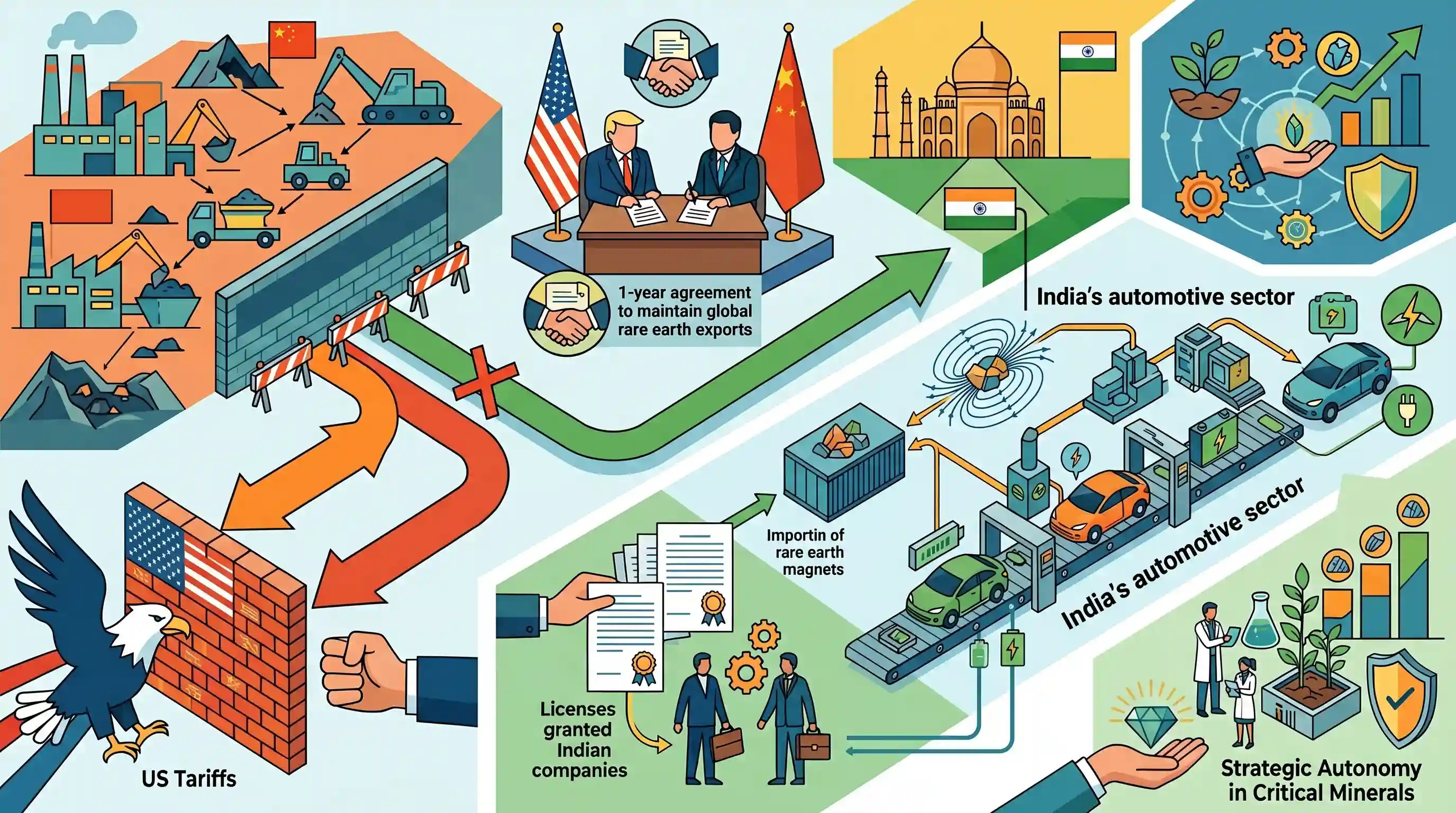
The Ministry of External Affairs (MEA) confirmed that select Indian companies have secured licenses to import rare earth magnets from China, marking the first such clearances since Beijing imposed strict export controls in April 2025. These neodymium magnets are vital for the manufacturing of electric vehicles (EVs). The development coincided with a meeting between US President Donald Trump and Chinese President Xi Jinping in South Korea, where they signed a one-year agreement to maintain global rare earth exports. China's recent export bans on critical minerals—enacted as retaliatory measures against US tariffs—have highlighted global supply chain vulnerabilities and directly threatened India's automotive sector, reinforcing the need for strategic autonomy in critical minerals.
Key Points
- India's MEA confirmed that a few Indian companies (DE Diamond, Hitachi, Continental India) have been granted conditional permits by China to import rare earth magnets.
- These are the first clearances since Beijing imposed strict export controls on rare earth magnets in April 2025 as retaliation against US tariffs.
- Rare earth magnets (such as neodymium-iron-boron) are indispensable for electric vehicle (EV) manufacturing, particularly for traction motors and steering systems.
- The development coincided with US President Donald Trump and Chinese President Xi Jinping signing a one-year agreement in South Korea to keep rare earth exports flowing globally.
- The episode underscores India's vulnerability to global supply chain disruptions and China's near-monopoly on critical minerals.
Important Terms
Critical Minerals

Minerals essential for economic development and national security, characterized by high supply risk and geographical concentration. India has identified 30 such minerals, including lithium, cobalt, and rare earths.
UPSC context
GS-1 (Geography-Resources) and GS-3 (Energy/Economy); focuses on mineral security and the green energy transition.
Rare Earth Elements (REEs)
A group of 17 chemical elements (15 lanthanides plus scandium and yttrium) vital for high-tech electronics, electric vehicle motors, and defense systems. China dominates global mining and processing.
UPSC context
GS-1 and GS-3; relevant for discussing resource geopolitics and clean energy manufacturing.
Strategic Autonomy
A core tenet of Indian foreign policy emphasizing the pursuit of national interests and independent decision-making without becoming overly dependent on any single power or alliance.
UPSC context
GS-2 (International Relations); critical for questions on India's balancing act between global powers.
US-China Rare Earth Agreement (2025)
A specific 2025 pact reached in Busan, South Korea, where both nations agreed to a one-year pause on rare earth export controls to stabilize global tech supply chains.
UPSC context
GS-2 (International Relations); important for analyzing geoeconomic shifts and global trade stability.
Supply Chain Resilience
The capacity of a supply chain to persist and recover from disruptions by diversifying sources, reducing import dependence, and building domestic manufacturing capabilities.
UPSC context
GS-3 (Economy/Infrastructure); central to discussions on 'Atmanirbhar Bharat' and global trade shocks.
Neodymium Magnets
The strongest type of permanent magnets (NdFeB) essential for electric vehicle (EV) motors, wind turbines, and high-tech weaponry. India is heavily reliant on Chinese imports for these components.
UPSC context
GS-3 (Science & Tech); relevant for the EV industry and indigenous manufacturing targets.
End-User Certificate (EUC)
A mandatory regulatory document confirming that imported sensitive materials will be used for specified non-military purposes and not re-exported to restricted third countries like the US.
UPSC context
GS-3 (Economy/Security); tests understanding of international trade regulations and dual-use technology controls.
Ministry of External Affairs (MEA)
The government body responsible for India's foreign relations, which actively mediates diplomatic approvals for critical resource imports and manages geoeconomic negotiations.
UPSC context
GS-2 (Governance/IR); identifies the institutional role in securing India's strategic resource interests.
Prelims Trap
"India has virtually no rare earth mineral reserves, necessitating complete reliance on Chinese imports."
False. India has the world's 5th largest rare earth reserves (primarily Monazite sand). The import reliance on China is due to a lack of commercial processing and extraction tech, not missing ore.
Static Concepts Connected
What are Rare Earth Elements (REEs) and where are they found in India?
- Definition: A group of 17 elements (15 lanthanides + scandium and yttrium) crucial for high-tech electronics, defense systems, and green technology like EV magnets.
- Indian Reserves: Chiefly found in Monazite sand, a radioactive mineral occurring along the coastal beaches of Kerala, Tamil Nadu, and Odisha.
- Regulatory Monopoly: Monazite is a prescribed substance under the Atomic Energy Act, meaning only the PSU Indian Rare Earths Limited (IREL) is authorized to mine and process it.
What institutional measures has India taken to secure critical mineral supply chains?
- Domestic (KABIL): Khanij Bidesh India Ltd. (KABIL), a JV of three CPSEs, was formed specifically to identify, acquire, and develop strategic mineral assets (like Lithium) overseas.
- Global (MSP): India joined the US-led Mineral Security Partnership (MSP), a coalition of 14 nations + the EU, aimed at building secure, diversified critical mineral supply chains away from Chinese dominance.
Cross-Topic Patterns
Critical Minerals + Net Zero 2070
The success of FAME policies and Panchamrit climate goals are constrained by geoeconomic chokepoints, elevating rare earths to the strategic importance of crude oil for India's energy transition.
Trade Weaponization + WTO GATT Rules
China's export controls on raw materials often spark WTO disputes. Expect questions linking national security exceptions (Article XXI of GATT) to geopolitical supply-chain weaponization.

A multi-statement Prelims question in 2026 will likely fuse India's rare earth reserves (Monazite) with global frameworks like the MSP.
Linked PYQs · 4
Linked PYQs · 4
- 2025PrelimsGS1
Consider the following statements : Statement I: Some rare earth elements are used in the manufacture of flat television screens and computer monitors. Statement II : Some rare earth elements have phosphorescent properties. Which one of the following is correct in respect of the above statements?
- 2025PrelimsGS1
In the context of electric vehicle batteries, consider the following elements : I. Cobalt II. Graphite III. Lithium IV. Nickel How many of the above usually make up battery cathodes?
- 2024MainsGS2
‘The West is fostering India as an alternative to reduce dependence on China's supply chain and as a strategic ally to counter China's political and economic dominance.’ Explain this statement with examples.
- 2023MainsGS3
The adoption of electric vehicles is rapidly growing worldwide. How do electric vehicles contribute to reducing carbon emissions and what are the key benefits they offer compared to traditional combustion engine vehicles?
