US-China Trade War Escalation and Rare Earth Export Controls
Source:The Hindu ↗
Why It Matters
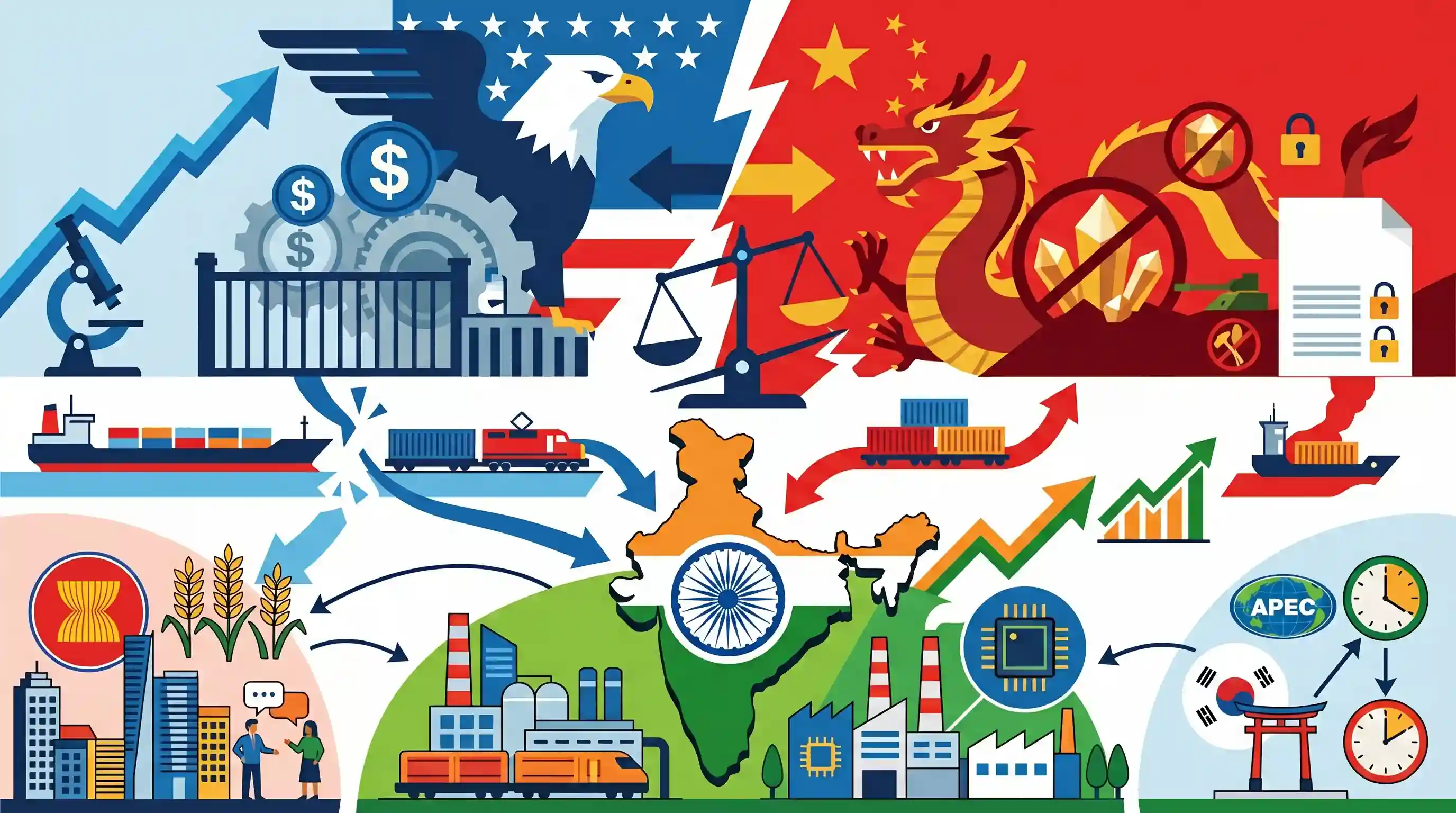
The retaliatory cycle of trade barriers and export controls between the world's two largest economies threatens global economic stability. For India, this presents both challenges and opportunities regarding supply chain diversification (e.g., rare earth minerals) and shifting manufacturing hubs amid the evolving U.S.-China strategic competition.
Summary
U.S. and Chinese economic officials recently engaged in critical talks in Kuala Lumpur during the ASEAN summit to prevent further escalation of their ongoing trade dispute. The dialogue follows a renewed cycle of retaliation, where the U.S. expanded its export blacklist against thousands of Chinese firms and launched a tariff probe over China's non-compliance with the 2020 Phase One trade agreement. In response, China tightened export controls on strategically critical rare earth minerals, requiring licenses to prevent their use in foreign military systems. Both nations are now seeking to stabilize relations to pave the way for a crucial bilateral meeting between Donald Trump and Xi Jinping at the upcoming APEC summit in South Korea.
Key Points
- Top economic officials from the U.S. and China met in Kuala Lumpur to avert a major escalation in the ongoing trade war.
- The U.S. recently expanded its export blacklist, barring exports to thousands of Chinese firms.
- China retaliated by imposing global export controls on rare earth elements, mandating export licenses to restrict their use in military systems.
- The U.S. also initiated a tariff probe against China for failing to fulfill commitments under the 2020 Phase One trade agreement.
- The talks aim to salvage an upcoming meeting between Presidents Donald Trump and Xi Jinping at the APEC summit in South Korea.
Important Terms
ASEAN

A regional intergovernmental organization comprising ten Southeast Asian nations, established in 1967 to promote economic growth, social progress, and regional stability through the principle of non-interference.
UPSC context
GS-2 (International Relations); tests understanding of regional groupings, India's Act East Policy, and security architecture in the Indo-Pacific.
APEC
An intergovernmental forum of 21 Pacific Rim economies that promotes free trade and economic cooperation. India currently holds observer status and seeks membership to integrate into global supply chains.
UPSC context
GS-2 (International Relations); evaluates knowledge of multilateral economic forums and the significance of India’s potential membership for global trade integration.
2020 US-China Phase One trade agreement
A bilateral deal signed in January 2020 to de-escalate the trade war; it required China to increase US imports by $200 billion and implement intellectual property reforms.
UPSC context
GS-2/GS-3; tests knowledge of bilateral trade disputes, their global economic impacts, and implications for India’s manufacturing and export sectors.
Rare Earth Minerals
A group of 17 metallic elements essential for high-tech applications like electronics, EVs, and defense. China currently dominates the global supply and processing of these strategic resources.
UPSC context
GS-1 (Geography) / GS-3 (Economy/Security); tests understanding of strategic resource distribution and critical mineral supply chains.
Prelims Trap
Rare Earth Elements (REEs) are named so because they are geologically extremely scarce in the Earth's crust.
REEs are actually relatively abundant. They are called 'rare' because they are highly dispersed and rarely found in concentrated, easily minable ore deposits.
Static Concepts Connected
What are Rare Earth Elements (REEs) and why are they strategically critical?
- Definition: A group of 17 chemically similar metallic elements comprising 15 lanthanides, plus scandium and yttrium.
- Geological abundance: Not geologically rare, but highly dispersed, making extraction economically difficult and environmentally polluting.
- Strategic application: Indispensable for defense systems, wind turbines, electric vehicles, and high-tech consumer electronics.
How does APEC function and what is India's current membership status in the grouping?
- Core mandate: Founded in 1989 to promote free trade, investment, and economic growth across the Asia-Pacific region.
- India's status: India is currently an observer, not a full member, having been previously denied entry due to concerns over its economic reform pace.
- Operational model: Unlike the WTO, APEC operates on non-binding commitments, open dialogue, and consensus rather than treaty obligations.
Cross-Topic Patterns
China's REE curbs & India's KABIL
China's weaponization of REE exports directly contextualizes India's push to secure overseas critical mineral assets in countries like Australia and Argentina through the state-owned joint venture KABIL.
Trade fragmentation & China Plus One
Recurring US-China tariff probes accelerate the 'China Plus One' supply chain strategy, presenting structural FDI opportunities for India in electronics, pharmaceuticals, and semiconductor manufacturing.

Expect a GS-2 mains question on the 'weaponization of supply chains' and how US-China decoupling impacts India's critical mineral security.
Linked PYQs · 3
Linked PYQs · 3
- 2018MainsGS2
What are the key areas of reform if the WTO has to survive in the present context of "Trade War', especially keeping in mind the interest of India?
- 2012PrelimsGS1
Recently, there has been a concern over the short supply of a group of elements called 'rare earth metals'. Why? 1. China, which is the largest producer of these elements, has imposed some restrictions on their export. 2. Other than China, Australia, Canada and Chile, these elements are not found in any country. 3. Rare earth metals are essential for the manufacture of various kinds of electronic items and there is a growing demand for these elements. Which of the statements given above is/are correct?
- 2021PrelimsGS1
Consider the following statements : 1. The Global Ocean Commission grants licences for seabed exploration and mining in international waters. 2. India has received licences for seabed mineral exploration in international waters. 3. 'Rare earth minerals' are present on seafloor in international waters. Which of the statements given above are correct?
