US and China Reach Preliminary Consensus on Trade Deal
Source:The Hindu ↗
Why It Matters
The easing of the US-China trade war has direct implications for global supply chains, inflation, and economic stability. Understanding the geopolitics around rare earth elements and trade protectionism is essential for assessing India's strategic autonomy, trade policy, and position within the evolving global order.
Summary
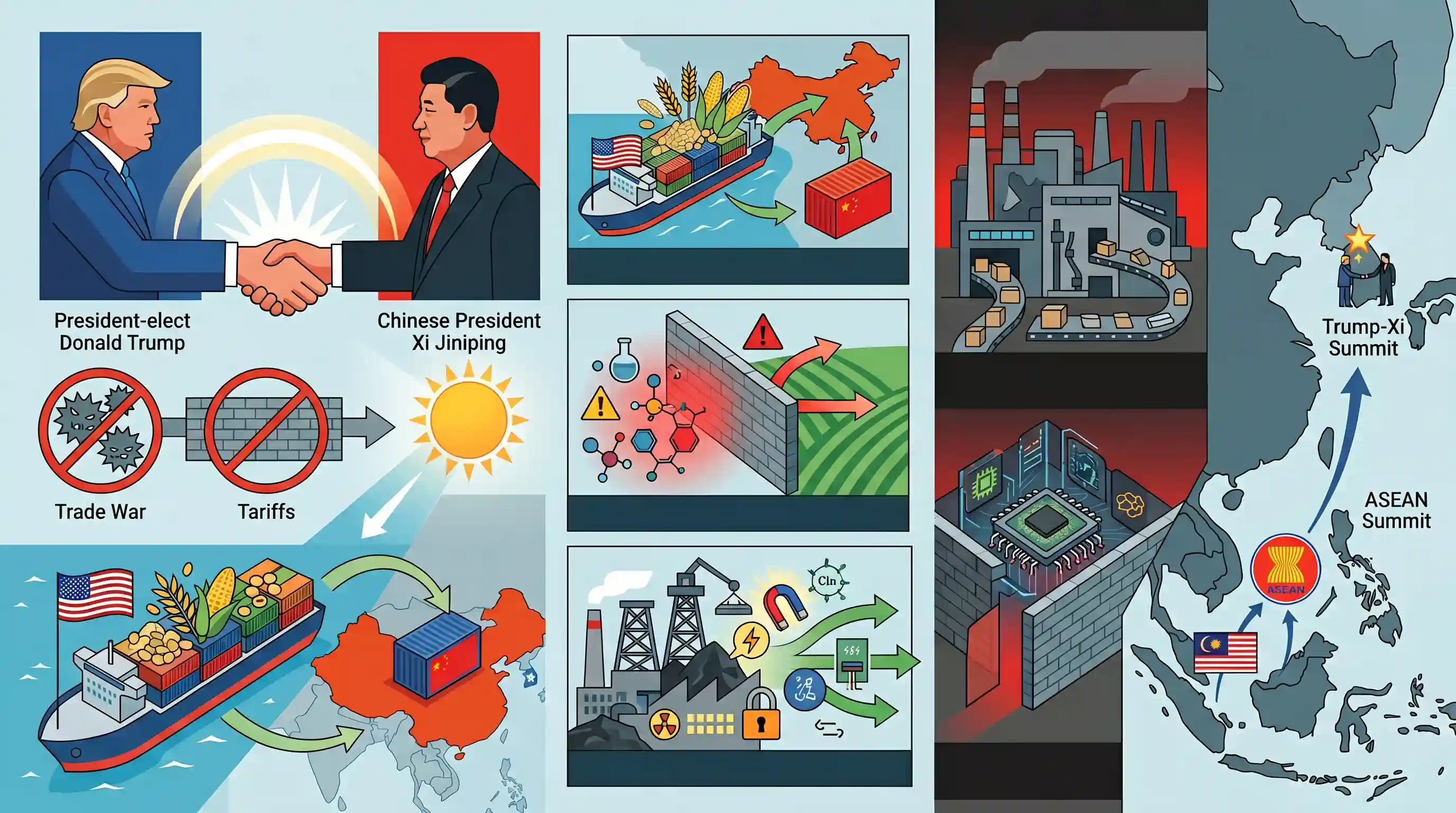
The United States and China have reached a preliminary consensus on a trade deal to avoid further tariff escalations ahead of a scheduled meeting between US President-elect Donald Trump and Chinese President Xi Jinping. China has reportedly agreed to make substantial agricultural purchases from the US, halt exports of fentanyl precursor chemicals, and suspend recent export controls on crucial rare earth elements. While core structural issues like state-backed manufacturing imbalances and access to advanced semiconductors remain unaddressed, the immediate easing of trade hostilities reduces the threat of a widening global economic conflict. The leaders are expected to meet in South Korea following the ASEAN summit in Malaysia.
Key Points
- The US and China have reached a preliminary trade agreement to avert an escalation of tariffs ahead of a high-stakes meeting between Donald Trump and Xi Jinping in South Korea.
- As part of the deal, China agreed to substantial US agricultural purchases, halting exports of fentanyl precursors, and suspending export controls on rare earth elements.
- The agreement addresses immediate trade hostilities that threatened global economic growth but leaves long-term structural issues, such as China's state-backed manufacturing, unresolved.
- The leaders' scheduled meeting follows their attendance at the ASEAN summit in Kuala Lumpur, Malaysia.
Important Terms
Association of Southeast Asian Nations (ASEAN)

A 10-member regional bloc (11 with Timor-Leste) promoting economic growth and stability in Southeast Asia. It follows the "ASEAN Way" of consensus-based, non-interference diplomacy.
UPSC context
GS Paper 2: International Relations. Central to India’s Act East Policy and Indo-Pacific strategy; key for regional security and trade.
Rare Earth Elements (REEs)
A group of 17 metallic elements essential for high-tech products like smartphones, EVs, and defense systems. China currently dominates global mining and processing (approx. 60-90%).
UPSC context
GS Paper 1 (Geography) & GS Paper 3 (Economy/Science). Vital for India’s National Critical Minerals Mission and strategic autonomy in green energy.
Semiconductors
Materials (e.g., Silicon) with electrical conductivity between conductors and insulators. They are the "brain" of modern electronics, critical for AI, telecommunications, and advanced weaponry.
UPSC context
GS Paper 3: Science & Technology and Economy. Focus of the India Semiconductor Mission (ISM) to reduce import dependency and secure supply chains.
Fentanyl Precursors
Dual-use chemicals used to synthesize the potent synthetic opioid fentanyl. Their regulation is a significant point of diplomatic negotiation between the US and China.
UPSC context
GS Paper 2: International Relations. Illustrates how non-traditional security threats (drug trafficking) are used as leverage in major power geopolitics.
Export Controls
Government-imposed regulations that restrict the export of specific goods, software, or technology for national security or foreign policy reasons, often targeting advanced tech like chips.
UPSC context
GS Paper 2: International Relations. Key instrument in the US-China "tech war" affecting global trade norms and WTO stability.
Prelims Trap
"China holds a monopoly on the global reserves of rare earth elements."
China dominates the processing and production of rare earths, but it does NOT hold a monopoly on global reserves. India, Australia, and the US hold significant reserves.
Static Concepts Connected
What makes Rare Earth Elements (REEs) strategically critical, and does India have them?
- Not genuinely rare: A group of 17 elements (15 lanthanides + scandium, yttrium). They are relatively abundant in Earth's crust but rarely found in concentrated, economically viable deposits.
- Strategic applications: Essential for permanent magnets in wind turbines and EVs, advanced defense electronics, and cutting-edge semiconductors.
- Indian reserves: India holds the 5th largest global reserves (mostly as Monazite sand in coastal placers), but relies almost entirely on imports for finished REE products.
How do nations weaponize trade and export controls under WTO frameworks?
- National Security Exception: Article XXI of GATT allows member states to breach normal WTO obligations (like imposing export controls or bans) if required to protect essential national security interests.
- State subsidies: Direct financial support to domestic manufacturing distorts free trade, prompting importing nations to levy Countervailing Duties (CVDs) to neutralize the price advantage.
Cross-Topic Patterns
Rare Earths + Supply Chain Resilience
China's weaponization of REE export controls validates the Quad's push for the Supply Chain Resilience Initiative (SCRI) and accelerates India's domestic Critical Minerals Mission.
Fentanyl precursors + Border Security
The regulation of fentanyl precursors ties into India's internal security syllabus, particularly the shift from plant-based narcotics to synthetic drug trafficking networks operating from the Golden Triangle.

Expect a prelims question contrasting Rare Earth reserves with processing dominance, linking export controls to India's mining reforms.
Linked PYQs · 3
Linked PYQs · 3
- 2018MainsGS2
What are the key areas of reform if the WTO has to survive in the present context of "Trade War', especially keeping in mind the interest of India?
- 2021MainsGS2
“The USA is facing an existential threat in the form of a China, that is much more challenging than the erstwhile Soviet Union.” Explain.
- 2025PrelimsGS1
Consider the following statements : Statement I: Some rare earth elements are used in the manufacture of flat television screens and computer monitors. Statement II : Some rare earth elements have phosphorescent properties. Which one of the following is correct in respect of the above statements?
