US and China Opt Out of Military AI Declaration at REAIM Summit
Source:The Hindu ↗
Why It Matters
Illustrates the ethical, strategic, and governance challenges associated with the rapid militarization of emerging technologies like AI. It is highly relevant for GS3 (Science & Tech and Security), GS2 (International Relations/Global Agreements), and GS4 (Ethics in International Relations).
Summary
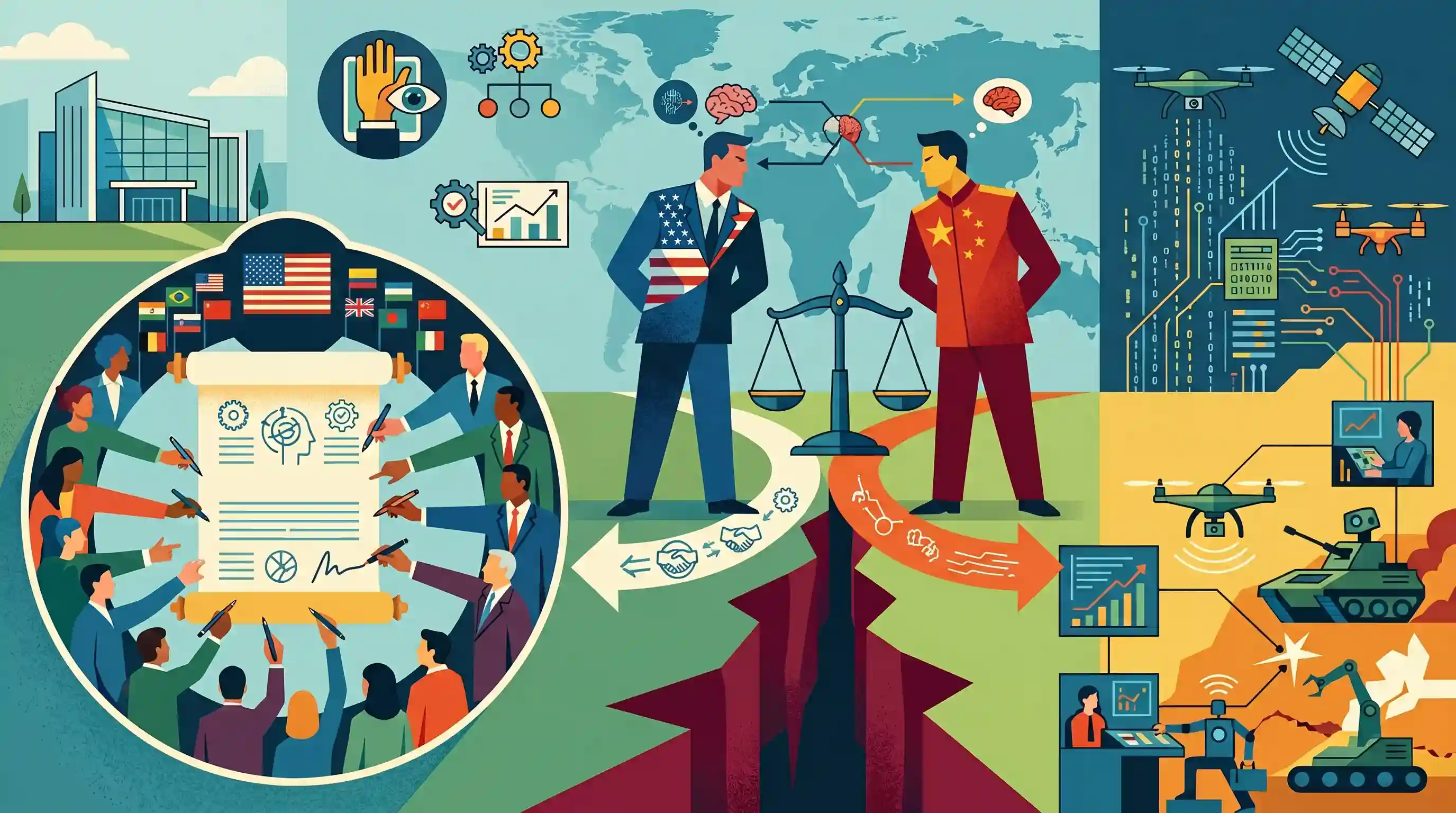
At the Responsible AI in the Military Domain (REAIM) summit in Spain, 35 nations signed a non-binding declaration outlining 20 ethical and operational principles for the use of artificial intelligence in warfare. However, major military powers including the United States and China opted out. The declaration emphasizes human oversight, clear chains of command, and rigorous risk assessments. The hesitancy of major powers highlights a global 'prisoner's dilemma' where nations are caught between implementing responsible ethical constraints and the fear of ceding strategic military advantage to geopolitical rivals.
Key Points
- Only 35 out of 85 countries at the REAIM summit in Spain signed a non-binding joint declaration establishing 20 principles for governing AI deployment in warfare.
- Major military powers, specifically the United States and China, opted out of the declaration amid geopolitical rivalries and uncertainties in transatlantic relations.
- The principles include ensuring human oversight over AI weapons, establishing clear chains of command, and mandating robust risk assessments and personnel training.
- The situation represents a classic 'prisoner's dilemma' in international relations, where nations hesitate to self-impose ethical constraints on AI for fear of losing competitive military advantage to unconstrained adversaries.
Important Terms
Responsible AI in the Military Domain (REAIM)

A global platform launched in 2023 to develop international norms and governance for ethical AI integration in warfare, involving governments, industry, and civil society.
UPSC context
GS II/III: Crucial for international tech-diplomacy and regulation of emerging defense technologies.
REAIM Blueprint for Action
A non-binding roadmap endorsed by 61 nations (including the U.S.) at the 2024 Seoul summit, establishing initial principles for human oversight and accountability in military AI.
UPSC context
GS II: Illustrates the evolution of soft-law norms in global tech governance.
Pathways for Action (REAIM 2026)
The 2026 Spanish summit document focusing on operationalizing AI principles; its 20 points were signed by only 35 nations, with the U.S. and China notably opting out.
UPSC context
GS II: Key for analyzing the 'great power' divide in international security agreements.
Lethal Autonomous Weapons Systems (LAWS)
Military systems capable of selecting and engaging targets without human intervention; they are the primary subject of global AI disarmament and ethical regulation debates.
UPSC context
GS III: Internal security and science; tests knowledge of ethical-technological 'red lines' in modern warfare.
U.N. Institute for Disarmament Research (UNIDIR)
An autonomous UN institution providing independent research and advisory support for disarmament; it serves as a technical advisor to the REAIM process.
UPSC context
GS II: Important UN-affiliated body involved in global security and tech-treaty research.
Geopolitical Prisoner’s Dilemma
A game-theory concept where nations avoid cooperating on ethical AI constraints due to fear of losing a strategic military advantage to geopolitical rivals.
UPSC context
GS IV: Ethics in international relations; helps analyze why collective security agreements often fail.
Prelims Trap
The REAIM declaration is a legally binding UN treaty on military AI signed by major powers like the US and China.
REAIM is a strictly non-binding declaration. Furthermore, major military powers like the US and China explicitly opted out, highlighting deep geopolitical divides.
Static Concepts Connected
How do core International Humanitarian Law principles apply to autonomous weapons?
- Principle of Distinction: AI weapons struggle to reliably distinguish between active combatants and non-combatant civilians in complex, dynamic conflict environments.
- Principle of Proportionality: Algorithms cannot currently replicate the human judgment required to weigh anticipated military advantage against potential incidental civilian harm.
- Accountability Gap: When autonomous systems violate laws of war, assigning legal and moral responsibility (to developers, commanders, or the machine) remains unresolved.
How does the 'Prisoner's Dilemma' explain the military AI arms race?
- Mutual Mistrust: Rational states fail to cooperate on ethical AI guardrails because they cannot verify or trust that adversaries will do the same.
- Strategic Disadvantage: States fear that unilaterally self-imposing ethical constraints will cede a decisive military and technological advantage to unconstrained rivals.
- Suboptimal Outcome: Consequently, all nations aggressively pursue AI militarization without guardrails, ultimately leading to decreased global security and stability for everyone.
Cross-Topic Patterns
Civilian AI safety vs Military AI sovereignty
States easily sign civilian AI safety pacts like the Bletchley Declaration but opt out of military frameworks like REAIM to protect defense deterrence and technological sovereignty.
AI bridging GS3 Tech and GS4 Ethics
Lethal Autonomous Weapons Systems (LAWS) force aspirants to connect dual-use technology with moral philosophy, specifically regarding who bears responsibility for algorithmic kills.

Expect a multi-statement Prelims question contrasting non-binding REAIM military AI principles with civilian AI pacts like Bletchley.
Linked PYQs · 4
Linked PYQs · 4
- 2023MainsGS3
Introduce the concept of Artificial Intelligence (AI). How does Al help clinical diagnosis? Do you perceive any threat to privacy of the individual in the use of Al in healthcare?
- 2023MainsGS3
The use of unmanned aerial vehicles (UAVs) by our adversaries across the borders to ferry arms/ammunitions, drugs, etc., is a serious threat to the internal security. Comment on the measures being taken to tackle this threat.
- 2024MainsGS4
The application of Artificial Intelligence as a dependable source of input for administrative rational decision-making is a debatable issue. Critically examine the statement from the ethical point of view.
- 2020MainsGS4
(b) List five ethical factors that would influence the decision to sell arms to foreign governments.
