US China trade war tariff pause and global supply chain stability
Source:Indian Express ↗
Why It Matters
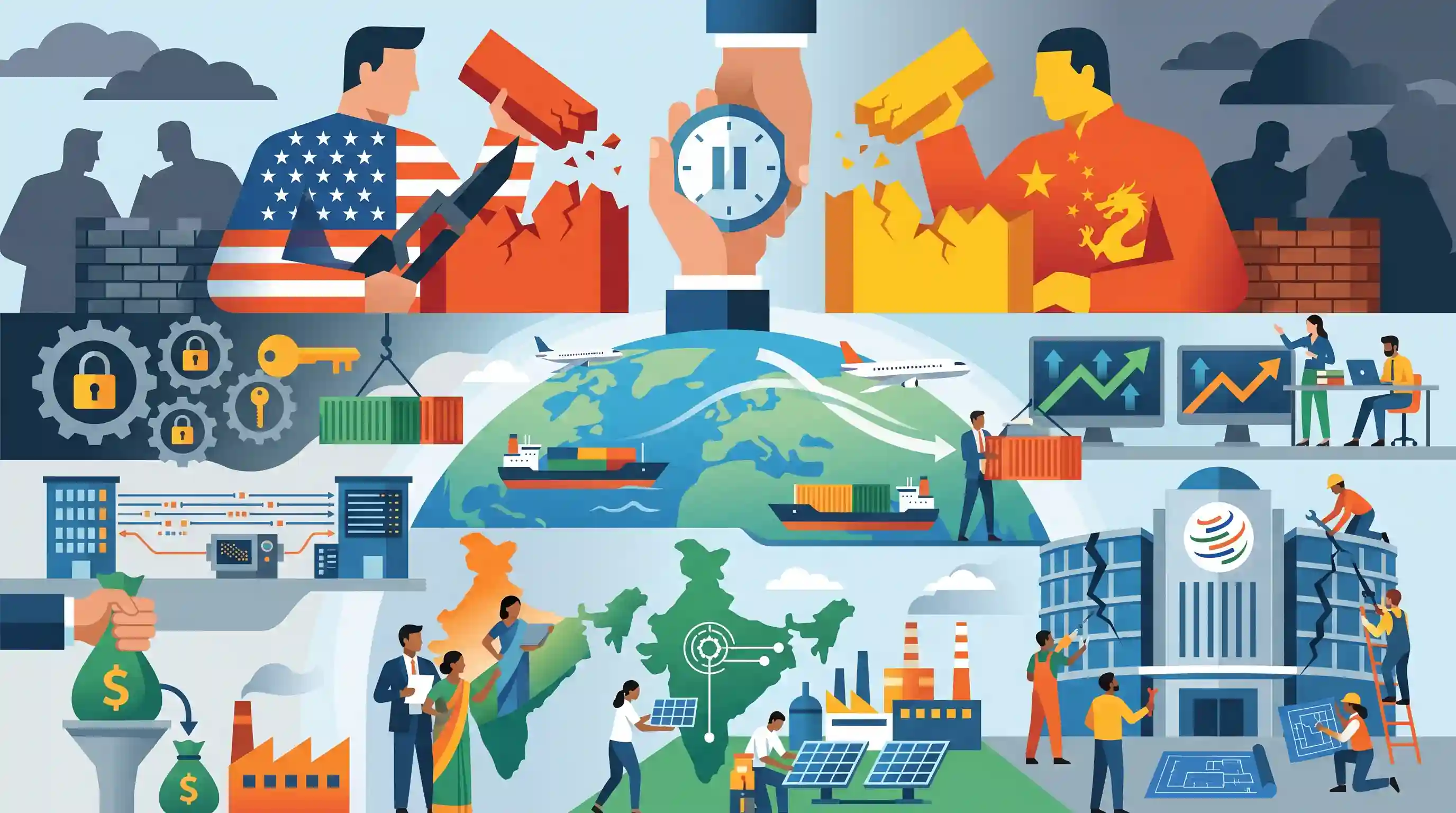
The US-China trade war has significant cascading effects on the global economy, international trade governance (WTO), and supply chains. Understanding these dynamics is crucial for aspirants to analyze global geopolitical shifts, the rise of protectionism, and their direct and indirect implications for India's macroeconomic stability and foreign policy.
Summary
The editorial welcomes the recent climbdown in the US-China trade war as a much-needed pause that provides temporary relief to the global economy. By halting the escalation of reciprocal tariffs, the truce helps stabilize global financial markets, supply chains, and international trade flows. However, the article cautions that the pause does not resolve the deep-rooted structural disputes over intellectual property, technology transfer, and state subsidies. For India and the broader international community, while the de-escalation reduces immediate economic volatility, the underlying geopolitical rivalry and trends of protectionism underscore the need for resilient domestic economies and urgent reforms in global trade bodies like the WTO.
Key Points
- The US and China have reached a temporary truce, pausing further tariff escalations in their ongoing trade war.
- This de-escalation provides immediate relief to global supply chains, financial markets, and economic growth prospects that were threatened by rising protectionism.
- Core structural issues between the two nations, such as intellectual property rights, state subsidies, and technology transfers, remain largely unresolved despite the pause.
- The shifting dynamics highlight the systemic challenges facing global trade governance and the need for World Trade Organization (WTO) reforms amidst great power competition.
- For India, the pause offers a reprieve from global economic shocks, but strategic focus must remain on leveraging global supply chain realignments and boosting domestic economic resilience.
Important Terms
World Trade Organization (WTO)

The only global international organization dealing with the rules of trade between nations. It provides a forum for negotiating agreements and a legal mechanism for resolving disputes.
UPSC context
GS-2: Important International institutions. Tests knowledge of trade governance, dispute settlement, and current calls for reform.
Protectionism
Economic policy of shielding domestic industries from foreign competition through methods like high tariffs, import quotas, and restrictive regulations.
UPSC context
GS-3: Indian Economy and trade. Tests understanding of trade barriers and their impact on globalized economies.
Intellectual Property Rights (IPR)
Legal rights protecting creations of the mind, such as patents and trademarks. Disputes often arise over forced technology transfer and copyright theft.
UPSC context
GS-3: Issues relating to intellectual property rights. Tests knowledge of TRIPS and international innovation conflicts.
Global Supply Chains
The cross-border network of companies and activities involved in the production and delivery of goods from raw materials to final consumers.
UPSC context
GS-3: Effects of liberalization. Tests understanding of supply chain resilience and India’s strategic "China Plus One" role.
State Subsidies
Financial assistance provided by a government to domestic producers to lower costs and improve competitiveness against foreign imports.
UPSC context
GS-3: Government Budgeting/Economy. Tests awareness of unfair trade practices and WTO-related subsidy classifications.
Prelims Trap
"The WTO's SCM agreement strictly prohibits all forms of state subsidies provided by member nations."
The SCM agreement categorizes subsidies into 'prohibited' (tied to export performance) and 'actionable' (can be challenged if they hurt others). It does not universally ban all state subsidies.
Static Concepts Connected
What are the core WTO agreements governing structural trade disputes?
- WTO SCM: Agreement on Subsidies and Countervailing Measures. Regulates "prohibited" (export-tied) and "actionable" state subsidies.
- WTO TRIPS: Trade-Related Aspects of Intellectual Property Rights. Sets minimum global standards for IP enforcement and technology transfers.
- WTO TRIMS: Trade-Related Investment Measures. Forbids quantitative restrictions and local content requirements on foreign investments.
Why is the WTO Dispute Settlement mechanism currently facing a crisis?
- Appellate Body deadlock: The United States has systematically blocked the appointment of new judges to the WTO's Appellate Body since 2019, rendering it non-functional.
- MPIA workaround: Several nations formed the Multi-Party Interim Appeal Arbitration Arrangement to bypass the deadlock. Notably, the US and India are not members.
Cross-Topic Patterns
China Plus One & domestic PLI strategy
The bilateral trade war catalyzed the "China Plus One" strategy, directly linking global geopolitics to India's domestic Production Linked Incentive (PLI) schemes aimed at capturing migrating multinational manufacturing.
Trade protectionism and currency manipulation
Tariffs often trigger competitive currency devaluation (e.g., deliberately weakening the Yuan) to maintain export competitiveness, linking bilateral trade barriers directly to forex reserves and global monetary policy dynamics.

Expect a 2026 Prelims question pairing WTO SCM/TRIMS provisions with India's PLI scheme and local content requirements.
Linked PYQs · 2
Linked PYQs · 2
- 2018MainsGS2
What are the key areas of reform if the WTO has to survive in the present context of "Trade War', especially keeping in mind the interest of India?
- 2020PrelimsGS1
With reference to Trade-Related Investment Measures (TRIMS), which of the following statements is/are correct? 1. Quantitative restrictions on imports by foreign investors are prohibited. 2. They apply to investment measures related to trade in both goods and services. 3. They are not concerned with the regulation of foreign investment. Select the correct answer using the code given below:
