US Authorities Arrest Thirty Undocumented Indian Nationals
Source:The Hindu ↗
Why It Matters
Highlights the growing challenge of illegal immigration from India to developed countries like the US (often facilitated by human smuggling networks like 'donkey flights'). It has implications for the perception of the Indian diaspora, migrant safety, and consular aspects of US-India bilateral relations.
Summary
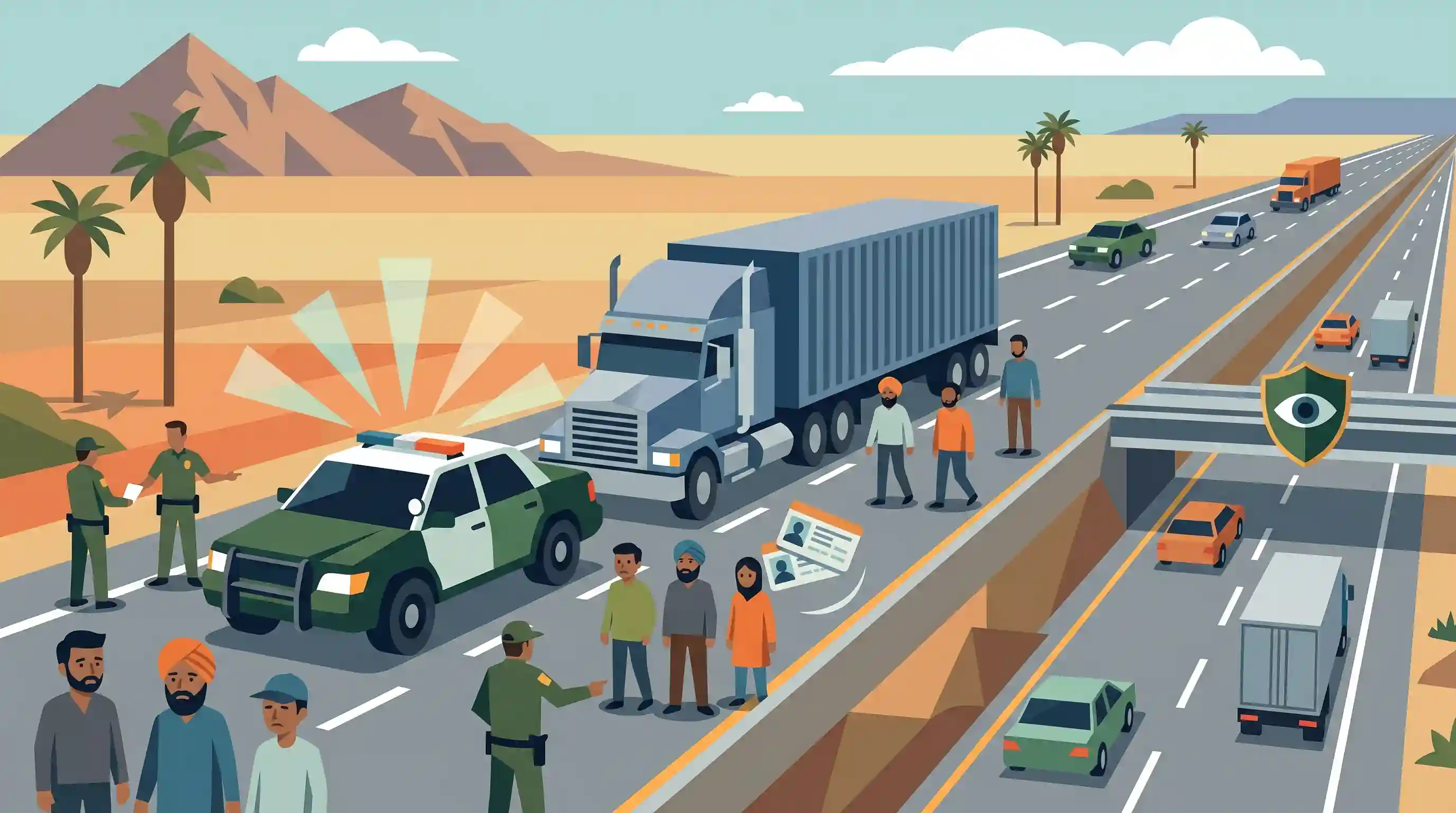
U.S. Border Patrol agents in California have arrested 30 Indian nationals living illegally in the United States. The individuals were apprehended during vehicle stops and interagency operations, including Operation Highway Sentinel. They were found operating semitrucks with commercial driver's licenses (CDLs) despite their undocumented status. The operation targeted immigration law violations and aimed to safeguard U.S. highways by enforcing regulatory standards in the commercial transportation sector, following concerns about fatal accidents involving illegally operating drivers. The incident underscores the growing issue of undocumented Indian migration to the US.
Key Points
- U.S. Border Patrol agents arrested 30 Indian nationals living illegally in California.
- The undocumented immigrants were apprehended while operating semitrucks with commercial driver's licenses (CDLs).
- The arrests took place during vehicle stops at immigration checkpoints and operations such as Operation Highway Sentinel.
- The enforcement action aimed to address immigration violations and enforce regulatory and safety standards in the commercial transportation sector.
- Authorities raised concerns over fatal accidents caused by unqualified or illegal individuals operating commercial vehicles.
- The incident brings attention to the rising number of undocumented Indian migrants entering the US.
Important Terms
Operation Highway Sentinel

A joint U.S. enforcement initiative targeting undocumented individuals operating commercial vehicles. It aims to enhance highway safety following fatal accidents and strictly enforce federal immigration laws within the transportation sector.
UPSC context
GS Paper-2: International Relations; tests knowledge of foreign policy impacts on the Indian diaspora and bilateral immigration enforcement measures.
U.S. Border Patrol
The primary U.S. federal agency responsible for securing land borders and preventing illegal entry of persons and contraband between official ports of entry. It operates under Customs and Border Protection.
UPSC context
GS Paper-2: Governance; relevant for understanding global migration management and the institutional challenges facing Indian migrants abroad.
El Centro Sector
An administrative division of the U.S. Border Patrol in Southern California responsible for interior immigration enforcement and checkpoints along major highway corridors in the Imperial Valley region.
UPSC context
GS Paper-2: Indian Diaspora; illustrates specific geographical enforcement zones where undocumented Indians face legal risks and detention.
Undocumented Indian Diaspora
Indian nationals living abroad without valid legal status. In the U.S., this group includes approximately 7.25 lakh individuals, highlighting issues of human smuggling and socio-economic 'push' factors.
UPSC context
GS Paper-2: Indian Diaspora; key for analyzing migration trends, the welfare of citizens abroad, and diplomatic negotiations on repatriation.
Homeland Security Investigations (HSI)
The investigative arm of the U.S. Department of Homeland Security (DHS) that combats transnational crime, including human smuggling, financial crimes, and immigration-related fraud.
UPSC context
GS Paper-2: Bilateral Relations; shows the role of specialized foreign agencies in cross-border law enforcement affecting Indian nationals.
Prelims Trap
"Human smuggling and human trafficking are legally synonymous under UN conventions."
Smuggling involves voluntary, illegal border crossing for a fee. Trafficking involves coercion and exploitation, and does not require crossing an international border.
Static Concepts Connected
What are Migration and Mobility Partnership Agreements (MMPAs)?
- Core Objective: To establish safe, legal, and orderly migration pathways for students and professionals while combating illegal immigration.
- Irregular Migrants: They include formal provisions to facilitate the swift identification, return, and readmission of undocumented citizens.
- Key Partners: India has proactively signed MMPAs with nations like the UK, France, Germany, Australia, and Italy.
How does the UN distinguish human smuggling from human trafficking?
- Role of Consent: Smuggling involves the migrant's consent to illegally cross borders. Trafficking involves coercion, deception, and ongoing exploitation.
- Border Crossing: Smuggling is inherently transnational and requires border crossing. Trafficking can occur entirely within a single country's borders.
- Palermo Protocols: The UN Convention against Transnational Organized Crime (UNTOC) addresses them via two distinct supplementary Palermo Protocols.
Cross-Topic Patterns
Jobless Growth driving 'Donkey Flights'
The shift from elite 'brain drain' to desperate, debt-financed 'dunki' migration highlights India's domestic employment crunch, directly linking GS3 economic challenges to GS2 diaspora and international relations issues.
Smuggling and Transnational Organized Crime
Cartels exploit 'visa-on-arrival' loopholes in Latin American transit countries to smuggle South Asians into the US, merging illicit human smuggling routes with global narcotics networks.

MMPA features and e-Migrate portal updates are prime targets for a 2026 Prelims multi-statement question on diaspora management.
Linked PYQs · 1
Linked PYQs · 1
- 2020MainsGS2
Indian diaspora has a decisive role to play in the politics and economy of America and European Countries'. Comment with examples.
