Regional Security and Diplomatic Reset in India Bangladesh Ties
Source:Indian Express ↗
Why It Matters
Understanding the trilateral dynamics between India, Bangladesh, and the U.S. is crucial for analyzing India's foreign policy challenges, particularly regarding the 'Neighbourhood First' policy and the geopolitics of the Indo-Pacific. It is highly relevant for GS Paper 2 questions on international relations and regional security architecture.
Summary
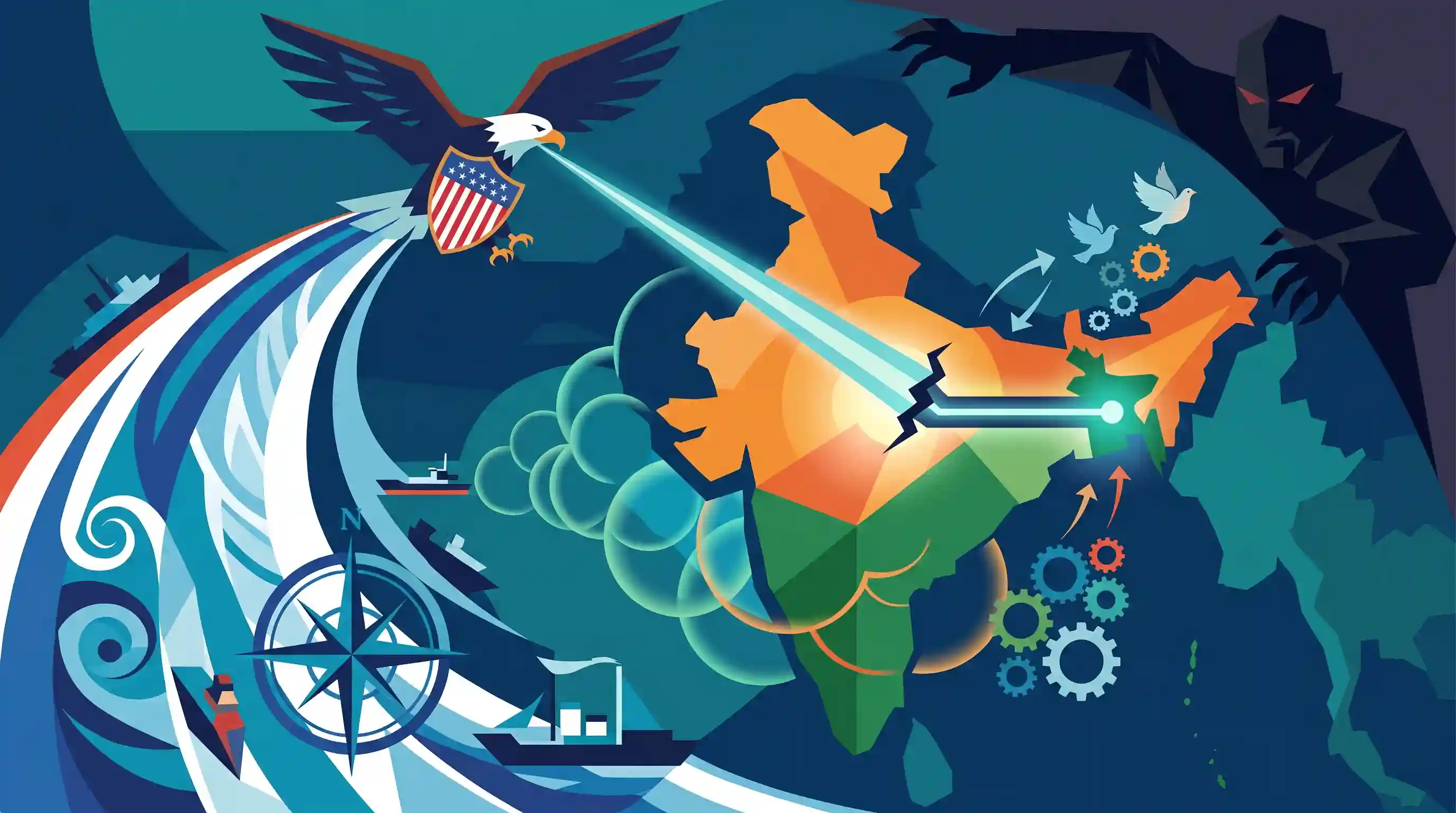
The article discusses Washington's strategic signaling in South Asia, specifically its push for a swift diplomatic reset between India and Bangladesh following political or electoral frictions. The United States views stable India-Bangladesh relations as critical to regional security and the success of its broader Indo-Pacific strategy. By urging normalization, Washington aims to prevent geopolitical instability in the subcontinent that could be exploited by rival powers like China. This dynamic highlights the complex interplay between the U.S. Indo-Pacific vision and India's 'Neighbourhood First' policy, bringing an external diplomatic element to New Delhi's regional sphere of influence.
Key Points
- Washington is advocating for an urgent normalization or 'reset' in ties between India and Bangladesh to ensure regional stability in South Asia.
- The U.S. views a stable India-Bangladesh partnership as a cornerstone for maintaining security and preventing strategic vulnerabilities in the Indo-Pacific region.
- Prolonged diplomatic friction between New Delhi and Dhaka could create a geopolitical vacuum, potentially allowing increased Chinese footprint in the subcontinent.
- The active signaling by the U.S. adds an external diplomatic dimension to India's traditionally bilateral approach to its immediate neighborhood, testing the nuances of its 'Neighbourhood First' policy.
Important Terms
Neighbourhood First Policy

India’s diplomatic strategy prioritizing relations with its immediate South Asian neighbors. It emphasizes regional stability, connectivity, and non-reciprocal economic assistance to foster a peaceful periphery and counter external influences.
UPSC context
GS Paper II: India’s Foreign Policy. Tests strategic management of neighbors and impact of domestic political shifts on regional security.
Indo-Pacific Strategy
A U.S.-led geopolitical vision for a "free, open, and secure" region spanning the Indian and Pacific Oceans. It emphasizes democratic values, maritime security, and collective deterrence against regional hegemony.
UPSC context
GS Paper II: Global Groupings. Evaluates India’s alignment with major powers and balancing of continental versus maritime security interests.
BIMSTEC
A seven-member regional grouping (including India and Bangladesh) connecting South and Southeast Asia. It focuses on sector-driven cooperation and serves as a primary vehicle for India's Bay of Bengal diplomacy.
UPSC context
GS Paper II: Regional Groupings. Important for 'Act East' policy, testing sub-regional integration and connectivity in the Bay of Bengal.
SAARC
An eight-member regional intergovernmental organization established in 1985. While designed to foster South Asian integration, its efficacy has been limited by bilateral frictions, particularly between India and Pakistan.
UPSC context
GS Paper II: International Relations. Tests the challenges of regionalism and the shift from broader South Asian to sub-regional groupings.
Prelims Trap
India accepts US mediation under the Indo-Pacific framework to resolve bilateral disputes with neighboring South Asian countries.
India strictly adheres to bilateralism in South Asia. While there is strategic convergence in the Indo-Pacific, India rejects formal third-party diplomatic intervention in its immediate neighborhood.
Static Concepts Connected
What are the core principles of the Gujral Doctrine?
- Non-reciprocity: India grants concessions to neighbors like Bangladesh, Bhutan, and Nepal in good faith without expecting reciprocal actions.
- Non-interference: No South Asian country should allow its territory to be used against the interests of another nation.
- Bilateral resolution: All bilateral disputes should be settled through peaceful bilateral negotiations without external or third-party mediation.
Which Indian states share an international border with Bangladesh?
- Longest boundary: India shares a 4,096.7 km border with Bangladesh, the longest international land boundary India has with any neighbor.
- Five States: West Bengal, Assam, Meghalaya, Tripura, and Mizoram share land borders with Bangladesh.
- Tripura's geography: Tripura is uniquely surrounded by Bangladesh on three sides (North, South, and West).
Cross-Topic Patterns
Bay of Bengal as Indo-Pacific Fulcrum
Bangladesh acts as the crucial link between India's 'Neighbourhood First' and 'Act East' policies. The US views this maritime geography as essential for broader Indo-Pacific security architectures.
Geopolitical Vacuums and Internal Security
Friction with Dhaka creates openings for China's BRI and String of Pearls. It simultaneously risks border mismanagement and insurgency spillover into India's Northeast, blending GS2 IR with GS3 Security.

Expect a GS2 Mains question evaluating how US Indo-Pacific strategies complicate India's strict bilateralism under 'Neighbourhood First'.
Linked PYQs · 4
Linked PYQs · 4
- 2020MainsGS2
What is the significance of Indo-US defence deals over Indo-Russian defence deals? Discuss with reference to stability in the Indo-Pacific region.
- 2015MainsGS2
Project 'Mausam' is considered a unique foreign policy initiative of the Indian Government to improve relationship with its neighbours. Does the project have a strategic dimension? Discuss.
- 2016MainsGS2
Increasing cross-border terrorist attacks in India and growing interference in the internal affairs of several member-states by Pakistan are not conducive for the future of SAARC (South Asian Association for Regional Cooperation)." Explain with suitable examples.
- 2025PrelimsGS1
Consider the following statements in respect of BIMSTEC : I. It is a regional organization consisting of seven member States till January 2025. II. It came into existence with the signing of the Dhaka Declaration, 1999. III. Bangladesh, India, Sri Lanka, Thailand and Nepal are founding member States of BIMSTEC. IV. In BIMSTEC, the subsector of 'tourism' is being led by India. Which of the statements given above is/are correct?
