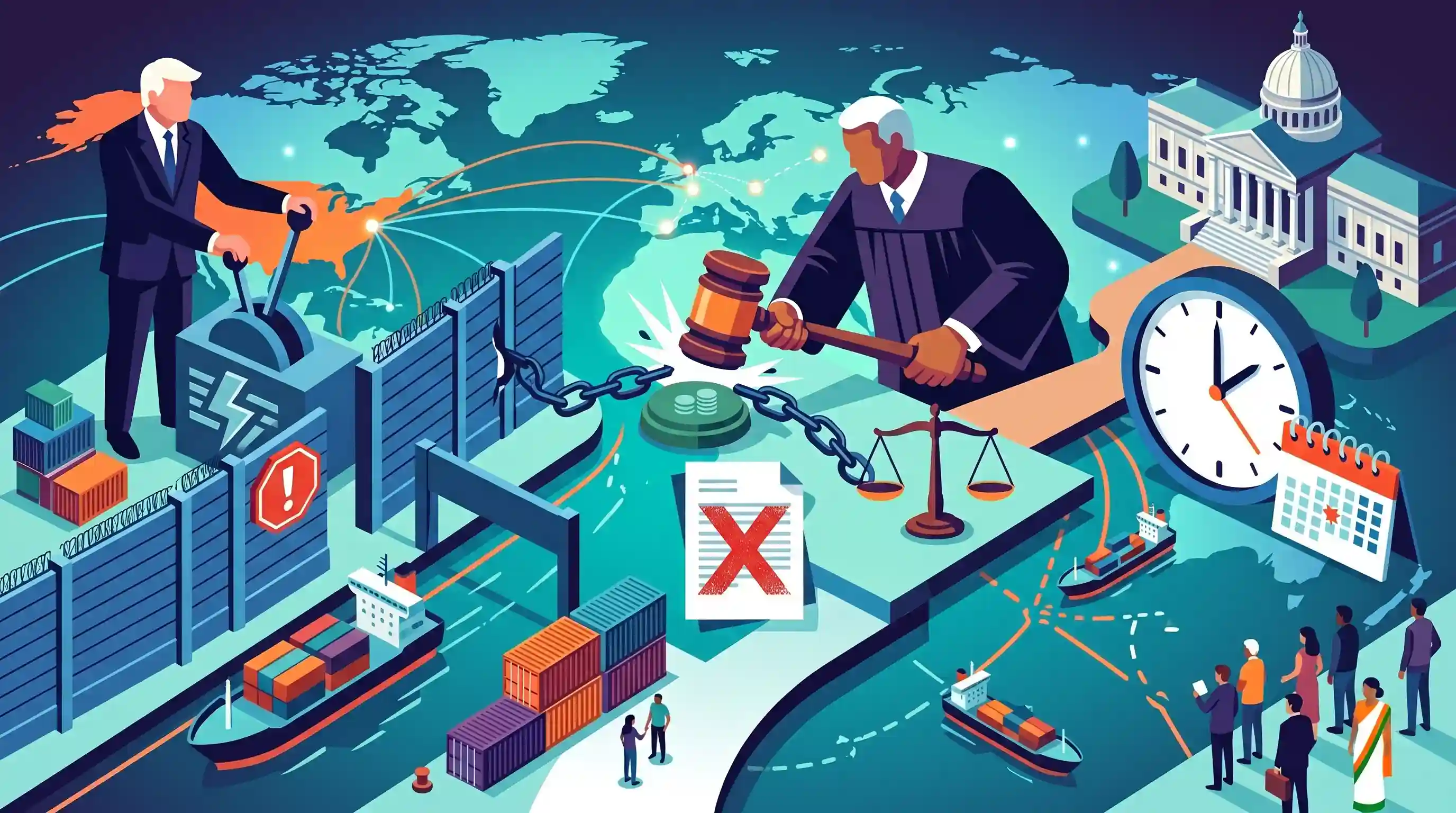
US appeals court ruling on executive emergency powers and tariffs
Source:The Hindu ↗
Why It Matters
US tariff policies directly impact global supply chains and the export competitiveness of nations like India. This legal challenge also highlights the tension between executive emergency powers and judicial oversight in shaping international trade relations.
Summary
A US federal appeals court has affirmed that President Donald Trump's widespread global tariffs, imposed using the International Emergency Economic Powers Act (IEEPA), are illegal because emergency powers do not explicitly permit taxation. However, the tariffs will remain in effect until mid-October to allow for an appeal to the US Supreme Court, keeping global trade dynamics in suspense.
Key Points
- A US federal appeals court ruled (7-4) that widespread global tariffs imposed by President Donald Trump under the IEEPA are illegal.
- The court held that the emergency economic powers under the statute do not explicitly include the authority to impose tariffs or taxes.
- The tariffs will temporarily remain in place until mid-October to allow the administration to appeal the decision to the US Supreme Court.
- This ruling poses a significant challenge to the US administration's use of tariffs as a primary economic and foreign policy tool, impacting global trade dynamics.
Important Terms
International Emergency Economic Powers Act (IEEPA)

A 1977 law granting the US President authority to regulate economic transactions during declared national emergencies; recently ruled insufficient to unilaterally impose broad tariffs without Congressional approval.
UPSC context
Relevant for GS Paper 2 (Executive Powers) and GS Paper 3 (Global Trade), testing impact of foreign policies on India's interests.
U.S. Court of Appeals for the Federal Circuit
A specialized US appellate court with nationwide jurisdiction over international trade, patents, and government contracts; it reviewed and affirmed the illegality of the IEEPA-based global tariffs.
UPSC context
GS Paper 2 (Judiciary); tests understanding of international trade dispute resolution and judicial oversight in major economies.
U.S. Court of International Trade (CIT)
A federal court with exclusive jurisdiction over civil actions arising from US customs and international trade laws; it was the first to rule Trump's reciprocal tariffs illegal.
UPSC context
GS Paper 2 (Institutions); relevant for aspirants tracking trade litigation affecting Indian export sectors like textiles and jewelry.
U.S. Supreme Court (SCOTUS)
The highest judicial body in the US, which eventually invalidated broad executive tariffs under IEEPA (6-3 ruling), reinforcing the constitutional separation of powers regarding taxation.
UPSC context
GS Paper 2 (Separation of Powers); tests how constitutional checks in developed nations stabilize or disrupt global trade.
European Union (EU)
A supranational political and economic union of 27 European member states; often a primary party in trade disputes and a key partner for India in diversifying trade.
UPSC context
GS Paper 2 (International Relations); tests India's strategic response to global protectionism and the need for FTAs with major blocs.
Prelims Trap
"The World Trade Organization (WTO) recently ruled the widespread US global tariffs illegal."
The tariffs were struck down by a US domestic federal appeals court for violating US separation of powers, not by the WTO.
Static Concepts Connected
How does the power to levy tariffs differ between the US and India?
- US System: Characterized by a strict separation of powers; only Congress has the constitutional authority to levy taxes or tariffs, limiting unilateral Presidential action.
- Indian System: Parliament passes the overarching law (e.g., Customs Act, 1962), but delegates power to the Executive to adjust customs duties dynamically without immediate legislative votes.
Why is the WTO unable to resolve recent global tariff disputes?
- Appellate Paralysis: The WTO's Appellate Body has been dysfunctional since 2019 because the US has continually blocked the appointment of new judges.
- Security Exceptions: Countries increasingly invoke GATT Article XXI (national security exception) to justify unilateral tariffs, effectively bypassing standard multilateral trade rules.
- Appeals into the void: Without a functioning Appellate Body, countries appeal panel decisions into a void, leaving retaliatory tariff disputes unresolved and rulings unenforceable.
Cross-Topic Patterns
US protectionism + Indian MSMEs
Unilateral tariffs squeeze margins for India's traditional labor-intensive exports (textiles, leather, gems), threatening employment and competitiveness in the vulnerable MSME sector.
Separation of powers + Trade policy
The US judiciary acting as a hard check against executive trade overreach contrasts with India's parliamentary system, where the executive enjoys delegated legislative powers on tariffs.

Expect a GS3 question linking the paralyzed WTO Appellate Body with the rise of unilateral domestic tariffs hurting developing economies.
Linked PYQs · 3
Linked PYQs · 3
- 2025MainsGS3
What are the challenges before the Indian economy when the world is moving away from free trade and multilateralism to protectionism and bilateralism? How can these challenges be met?
- 2018MainsGS2
What are the key areas of reform if the WTO has to survive in the present context of "Trade War', especially keeping in mind the interest of India?
- 2012MainsGS2
Discuss the likely negative impact of the protectionist measures proposed by the US on India's software industry.
