Strait of Hormuz talks and global energy security implications
Source:The Hindu ↗
Why It Matters
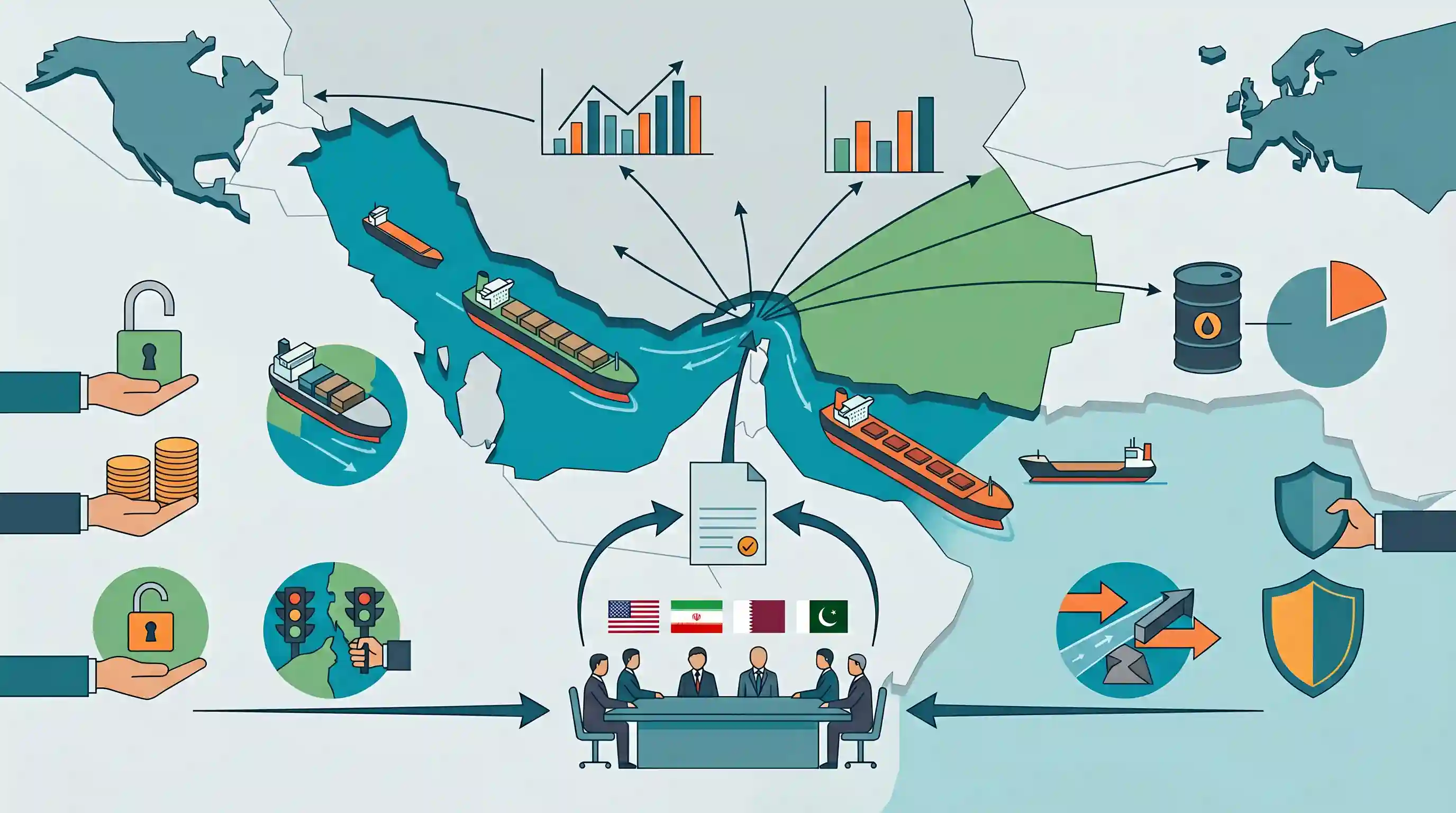
The Strait of Hormuz is one of the world's most vital maritime chokepoints, handling roughly 20% of global oil and LNG trade. Disruptions in this region severely impact global energy security and supply chains, directly affecting energy-importing nations like India through inflated oil prices and economic instability. Furthermore, shifting diplomatic alignments and mediation efforts in West Asia are crucial for understanding global geopolitical dynamics.
Summary
The United States and Iran have entered into technical negotiations in Doha to finalize a peace deal and resume shipping operations in the strategic Strait of Hormuz. The talks, mediated by Qatar and Pakistan, stem from a 14-point interim agreement reached after US-Israeli military strikes on Iran. While Iran's priorities include control over the strait's management and access to $6 billion in frozen assets, the US is focused on ensuring the unimpeded flow of maritime trade. The blockade and regional instability have previously driven up global oil and fuel prices, highlighting the strait's critical role in handling a fifth of the world's oil and LNG supplies.
Key Points
- The US and Iran have initiated technical talks in Doha aimed at securing a lasting peace deal and restarting commercial shipping through the Strait of Hormuz.
- The negotiations build upon a 14-point interim accord established following recent US-Israeli strikes on Iran.
- Qatar and Pakistan are playing key roles as mediators in facilitating the discussions between the two nations.
- Iran's demands include regaining management of the Strait of Hormuz and securing the release of $6 billion in frozen assets.
- The US's primary objective is to restore the free flow of maritime traffic through the strait, a critical chokepoint that handles one-fifth of global oil and liquefied natural gas (LNG).
Important Terms
Strait of Hormuz

A strategic waterway between the Persian Gulf and Gulf of Oman, separating Iran and Oman. It handles roughly one-fifth of global oil and LNG trade.
UPSC context
GS Paper I (Geography) & II (IR). Tests strategic maritime geography and its impact on global energy supply chains.
Hezbollah
A Shia militant organization and political party in Lebanon, backed by Iran. It is a central actor in the "Axis of Resistance" against Israel and Western influence.
UPSC context
GS Paper II (International Relations). Crucial for understanding West Asian instability and the role of non-state actors in regional conflicts.
14-point interim accord
A diplomatic framework (Islamabad Memorandum) aimed at de-escalating US-Iran hostilities, reopening the Strait of Hormuz, and establishing a 60-day window for a final peace deal.
UPSC context
GS Paper II (IR). Relevant for West Asian diplomacy, mediation (Qatar/Pakistan), and transitional security agreements in global flashpoints.
Maritime Chokepoint
Strategic, narrow passages (e.g., Hormuz, Malacca) connecting larger water bodies where traffic can be easily blocked, creating significant economic and security risks.
UPSC context
GS Paper I (World Geography). Tests the intersection of physical geography and global trade security.
Energy Security
The reliable and affordable availability of energy sources. Disruption in major transit routes like Hormuz threatens India's macroeconomic stability and inflation levels.
UPSC context
GS Paper III (Economy/Energy). Vital for India’s development, trade balance, and strategic petroleum reserves (SPR).
Frozen Assets
Financial resources (currently $6 billion for Iran) held by foreign banks and blocked under sanctions, used as diplomatic leverage in negotiations.
UPSC context
GS Paper II (IR). Tests understanding of economic sanctions, international law, and bargaining tools in diplomacy.
Prelims Trap
"Under UNCLOS, Iran can unilaterally suspend passage in the Strait of Hormuz if it threatens national security."
The Strait of Hormuz is governed by 'transit passage', which cannot be suspended by coastal states. This differs from 'innocent passage' in standard territorial waters, which allows temporary suspension.
Static Concepts Connected
What distinguishes 'Transit Passage' from 'Innocent Passage' under UNCLOS?
- Transit Passage: Applies to straits used for international navigation (like Hormuz). It guarantees continuous and expeditious transit and cannot be suspended.
- Innocent Passage: Applies to standard territorial seas. Coastal states can temporarily suspend it for essential security protection.
- Submarine Navigation: Under transit passage, submarines can navigate submerged. Under innocent passage, they must navigate on the surface and show their flag.
How do Middle East maritime blockades impact India's macroeconomic stability?
- Imported Inflation: Spikes in global crude and LNG prices increase freight and domestic fuel costs, driving up headline CPI.
- CAD Widening: Inelastic demand for oil means higher import bills instantly strain forex reserves and widen the CAD.
- Currency Depreciation: Increased dollar demand by Oil Marketing Companies (OMCs) to pay for expensive crude weakens the Indian Rupee.
Cross-Topic Patterns
Rise of Middle-Power Diplomacy
Qatar and Pakistan mediating between the US and Iran highlights a recurring UPSC theme: the shift from US unipolar hegemony to regional middle powers anchoring de-escalation in West Asia.
Maritime Chokepoints & India's SPR
Vulnerability at the Strait of Hormuz directly links to questions on India's energy security and the urgent expansion of the Indian Strategic Petroleum Reserves (ISPRL) to buffer global supply shocks.

Map questions on West Asian straits (Hormuz, Bab-el-Mandeb) paired with UNCLOS transit passage regimes are highly probable for Prelims 2026.
Linked PYQs · 2
Linked PYQs · 2
- 2026PrelimsGS1
Ships from which of the following countries have to cross the Strait of Hormuz to reach out to the Indian Ocean ? 1. Bahrain 2. Syria 3. Qatar 4. Egypt Select the answer using the code given below :
- 2024PrelimsGS1
Consider the following statements : Statement-I : Sumed pipeline is a strategic route for Persian Gulf oil and natural gas shipments to Europe. Statement-II : Sumed pipeline connects the Red Sea with the Mediterranean Sea. Which one of the following is correct in respect of the above statements?
