India and US Unveil Interim Trade Framework for Broad Pact
Source:Indian Express ↗
Why It Matters
Securing favorable trade terms and reducing tariffs with the United States, India's largest trading partner, is crucial for boosting Indian exports, managing the trade deficit, and solidifying a strategic bilateral partnership in an era where global trade is increasingly shifting from multilateralism to bilateralism.
Summary
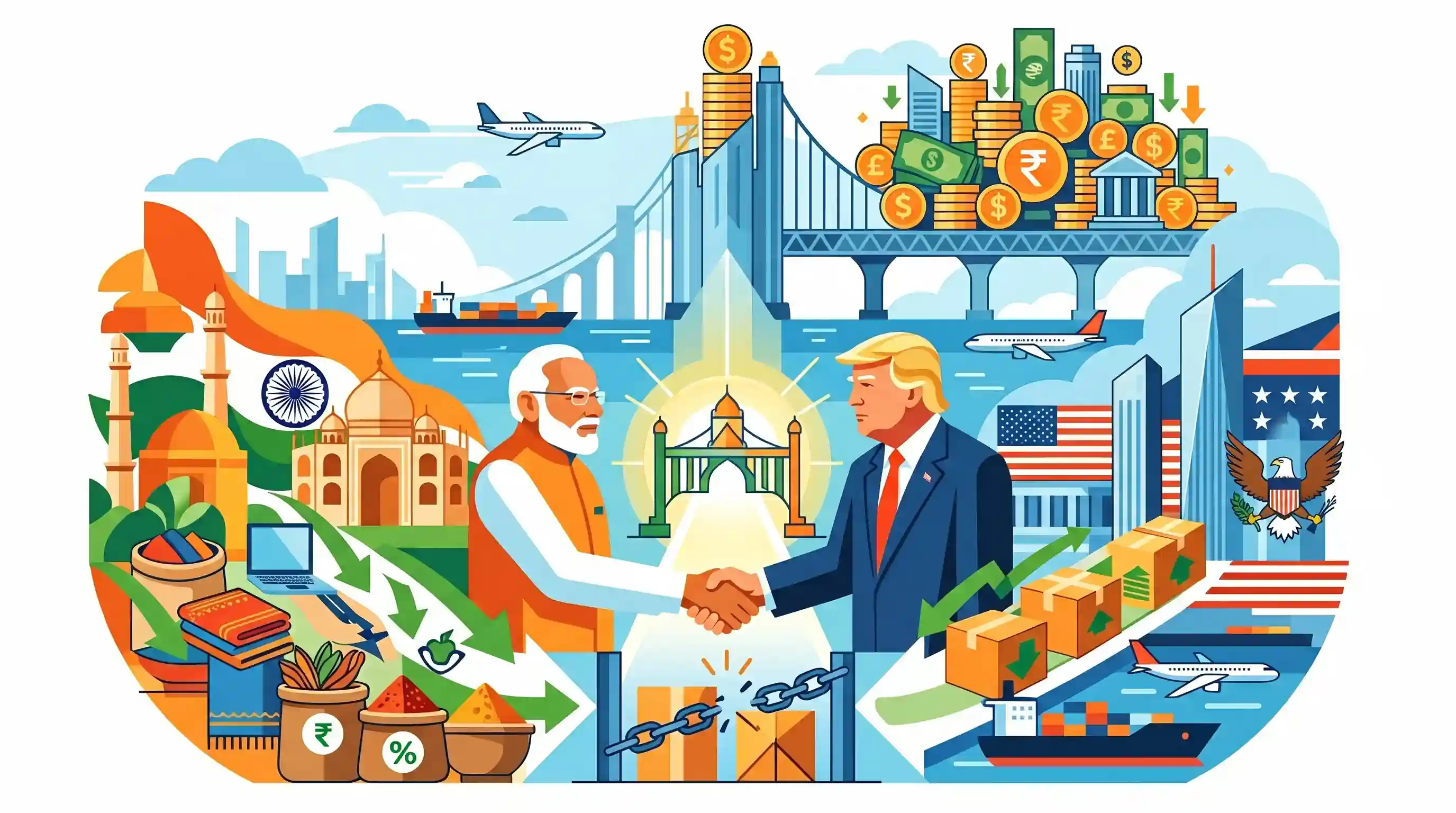
The US and India have announced an interim trade framework that includes substantial tax cuts on Indian goods. This development serves as a foundation for a broader, comprehensive $500 billion trade pact under the leadership of US President Donald Trump and Indian Prime Minister Narendra Modi, reflecting deepening bilateral economic ties.
Key Points
- The US and India have unveiled an interim trade framework, featuring major tax cuts for specific Indian goods.
- The interim agreement acts as a stepping stone toward a broader, comprehensive $500 billion bilateral trade pact.
- The development highlights the deepening economic diplomacy and strategic alignment under the leadership of Donald Trump and Narendra Modi.
- This bilateral move reflects India's strategy to secure key export markets amid a global shift toward protectionism and bilateral trade agreements.
Important Terms
Interim Trade Agreement (ITA)

A preliminary trade pact (often called an 'early harvest' deal) providing immediate tariff relief and market access while a comprehensive Bilateral Trade Agreement is being finalized.
UPSC context
GS Paper II: Bilateral Agreements. Tests understanding of phased trade diplomacy and transitional frameworks in international economic relations.
Bilateral Trade Agreement (BTA)
A comprehensive, legally binding pact between two nations to regulate commerce, eliminate trade barriers, and enhance cooperation across sectors like technology, energy, and services.
UPSC context
GS Paper II & III: International Relations and Indian Economy. Central to discussions on economic diplomacy and foreign trade policy.
Reciprocal Tariffs
A trade policy where a nation matches the import duties of its trading partner to address trade deficits and ensure balanced market competition.
UPSC context
GS Paper III: Indian Economy/Trade. Tests awareness of protectionist trends, tariff equalization, and their impact on global supply chains.
Section 232
A US legal provision allowing the President to restrict imports (like steel or aluminum) if they are deemed a threat to national security.
UPSC context
GS Paper II: International Relations. Relevant for understanding non-commercial justifications for trade barriers and their legal basis in US law.
Non-Tariff Barriers (NTBs)
Trade restrictions not involving taxes, such as complex licensing, stringent technical standards, and sanitary regulations that limit the flow of goods.
UPSC context
GS Paper III: Economy. Tests depth of knowledge regarding ease-of-doing-business and technical hurdles in international trade.
Mission 500
A strategic roadmap to increase India-US annual bilateral trade to $500 billion by 2030 through enhanced market access and procurement.
UPSC context
GS Paper II: Bilateral Relations. Tests knowledge of specific milestones and quantitative targets in India's premier strategic partnerships.
Prelims Trap
India runs a persistent bilateral trade deficit with the United States.
Aspirants often assume India runs a trade deficit with all major partners. However, the US is one of the few major economies where India consistently maintains a significant trade surplus.
Static Concepts Connected
What is the difference between an Early Harvest Scheme and a Comprehensive FTA?
- Early Harvest Scheme: A precursor agreement focused on immediate tariff reductions for a limited, specific set of goods to build trust.
- Comprehensive FTA (CEPA/CECA): A broad agreement covering "substantially all trade" including goods, services, investments, intellectual property, and government procurement.
- WTO Compliance: While FTAs comply with GATT Article XXIV covering substantially all trade, interim/early harvest deals act as stepping stones.
What is the Generalized System of Preferences (GSP) under the WTO?
- Definition: A non-reciprocal preferential tariff system allowing developed countries to offer zero/low tariffs to exports from developing nations.
- Enabling Clause: It is authorized under the 'Enabling Clause' of the GATT, which provides a legal exception to the MFN principle.
- India-US Context: The US withdrew India's GSP status in 2019, citing inadequate and inequitable market access, shifting focus to bilateral FTAs.
Cross-Topic Patterns
Trade agreements linking to critical tech (iCET)
The framework's inclusion of advanced GPU access directly bridges traditional commercial trade with the Indo-US Initiative on Critical and Emerging Technology (iCET), showcasing the modern trade-security nexus.
Trade surpluses and currency manipulation watchlists
India's persistent trade surplus with the US is a double-edged sword; historically, it has led the US Treasury to place India on its 'Currency Monitoring List' regarding foreign exchange interventions.
Supply chain realignment amidst Western protectionism
Securing this US pact allows India to solidify its 'China+1' manufacturing base, hedging against rising Western protectionism and ensuring resilient integration into Global Value Chains (GVCs).

Expect a 2026 Prelims statement linking Indo-US trade surpluses to the WTO's Enabling Clause (GSP) or early-harvest schemes.
Linked PYQs · 2
Linked PYQs · 2
- 2025MainsGS3
What are the challenges before the Indian economy when the world is moving away from free trade and multilateralism to protectionism and bilateralism? How can these challenges be met?
- 2020MainsGS2
What is the significance of Indo-US defence deals over Indo-Russian defence deals? Discuss with reference to stability in the Indo-Pacific region.
