United States and China Tariff Truce and Global Supply Chains
Source:The Hindu ↗
Why It Matters
The US-China trade war heavily impacts global economic stability, inflation, and international supply chains. Understanding the dynamics of tariff wars, protectionism, and control over critical minerals (like rare earths) is essential for analyzing modern great power competition and its cascading effects on India's macroeconomic stability and strategic interests.
Summary
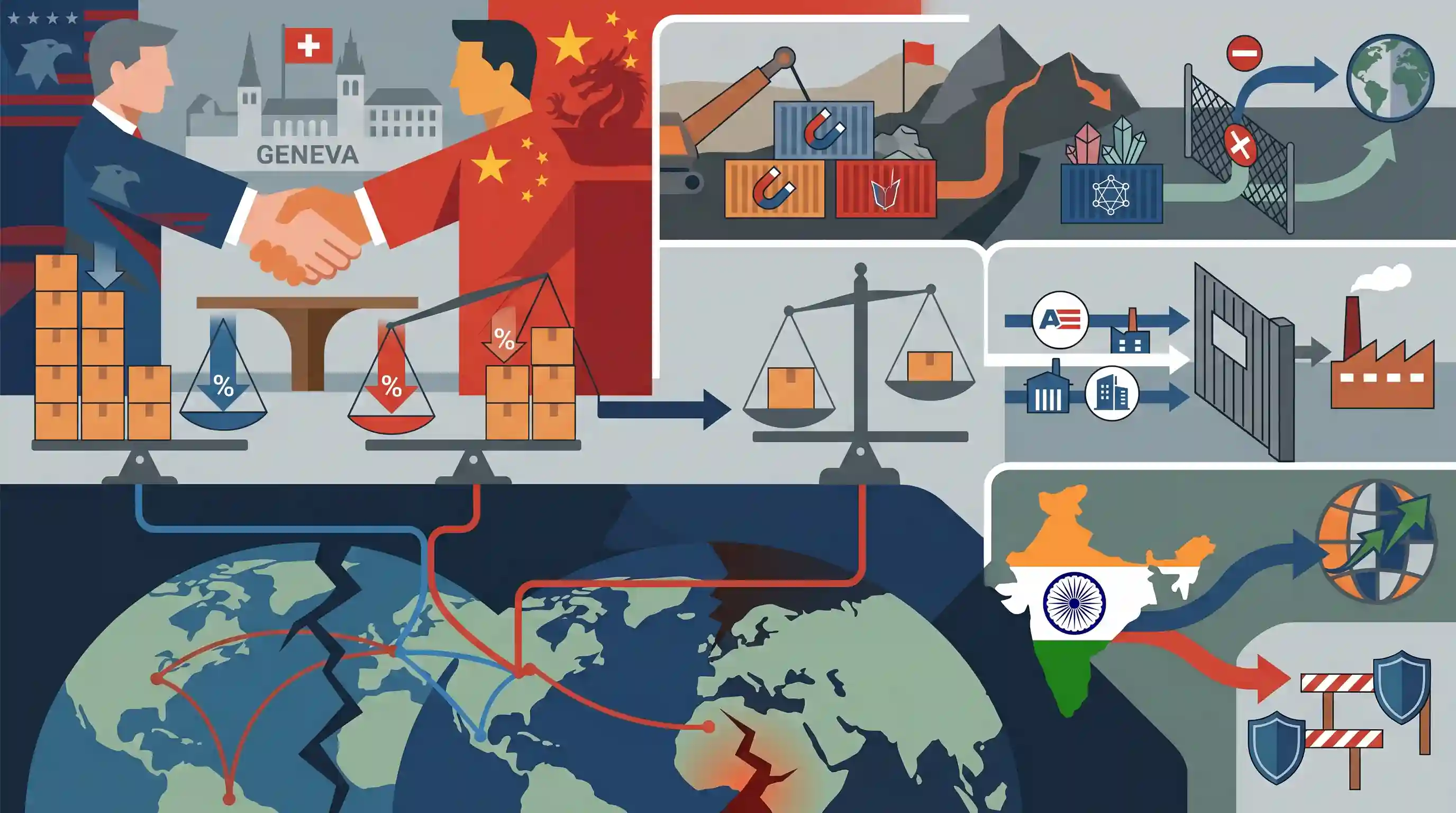
The United States and China have reached a 90-day truce agreement in Geneva to halt an escalating trade war and avert total economic decoupling. Under the deal negotiated by U.S. Treasury and Trade officials, the US will slash its proposed tariffs on Chinese goods by 115 percentage points to 30%, while China will reciprocate by cutting tariffs on US imports to 10%. Crucially, Beijing has also agreed to suspend export controls on vital rare earth materials and lift blocks on American companies. While this temporary "freeze" avoids severe disruptions to global supply chains and the global economy, the underlying structural disputes between the two superpowers remain unresolved.
Key Points
- The United States and China agreed to a 90-day tariff truce during talks in Geneva, temporarily pausing an escalating trade war that threatened complete economic decoupling.
- The US will drastically reduce tariffs on Chinese imports by 115 percentage points (from 145% to 30%), while China reciprocated by cutting tariffs on US goods to 10%.
- As part of the deal, Beijing agreed to suspend its recently imposed export controls on critical rare earth minerals and unblock American businesses.
- The agreement averts immediate global supply chain disruptions and prevents an "embargo" level of taxation, providing short-term relief to the global economy.
- Tensions remain high as the fundamental strategic and economic disputes between the two superpowers require long-term resolution beyond the 90-day freeze.
Important Terms
Rare Earth Materials

Group of 17 chemically similar elements (like Neodymium and Lithium) essential for high-tech manufacturing, green energy, and defense systems; China currently dominates their global processing and refining.
UPSC context
GS Paper 3: Science & Tech / Economy. Tests understanding of critical mineral supply chains and India's resource security vulnerabilities.
Trade War
An economic conflict where countries retaliate by imposing tariffs and trade barriers to protect domestic industries or address trade imbalances, disrupting global supply chains.
UPSC context
GS Paper 2: International Relations. Tests the impact of developed country policies on India's export competitiveness and growth.
Economic Decoupling
The deliberate reduction of economic interdependence between two nations, particularly in technology and manufacturing, to reduce strategic vulnerability.
UPSC context
GS Paper 2: International Relations. Evaluates the shifting global order and India's 'China+1' opportunity to attract manufacturing.
Export Controls
Laws and regulations that restrict the shipment of sensitive goods (like semiconductors or minerals) to foreign countries for national security or economic leverage.
UPSC context
GS Paper 3: Economy / Internal Security. Concerns technology transfers and the weaponization of trade in global geopolitics.
US Trade Representative (USTR)
The primary US government agency responsible for developing trade policy and negotiating bilateral and multilateral trade agreements.
UPSC context
GS Paper 2: International Relations. Relevant for understanding institutional actors in India-US trade negotiations and global trade governance.
Tariffs
A tax or duty imposed by a government on imported goods, used to raise revenue and protect domestic producers from foreign competition.
UPSC context
GS Paper 3: Economy. Tests basic trade concepts and their role in protectionist trends like "America First."
Prelims Trap
"Rare Earth Elements are named so because they are extremely scarce and rarely found in the Earth's crust."
REEs are actually relatively abundant (e.g., cerium is as abundant as copper). They are "rare" because they are rarely found in concentrated, economically viable deposits that are easy to extract.
Static Concepts Connected
What are Rare Earth Elements (REEs) and why are they strategically vital?
- Composition: They comprise 17 elements: 15 lanthanides on the periodic table, plus scandium and yttrium.
- Extraction Challenge: They are highly dispersed and notoriously difficult and environmentally damaging to mine and separate.
- Strategic Applications: They are indispensable for modern technology, including Neodymium for permanent magnets used in EVs, wind turbines, and defense electronics.
What are the primary Trade Remedy measures under the WTO?
- Anti-Dumping Duty (ADD): Imposed to counteract 'dumping' (when a country exports a product at a price lower than its domestic market value).
- Countervailing Duty (CVD): Levied to neutralize the negative effects of specific subsidies provided by the exporting country's government.
- Safeguard Measures: Temporary restrictions applied when a sudden, unforeseen surge in imports threatens to seriously injure a domestic industry.
Cross-Topic Patterns
Rare Earths & Minerals Security Partnership
China's weaponization of export controls on REEs validates the Quad's push for the Minerals Security Partnership (MSP), aiming to build supply chain resilience and break Beijing's monopoly on critical mineral refining.
Trade Wars & Imported Inflation
Bilateral tariff hikes risk global inflation. Consequent interest rate hikes by the US Fed can trigger Foreign Portfolio Investment (FPI) capital flight from emerging markets like India, depreciating the Rupee.
US Tariffs & Indian Product Dumping
Prolonged US-China tariffs often force Chinese excess capacity (like solar panels and steel) to be redirected into alternative developing markets like India, necessitating anti-dumping measures to protect domestic industries.

Expect a 2026 multi-statement question interlinking Rare Earth element composition, China Plus One strategy, and India's API vulnerabilities.
Linked PYQs · 4
Linked PYQs · 4
- 2025MainsGS3
What are the challenges before the Indian economy when the world is moving away from free trade and multilateralism to protectionism and bilateralism? How can these challenges be met?
- 2018MainsGS3
How would the recent phenomena of protectionism and currency manipulations in world trade affect macroeconomic stability of India?
- 2021MainsGS2
“The USA is facing an existential threat in the form of a China, that is much more challenging than the erstwhile Soviet Union.” Explain.
- 2025MainsGS2
"With the waning of globalization, post-Cold War world is becoming a site of sovereign nationalism.” Elucidate.
