US Sanctions on Russian Oil and Withdrawal from Climate Alliance
Source:The Hindu ↗
Why It Matters
This issue touches on two critical pillars of UPSC preparation: India's energy security (balancing cheap Russian crude against US sanctions/tariffs) and India's global climate leadership (the ISA). It provides a perfect case study for questions on 'strategic autonomy' and the 'impact of developed nations' policies on India's interests' in GS2, as well as energy transition challenges in GS3.
Summary
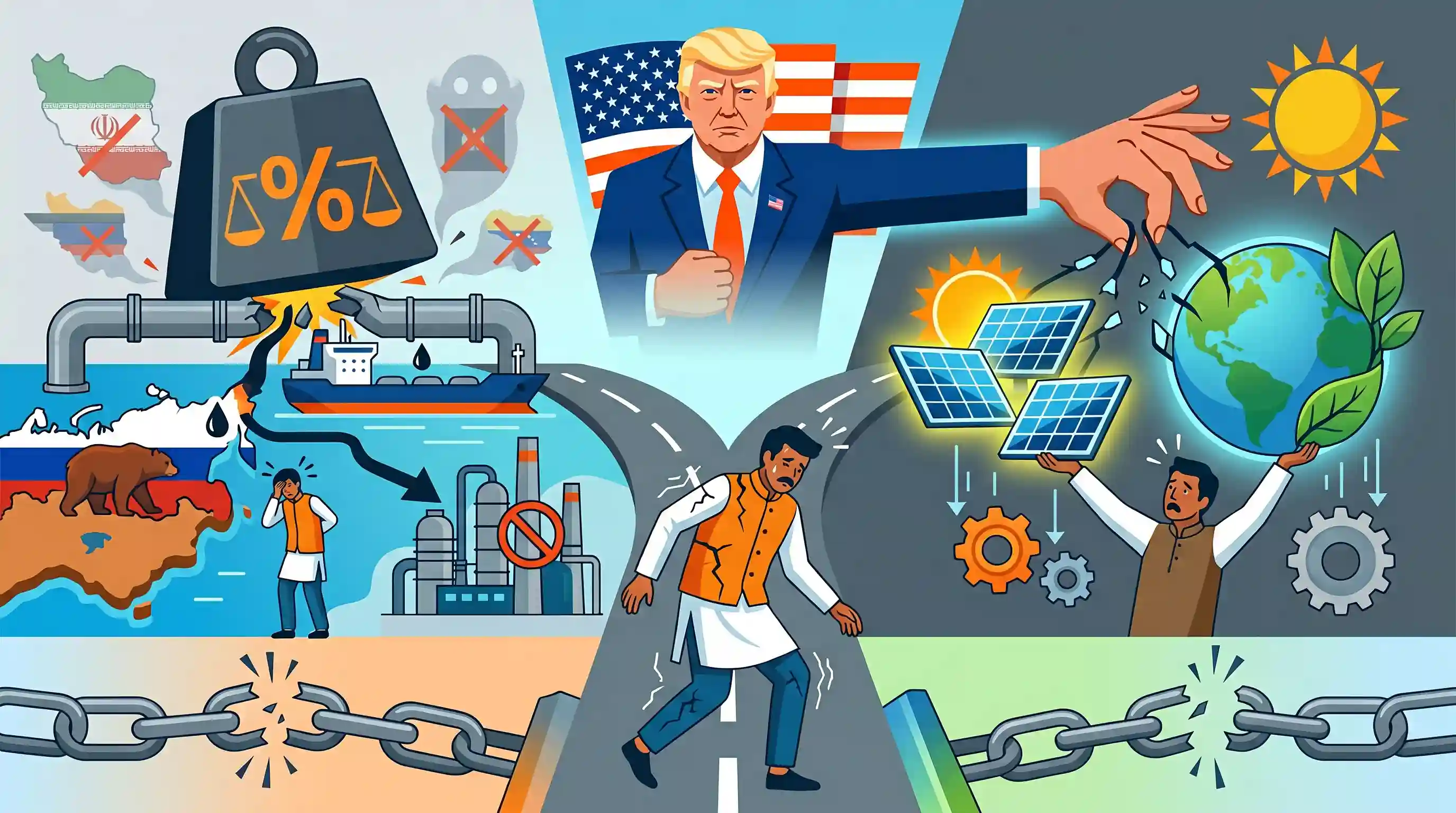
The United States has delivered a dual shock to India's strategic and environmental interests, coinciding with the arrival of US Ambassador-designate Sergio Gor in New Delhi. President Donald Trump signed the Russia Sanctions Act, which slaps a 500% tariff on nations purchasing Russian oil—directly challenging India's energy security and forcing buyers like Reliance Industries to halt purchases. Concurrently, the Trump administration announced its withdrawal from the India-led International Solar Alliance (ISA) and the UNFCCC. These measures severely test India's strategic autonomy, replicating the pressure previously applied on Indian imports from Iran and Venezuela, while simultaneously undermining global multilateral climate commitments.
Key Points
- US President Donald Trump approved the Russia Sanctions Act, imposing a 500% tariff on countries importing Russian oil, heavily impacting major buyers like India, China, and Brazil.
- The US formally withdrew from the India-led International Solar Alliance (ISA) and the UNFCCC, striking a major blow to multilateral climate cooperation.
- The arrival of US Ambassador-designate Sergio Gor in New Delhi coincides with these aggressive policies, signaling that restricting India's Russian oil imports will be a key US diplomatic priority.
- This development mirrors Trump's 2018 term, when immense US pressure forced India to zero out its oil imports from Iran and Venezuela.
- The moves put intense pressure on India's energy security framework—prompting private buyers like Reliance to pause purchases—while testing India's strategic autonomy.
Important Terms
Russia Sanctions Act

Proposed bipartisan U.S. legislation (Sanctioning Russia Act of 2025) authorizing punitive tariffs of at least 500% on countries importing Russian oil, gas, or uranium to restrict Moscow's war revenue.
UPSC context
GS Paper II: Effect of policies of developed countries on India's interests; tests India's energy diplomacy and trade resilience.
International Solar Alliance (ISA)
A treaty-based intergovernmental organization launched by India and France in 2015 to promote solar energy. It is headquartered in Gurugram and aims to mobilize $1 trillion in investments by 2030.
UPSC context
GS Paper II & III: Important International Institutions; India's leadership in global climate action and South-South cooperation.
United Nations Framework Convention on Climate Change (UNFCCC)
The foundational 1992 international treaty established to stabilize greenhouse gas concentrations. It provides the framework for global climate negotiations, including the Paris Agreement and annual COP summits.
UPSC context
GS Paper III: Conservation, Environmental Pollution and Degradation; crucial for understanding multilateral climate governance and U.S.-India climate friction.
Strategic Autonomy
A nation's ability to pursue its own foreign policy and national interests independently, without being forced into alliances or coerced by the dictates of other global powers.
UPSC context
GS Paper II: India's Foreign Policy; central theme in balancing relationships between the U.S. and Russia.
Secondary Sanctions
Trade restrictions that penalize third-party countries or entities for conducting business with a primary sanctioned target, effectively forcing global compliance via threats of losing U.S. market access.
UPSC context
GS Paper II: International Relations; a tool of geoeconomic coercion impacting India’s energy imports from Russia and Iran.
Energy Security
The uninterrupted availability of energy sources at an affordable price. For India, it involves diversifying suppliers to protect against price volatility and geopolitical disruptions.
UPSC context
GS Paper III: Infrastructure: Energy; critical for India's economic growth and vulnerability to global sanction regimes.
Reliance Industries
An Indian multinational conglomerate; its reported decision to halt Russian oil purchases highlights how U.S. tariff threats directly impact India's private sector and refining industry.
UPSC context
GS Paper III: Indian Economy; illustrates the corporate dimension of international sanctions and strategic energy procurement.
Prelims Trap
US sanctions on Russian oil purchases are legally binding on India under international law.
These are unilateral "secondary sanctions" (extraterritorial application of US domestic law), not UN Security Council multilateral sanctions. India legally recognizes only UN-mandated sanctions.
Static Concepts Connected
What distinguishes Secondary Sanctions from UN-mandated sanctions?
- Unilateral vs Multilateral: UN sanctions are binding under international law; secondary sanctions are a single country's domestic laws applied extraterritorially to third-party nations.
- Enforcement mechanism: Enforced by denying foreign entities access to the sanctioning country's domestic financial system, markets, or currency (e.g., the US Dollar).
- Indian stance: India officially maintains that it only recognizes and enforces multilateral sanctions imposed by the UN Security Council, not unilateral secondary sanctions.
What are the key features of the International Solar Alliance (ISA)?
- Genesis: A treaty-based intergovernmental organization jointly launched by India and France on the sidelines of COP21 in Paris (2015).
- Universal Membership: Originally limited to sunshine countries between the Tropics, the framework agreement was amended in 2020 to open membership to all UN member states.
- Primary Objective: Aims to mobilize $1 trillion in solar investments by 2030 and reduce the cost of solar technology and financing globally.
Cross-Topic Patterns
Energy Security & INR Internationalization
Unilateral US tariffs on Russian oil (IR) directly accelerate India's macroeconomic push for Rupee-Ruble bilateral trade settlement and bypassing the SWIFT financial system (Economy).
UNFCCC pullout & Article 6 Markets
The US exiting the UNFCCC fundamentally destabilizes the Paris Agreement architecture, directly threatening the operational viability and financing of Article 6 global carbon credit markets (Environment).

Secondary sanctions (energy) + UNFCCC withdrawal likely form a single 2026 Mains question on the limits of India's strategic autonomy.
Linked PYQs · 5
Linked PYQs · 5
- 2025MainsGS2
"Energy security constitutes the dominant kingpin of India's foreign policy, and is linked with India's overarching influence in Middle Eastern countries.” How would you integrate energy security with India's foreign policy trajectories in the coming years?
- 2017MainsGS2
The question of India's Energy Security constitutes the most important part of India's economic progress. Analyze India's energy policy cooperation with West Asian countries.
- 2021MainsGS3
Explain the purpose of the Green Grid Initiative launched at World Leaders Summit of the COP26 UN Climate Change Conference in Glasgow in November, 2021. When was this idea first floated in the International Solar Alliance (ISA)?
- 2016PrelimsGS1
Consider the following statements: 1. The International Solar Alliance was launched at the United Nations Climate Change Conference in 2015. 2. The Alliance includes all the member countries of the United Nations. Which of the statements given above is/are correct?
- 2010PrelimsGS1
The United Nations Framework Convention on Climate Change (UNFCCC) is an international treaty drawn at
