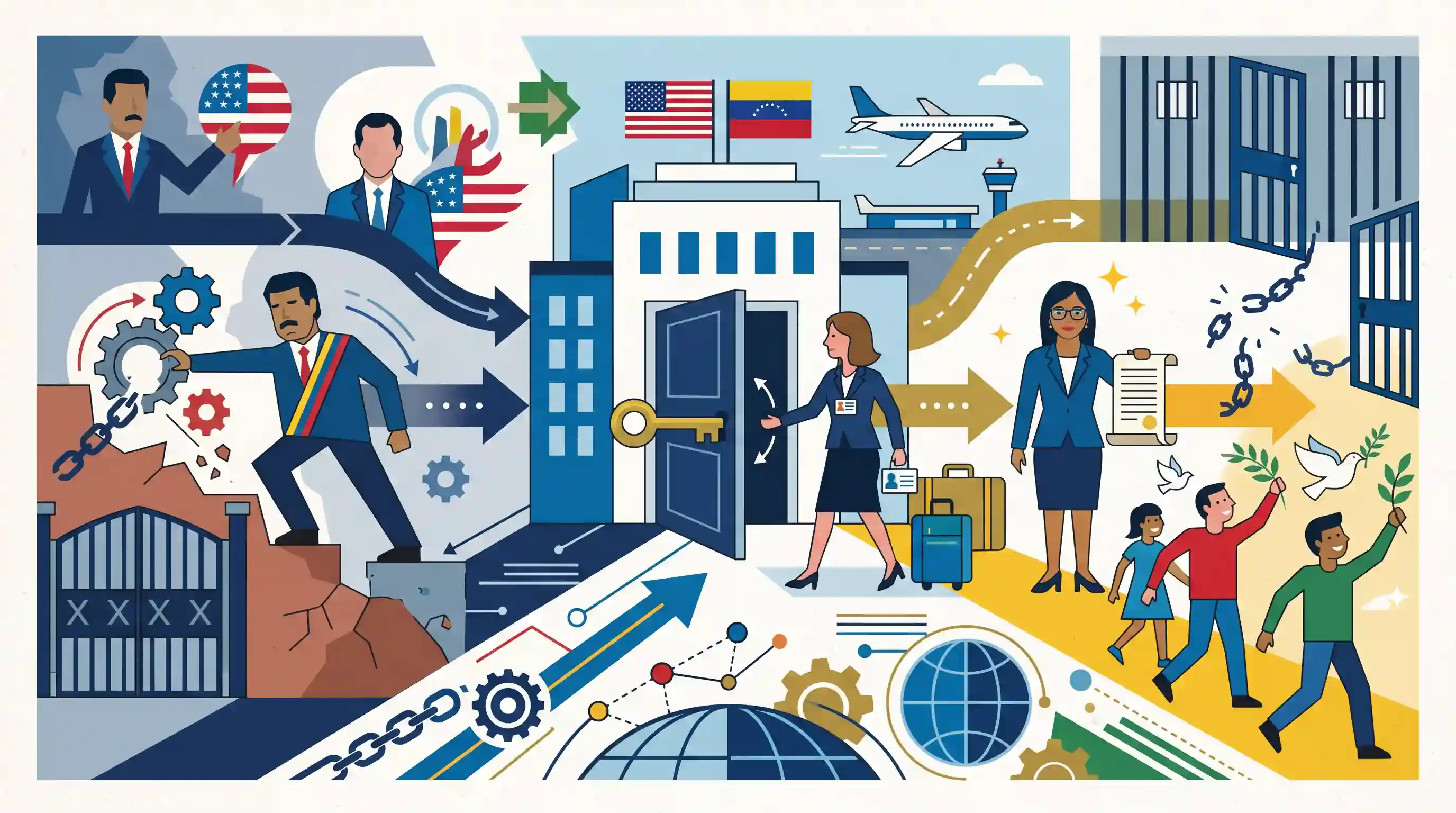
US diplomatic mission reopening in Venezuela after regime change
Source:Indian Express ↗
Why It Matters
The restoration of US-Venezuela diplomatic ties and the forceful removal of Nicolas Maduro signify a dramatic shift in South American geopolitics. Given Venezuela's massive proven oil reserves, this regime change and subsequent diplomatic normalization will have profound impacts on global energy markets. Furthermore, the US military intervention reflects a significant shift in Washington's foreign policy approach to Latin America, directly impacting the broader balance of power and potentially challenging the Russo-Chinese alliances that previously supported the Maduro government.
Summary
The United States has reopened its diplomatic mission in Venezuela after a seven-year hiatus, marked by the arrival of US Ambassador Laura Dogu in Caracas. This development follows a pivotal US-directed military action initiated by President Donald Trump that removed former leader Nicolas Maduro from power. Diplomatic relations were originally severed in February 2019 when the US backed opposition leader Juan Guaido. Alongside the restoration of ties, Venezuela's interim President Delcy Rodriguez has announced an amnesty bill aimed at releasing political prisoners, signaling early steps toward political normalization and addressing key opposition demands.
Key Points
- The US has reopened its diplomatic mission in Caracas, Venezuela, after seven years, with the arrival of Ambassador Laura Dogu.
- The reopening follows a recent US military action ordered by President Donald Trump that successfully removed Nicolas Maduro from office.
- Diplomatic ties were initially severed in February 2019 after the US formally recognized opposition leader Juan Guaido over Maduro.
- Interim Venezuelan President Delcy Rodriguez has announced an amnesty bill to release political prisoners, meeting a primary demand of the opposition.
Important Terms
Amnesty Bill

A legislative act granting a legal pardon for past political offenses, typically used during transitions to democracy to release political prisoners and foster national reconciliation by exempting individuals from criminal liability.
UPSC context
GS Paper II: Governance and Political Systems. Tests understanding of transitional justice and legal mechanisms for resolving internal political conflict.
Global Energy Security
The uninterrupted availability of energy sources at an affordable price. Venezuela's stability is critical as it holds the world's largest proven oil reserves, offering a vital alternative to Middle Eastern supplies.
UPSC context
GS Paper III: Infrastructure and Energy. Tests the link between global geopolitics and India's strategy to diversify crude oil imports.
Monroe Doctrine
A U.S. foreign policy principle (1823) opposing European interference in the Americas. In a modern context, it is often invoked to justify U.S. intervention in Latin American political and security affairs.
UPSC context
GS Paper II: International Relations. Tests knowledge of historical doctrines shaping modern superpower interventions and their impact on regional sovereignty.
Strategic Autonomy
India's foreign policy doctrine of making independent decisions based on national interest without being tethered to any specific power bloc, essential when balancing ties between the U.S. and energy-rich partners.
UPSC context
GS Paper II: Bilateral and Global Groupings. Tests the ability to analyze India's "non-alignment" approach in a shifting multipolar world order.
Diplomatic Normalization
The process of restoring standard diplomatic, economic, and political ties between two nations after a period of hostility or severed relations, often involving the reopening of embassies and exchange of ambassadors.
UPSC context
GS Paper II: International Relations. Tests understanding of the tools of diplomacy and the impact of policy shifts on global stability.
Interim Government
A temporary administration established to manage state affairs during a period of transition, such as following a coup, revolution, or the removal of a leader, until a permanent government is formed.
UPSC context
GS Paper II: International Relations and Governance. Tests understanding of constitutional crises and the international legal recognition of transitional administrations.
Prelims Trap
"Saudi Arabia possesses the world's largest proven crude oil reserves."
Venezuela holds the world's largest proven oil reserves (>300 billion barrels) in its Orinoco Belt. Aspirants mistakenly assume Saudi Arabia holds the top spot due to higher actual production.
Static Concepts Connected
What is ONGC Videsh Limited (OVL) and its footprint in Venezuela?
- Mandate: It is a Miniratna Schedule-A CPSE and the overseas arm of ONGC, tasked with acquiring oil and gas assets outside India.
- Venezuelan Assets: OVL holds a 40% stake in the San Cristobal project and an 11% stake in the Carabobo-1 project, both severely impacted by past US sanctions.
- Strategic Goal: Aims to enhance India's energy security by securing equity oil globally, buffering India against crude price volatility.
How does the UN Charter regulate unilateral use of force and regime change?
- Article 2(4): Prohibits the threat or use of force against the territorial integrity or political independence of any state. Unilateral regime change usually violates this principle.
- Legal Exceptions: Force is only lawful if explicitly authorized by the UN Security Council (Chapter VII) or in an act of self-defense (Article 51).
Cross-Topic Patterns
Energy Security + Extraterritorial Sanctions
With US-Venezuela normalization, the lifting of extraterritorial secondary sanctions on PDVSA will allow Indian refiners to legally resume heavy crude imports, aiding diversification and energy security.
Resource Geography + Latin America Mapping
Venezuela's Orinoco heavy oil belt and Lake Maracaibo frequently appear in Prelims mapping questions, alongside the Andes mountain range which spans seven South American nations.

Expect a multi-statement Prelims question mapping ONGC Videsh's overseas assets (San Cristobal) against the geography of the Orinoco belt.
Linked PYQs · 3
Linked PYQs · 3
- 2024PrelimsGS1
Consider the following statements : Statement-I : Recently, Venezuela has achieved a rapid recovery from its economic crisis and succeeded in preventing its people from fleeing/emigrating to other countries. Statement-II : Venezuela has the world's largest oil reserves. Which one of the following is correct in respect of the above statements?
- 2025PrelimsGS1
Consider the following countries : I. Bolivia II. Brazil III. Colombia IV. Ecuador V. Paraguay VI. Venezuela Andes mountains pass through how many of the above countries?
- 2025MainsGS2
"The reform process in the United Nations remains unresolved, because of the delicate imbalance of East and West and entanglement of the USA vs. Russo-Chinese alliance.” Examine and critically evaluate the East-West policy confrontations in this regard.
