US Grants Restricted Access to Advanced AI Model
Source:The Hindu ↗
Why It Matters
Highlights the ongoing global challenge of regulating dual-use advanced AI technologies, balancing the need for technological advancement and cybersecurity with national security and ethical considerations.
Summary
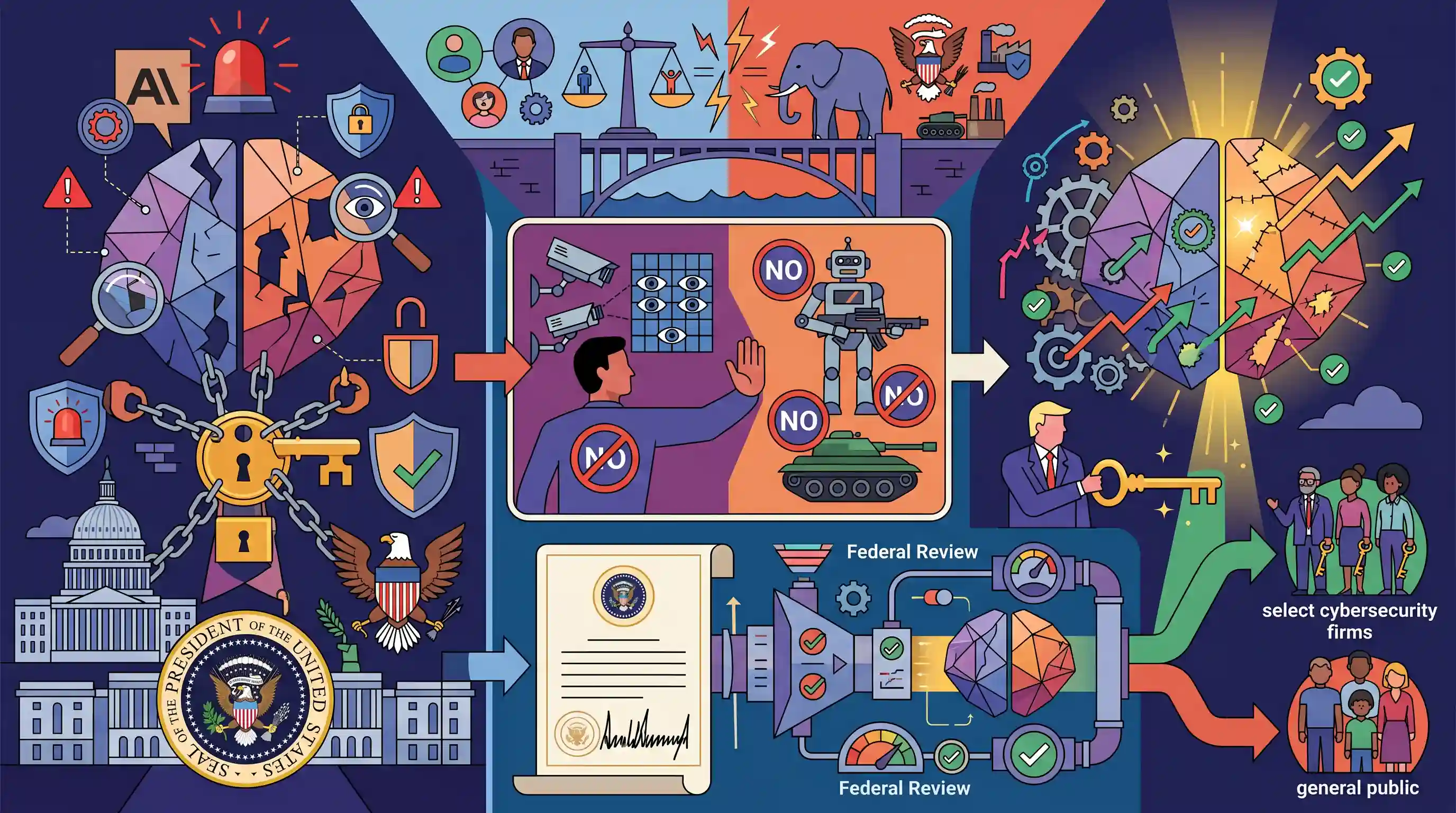
The US government has granted limited authorization for select cybersecurity firms to access Anthropic's powerful 'Mythos 5' AI model. This access had previously been blocked due to national security concerns after vulnerabilities in the model's safeguards were discovered. The Commerce Department noted that Anthropic has since made significant progress in addressing these risks. The development occurs against a backdrop of tension between Anthropic and the Trump administration over the ethical deployment of AI, specifically Anthropic's refusal to permit its technology for mass surveillance and autonomous weapons. Recently, a US executive order was signed to institute a federal review process for evaluating national security risks posed by advanced AI models.
Key Points
- The US government has authorized restricted access to Anthropic's advanced 'Mythos 5' AI model for a select group of cybersecurity firms.
- Access was previously suspended by authorities after discovering vulnerabilities that could bypass safeguards against model misuse.
- Anthropic has faced friction with the Trump administration over its refusal to allow its AI for mass surveillance or autonomous weapons, which led to a canceled Pentagon contract.
- The development aligns with a recent US executive order establishing a federal review process to assess national security risks in advanced AI systems prior to their release.
Important Terms
Anthropic

A US-based AI safety and research company known for its "Claude" and "Mythos" models, emphasizing "Constitutional AI" to ensure ethical behavior and safety guardrails.
UPSC context
GS Paper III (S&T/Ethics) - Tests understanding of private AI safety labs and the ethical challenges in frontier technology development.
Frontier AI Models
Highly advanced, large-scale AI systems (e.g., Mythos 5) with broad capabilities that could pose significant systemic risks to national security or public safety if misused.
UPSC context
GS Paper III (S&T/Internal Security) - Concerns the regulation of emerging technologies and managing high-impact risks from advanced artificial intelligence.
Autonomous Weapons Systems (AWS)
Military systems designed to select and engage targets without direct human intervention; they remain a central point of ethical and legal debate in modern warfare.
UPSC context
GS Paper II (International Relations) and GS Paper IV (Ethics) - Evaluates humanitarian laws, military ethics, and the "human-in-the-loop" requirement.
Export Controls
Government regulations (administered by the Commerce Department) that restrict the transfer of sensitive technologies, like powerful AI models, to prevent them from reaching foreign adversaries.
UPSC context
GS Paper II (IR/Trade) and GS Paper III (Internal Security) - Relates to technological sovereignty and strategic trade authorization regimes.
Department of Commerce (US)
The US executive department responsible for promoting economic growth and regulating sensitive trade, including the enforcement of export controls on "dual-use" technologies like AI.
UPSC context
GS Paper II - Significant for understanding global technology governance, trade disputes, and the regulatory oversight of foreign investments/exports.
Pentagon
Metonym for the US Department of Defense; its push for AI integration in "all lawful purposes" often clashes with AI labs' ethical safety policies.
UPSC context
GS Paper III (Security) - Tests knowledge of military-civil fusion, AI in defense, and state vs. corporate control over security tech.
Prelims Trap
A binding UN framework mandates the national security review of Frontier AI models globally.
Aspirants may confuse state-led regulations (US Executive Orders or the EU AI Act) with UN frameworks. Binding global UN treaties for AI national security reviews do not yet exist; governance remains fragmented.
Static Concepts Connected
What are Lethal Autonomous Weapons Systems (LAWS) and their core ethical concerns?
- Definition: Weapons that independently identify, select, and engage targets without meaningful human intervention or oversight.
- Accountability Vacuum: The difficulty in assigning legal or moral culpability under international humanitarian law when an autonomous machine commits a war crime or civilian harm.
- Escalation Risk: Autonomous systems reacting to each other algorithmically could trigger rapid, unintended military escalation, often termed as 'flash wars'.
What is "Red Teaming" in the context of Artificial Intelligence and Cybersecurity?
- Adversarial Simulation: An adversarial testing process where independent human experts or algorithms proactively emulate attackers to expose system vulnerabilities before public release.
- Bypassing Guardrails: In AI, it involves rigorously testing if foundation models can be tricked into generating harmful code, revealing private data, or violating built-in safety protocols.
Cross-Topic Patterns
Dual-use tech & sovereign control
The shift towards binding state-led reviews of advanced AI parallels the historical regulation of dual-use nuclear technologies, shifting power from private tech giants back to sovereign states.
Algorithmic mass surveillance vs Privacy
Tech firms refusing surveillance contracts echoes the ongoing GS2 debate regarding the proportionality principle of the Puttaswamy judgment in the face of algorithmic national security imperatives.

Expect a GS-4 or GS-3 question evaluating the "accountability vacuum" in Lethal Autonomous Weapons and state regulation of dual-use AI.
Linked PYQs · 3
Linked PYQs · 3
- 2023MainsGS3
Introduce the concept of Artificial Intelligence (AI). How does Al help clinical diagnosis? Do you perceive any threat to privacy of the individual in the use of Al in healthcare?
- 2020PrelimsGS1
With the present state of development, Artificial Intelligence can effectively do which of the following? 1. Bring down electricity consumption in industrial units 2. Create meaningful short stories and songs 3. Disease diagnosis 4. Text-to-Speech Conversion 5. Wireless transmission of electrical energy Select the correct answer using the code given below:
- 2021MainsGS3
Keeping in view India's internal security, analyse the impact of cross-border cyber attacks. Also discuss defensive measures against these sophisticated attacks.
