Macroeconomic Impact of US Russian Oil Waiver for India
Source:The Hindu ↗
Why It Matters
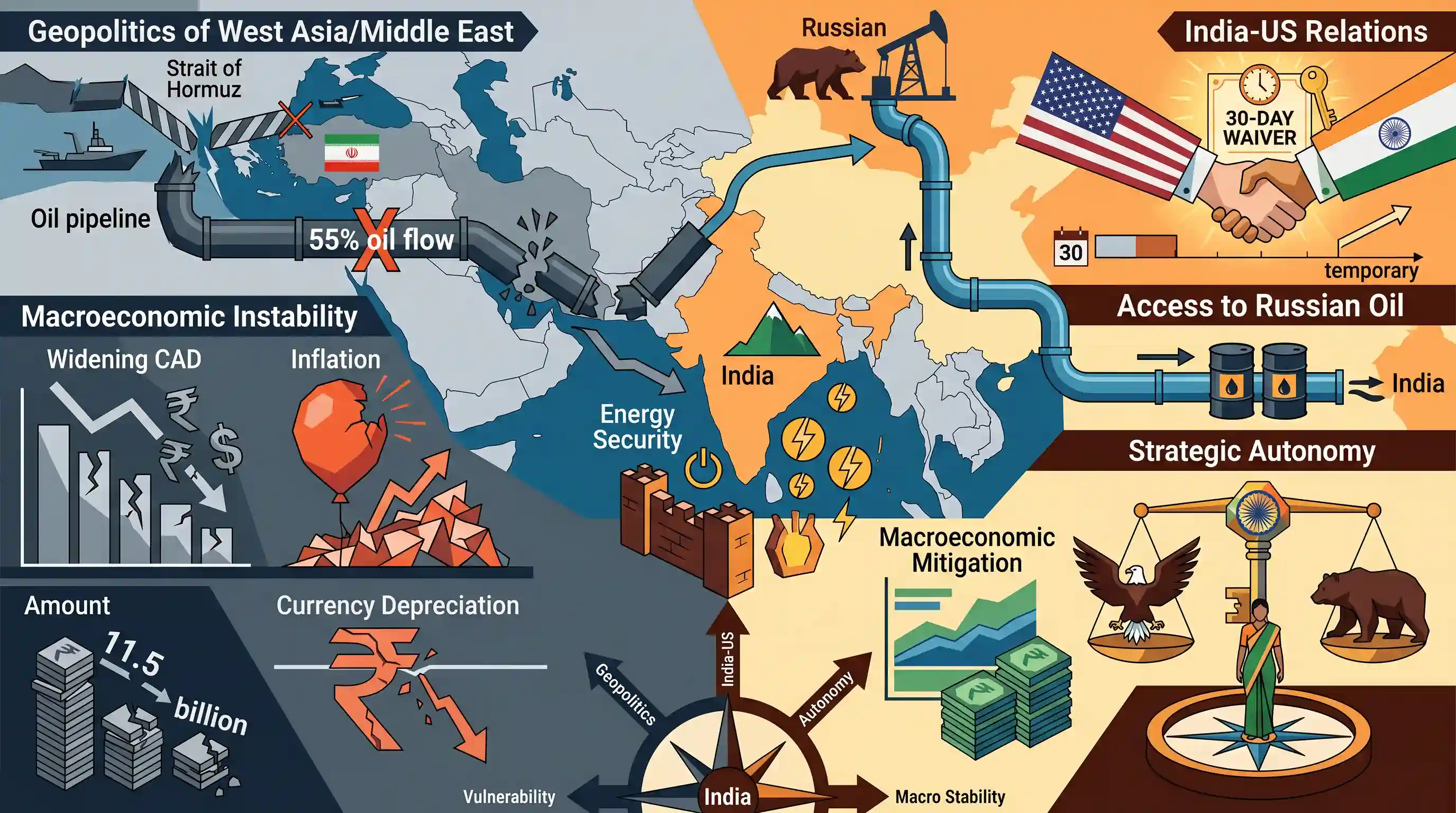
This issue is vital for UPSC aspirants as it bridges International Relations (GS2) with Economy (GS3). It demonstrates how geopolitical events in strategic chokepoints like the Strait of Hormuz directly impact India's macroeconomic stability (Current Account Deficit, inflation, rupee value). It also highlights India's strategic autonomy in balancing its energy security needs amidst great power competition between the US and Russia.
Summary
The United States has temporarily allowed India to import Russian oil for 30 days to alleviate global energy market pressures caused by Iranian disruptions in the Strait of Hormuz. For India, which relies on the Strait for 55% of its oil, this waiver is critical to managing a soaring $11.5 billion monthly oil import bill. Access to Russian oil helps mitigate potential macroeconomic shocks, including a widening Current Account Deficit, inflation, and currency depreciation. The development underscores India's strategic balancing act between securing its energy needs and navigating trade and geopolitical relations with both the US and Russia.
Key Points
- The United States has granted India a temporary 30-day waiver to import Russian oil to ease global energy market pressures.
- The waiver follows Iran's actions to disrupt global energy supplies, particularly around the crucial Strait of Hormuz, which handles 55% of India's oil imports.
- India's monthly oil import bill stands at $11.5 billion; importing Russian oil helps India mitigate the impact of global supply delays and price spikes.
- A sustained spike in Brent crude past $90 per barrel could widen India's Current Account Deficit (CAD) to 1.4% of GDP and depreciate the Rupee.
- Moody's warned that costly energy imports would raise inflation, worsening macroeconomic balances and complicating India's monetary and fiscal policy.
- The move highlights complex US-India dynamics, coming after President Trump reduced tariffs on Indian imports when India had paused direct Russian oil purchases.
Important Terms
Strait of Hormuz

A critical narrow waterway connecting the Persian Gulf to the Gulf of Oman. As a global chokepoint, it handles roughly one-fifth of world oil and half of India's imports.
UPSC context
GS-1 Geography (Chokepoints) and GS-2 (Geopolitics). Tests understanding of India's maritime energy vulnerability and West Asian stability.
Current Account Deficit (CAD)
The shortfall between a country's total earnings from exports and its total expenditure on imports. For India, high oil prices directly widen this deficit, straining forex reserves.
UPSC context
GS-3 Economy. Essential for analyzing Balance of Payments, Rupee stability, and the macroeconomic impact of global commodity shocks.
Strategic Autonomy
A state's ability to make sovereign decisions and pursue national interests in foreign policy without being structurally dependent on or coerced by external powers.
UPSC context
GS-2 International Relations. Evaluates India's foreign policy evolution from Non-Alignment to "multi-alignment" and its strategic balancing between global powers.
Energy Security
The uninterrupted availability of energy sources at an affordable price. It includes diversifying imports, expanding domestic production, and maintaining strategic petroleum reserves to mitigate external supply shocks.
UPSC context
GS-3 Economy/Infrastructure. Vital for discussing India’s developmental resilience, fiscal stability, and long-term energy transition strategies.
US Treasury
The US federal department managing government finances. Its Office of Foreign Assets Control (OFAC) enforces economic sanctions that regulate global trade and impact India’s energy ties with sanctioned nations.
UPSC context
GS-2 International Relations. Tests awareness of the extraterritorial impact of US sanctions on India’s trade and strategic independence.
Moody’s Ratings
A major global agency assessing the creditworthiness of debt issuers. Its sovereign ratings (e.g., Baa3 for India) influence the cost of borrowing and global investor confidence.
UPSC context
GS-3 Economy. Tests understanding of sovereign credit ratings and their role in attracting Foreign Portfolio Investment (FPI) and economic growth.
Prelims Trap
"The Strait of Hormuz connects the Persian Gulf to the Red Sea and is bordered by Iran and Saudi Arabia."
It actually connects the Persian Gulf to the Gulf of Oman (Arabian Sea) and is bordered by Iran and Oman (the Musandam exclave), not Saudi Arabia.
Static Concepts Connected
How do rising global crude oil prices impact India's macroeconomic stability?
- CAD Widening: An inflated oil import bill increases the trade deficit, causing the Current Account Deficit (CAD) to expand as a percentage of GDP.
- Rupee Depreciation: A higher CAD increases the demand for US dollars to pay for imported oil, putting downward pressure on the value of the Indian Rupee.
- Imported Inflation: Costlier crude cascades into higher domestic fuel and freight costs, causing 'imported inflation' and complicating the RBI's price stability mandate.
What are the critical maritime chokepoints for India's energy imports from West Asia?
- Strait of Hormuz: Connects the Persian Gulf to the Gulf of Oman. Handles 55% of India's oil imports. Crucially bordered by Iran and Oman.
- Bab-el-Mandeb: Connects the Red Sea to the Gulf of Aden. Vital for India's broader trade with Europe, bordered by Yemen, Djibouti, and Eritrea.
Cross-Topic Patterns
Energy Security + Strategic Autonomy
India leveraging US waivers to buy Russian oil exemplifies its 'multi-alignment' doctrine, prioritizing domestic macroeconomic stability over strict compliance with zero-sum geopolitical blocs.
Geopolitics + Imported Inflation
Middle East maritime disruptions directly test the RBI's inflation-targeting mandate, demonstrating how external geopolitical shocks can delay or constrain domestic monetary easing.

Expect a 2026 Prelims multi-statement question linking Strait of Hormuz geography directly with CAD and Rupee depreciation dynamics.
Linked PYQs · 5
Linked PYQs · 5
- 2025MainsGS2
"Energy security constitutes the dominant kingpin of India's foreign policy, and is linked with India's overarching influence in Middle Eastern countries.” How would you integrate energy security with India's foreign policy trajectories in the coming years?
- 2017MainsGS2
The question of India's Energy Security constitutes the most important part of India's economic progress. Analyze India's energy policy cooperation with West Asian countries.
- 2020MainsGS2
What is the significance of Indo-US defence deals over Indo-Russian defence deals? Discuss with reference to stability in the Indo-Pacific region.
- 2020PrelimsGS1
The term 'West Texas Intermediate', sometimes found in news, refers to a grade of
- 2022PrelimsGS1
In India, which one of the following is responsible for maintaining price stability by controlling inflation?
