US Operation Epic Fury and Escalating West Asia Conflict
Source:Indian Express ↗
Why It Matters
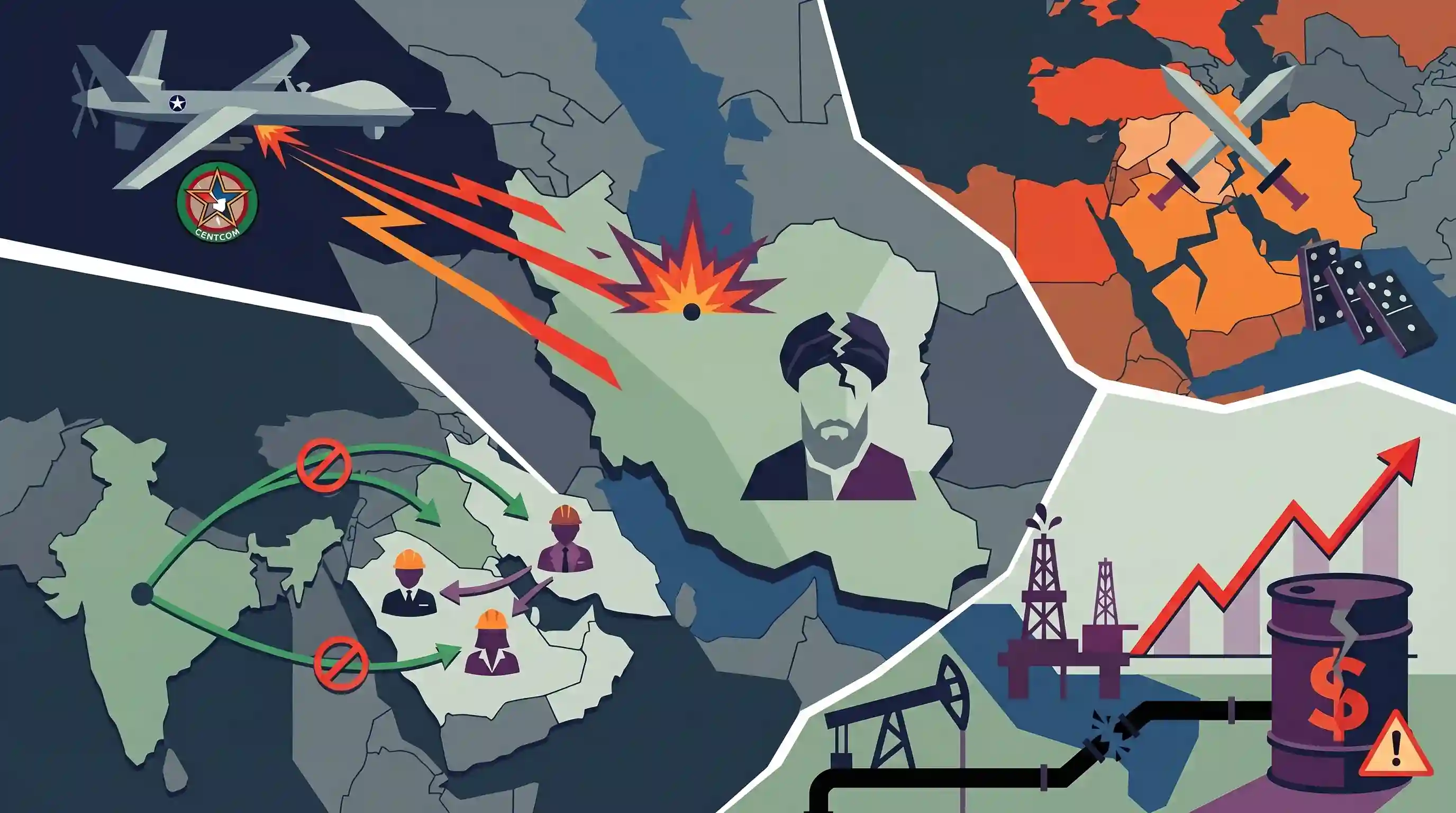
The assassination of Iran's Supreme Leader by the US is a tectonic shift in international relations. For civil services aspirants, it is a critical case study on the fragility of West Asian geopolitics, the immediate cascading impacts on global energy security, and the complex diplomatic tightrope India must walk to protect its diaspora, economic interests, and strategic projects (like Chabahar) in a volatile region.
Summary
The United States, through CENTCOM, launched 'Operation Epic Fury', a series of airstrikes on Iran that resulted in the death of Supreme Leader Ayatollah Ali Khamenei. The unprecedented military action, confirmed by released video footage, signals a drastic escalation in US-Iran hostilities. This event is poised to severely destabilize the Middle East, disrupt global energy markets, and reshape international geopolitical alignments, presenting profound strategic challenges for nations like India reliant on the region for energy and trade.
Key Points
- US forces executed 'Operation Epic Fury', carrying out airstrikes that targeted and killed Iranian Supreme Leader Ayatollah Ali Khamenei.
- CENTCOM released video footage documenting the operation, confirming an unprecedented direct military escalation between the US and Iran.
- The targeted killing fundamentally disrupts the security architecture of the Middle East, drastically increasing the risk of widespread regional conflict and proxy retaliations.
- The crisis poses severe threats to global energy security by potentially disrupting vital shipping lanes like the Strait of Hormuz, likely leading to massive shocks in crude oil prices.
- For India, this extreme volatility endangers its large expatriate population in the Gulf, strategic infrastructural projects like the Chabahar port, and its core energy import dependencies.
Important Terms
United States Central Command (CENTCOM)

One of 11 unified combatant commands of the US Department of Defense, overseeing military operations in the Middle East, Central Asia, and parts of South Asia.
UPSC context
GS Paper 2 & 3: Crucial for understanding US military posture in India's extended neighborhood and regional security dynamics.
Operation Epic Fury
The 2026 US-Israeli joint military campaign launched against Iran, targeting its leadership, nuclear infrastructure, and missile facilities, resulting in the death of the Supreme Leader.
UPSC context
GS Paper 2: Contemporary international event testing knowledge of West Asian geopolitics and the escalation of US-Iran hostilities.
Ayatollah Ali Khamenei
The highest political and religious authority in Iran since 1989, serving as the ultimate decision-maker in the country's clerical-political system.
UPSC context
GS Paper 2: Vital for analyzing Iranian political structure and the implications of leadership transitions on India-Iran relations.
Strait of Hormuz
A strategic maritime chokepoint between the Persian Gulf and Gulf of Oman, carrying approximately 20-30% of global oil trade, including major Indian imports.
UPSC context
GS Paper 1 & 3: Essential for geography and energy security topics regarding global trade routes and India's economic vulnerabilities.
Energy Security
The assurance of consistent and affordable energy supplies, a critical challenge for India due to its high dependence on West Asian oil and gas imports.
UPSC context
GS Paper 3: Core topic for economic development, strategic petroleum reserves, and the impact of geopolitical shocks on inflation.
Indian Diaspora
The over 9 million Indian nationals living and working in West Asia, whose safety and remittances are vital to India's domestic and foreign policy.
UPSC context
GS Paper 2: Relevant for questions on the role of diaspora in international relations and the government's citizen-protection responsibilities.
Chabahar Port
A strategic deep-sea port in Iran developed with Indian investment to provide a trade corridor to Afghanistan and Central Asia, bypassing Pakistan.
UPSC context
GS Paper 2: Tests knowledge of India's connectivity projects and the strategic risks posed by regional conflict to national assets.
Strategic Autonomy
A foreign policy doctrine where a state maintains independent decision-making and avoids becoming overly dependent on any single power or alliance.
UPSC context
GS Paper 2: A recurring concept in UPSC exams regarding India's non-aligned legacy and contemporary balancing between global powers.
Prelims Trap
Chabahar Port is located in the Persian Gulf, making it highly vulnerable to blockades in the Strait of Hormuz.
Chabahar is located on the Makran coast in the Gulf of Oman, outside the Strait of Hormuz. This insulates its maritime access from direct blockades of the strait.
Static Concepts Connected
What are the key maritime chokepoints in West Asia?
- Strait of Hormuz: The critical waterway connecting the Persian Gulf to the Gulf of Oman and the Arabian Sea, transiting roughly 20% of global oil consumption.
- Bab el-Mandeb: The strategic strait connecting the Red Sea to the Gulf of Aden, serving as the southern gateway to the Suez Canal.
Why is the Chabahar Port strategically critical for India's foreign policy?
- Bypassing Pakistan: Provides India direct maritime-land access to Afghanistan and resource-rich Central Asia without relying on Pakistani land routes.
- INSTC Hub: Serves as a vital geopolitical and commercial node in the International North-South Transport Corridor (INSTC), linking India to Eurasia.
- Countering Gwadar: Acts as a strategic counterweight to China's deep-sea presence at Pakistan's Gwadar port, located just 170 km away.
Cross-Topic Patterns
Oil shocks and Current Account Deficit
A spike in crude oil prices inflates India's import bill, widening the Current Account Deficit (CAD) and driving imported inflation, heavily impacting the RBI's monetary policy.
Gulf instability and Diaspora Evacuations
With 9 million Indians in the Gulf, regional escalations severely stress India's non-combatant evacuation capabilities, recalling past crisis responses like Operation Rahat and Operation Ajay.

West Asian chokepoints, INSTC routing, and the economic impact of crude oil shocks will likely merge into a core 2026 IR/Economy question.
Linked PYQs · 3
Linked PYQs · 3
- 2025MainsGS2
"Energy security constitutes the dominant kingpin of India's foreign policy, and is linked with India's overarching influence in Middle Eastern countries.” How would you integrate energy security with India's foreign policy trajectories in the coming years?
- 2017MainsGS2
The question of India's Energy Security constitutes the most important part of India's economic progress. Analyze India's energy policy cooperation with West Asian countries.
- 2024PrelimsGS1
Consider the following statements : Statement-I : Sumed pipeline is a strategic route for Persian Gulf oil and natural gas shipments to Europe. Statement-II : Sumed pipeline connects the Red Sea with the Mediterranean Sea. Which one of the following is correct in respect of the above statements?
