US Government Shutdown Impact on Aviation Infrastructure Security
Source:Indian Express ↗
Why It Matters
The article serves as a powerful case study for UPSC aspirants on how governance gridlocks (like government shutdowns) directly compromise critical infrastructure, public safety, and institutional quality. It also highlights the ethical and practical implications of forcing essential public servants to work under high-stress conditions without compensation.
Summary
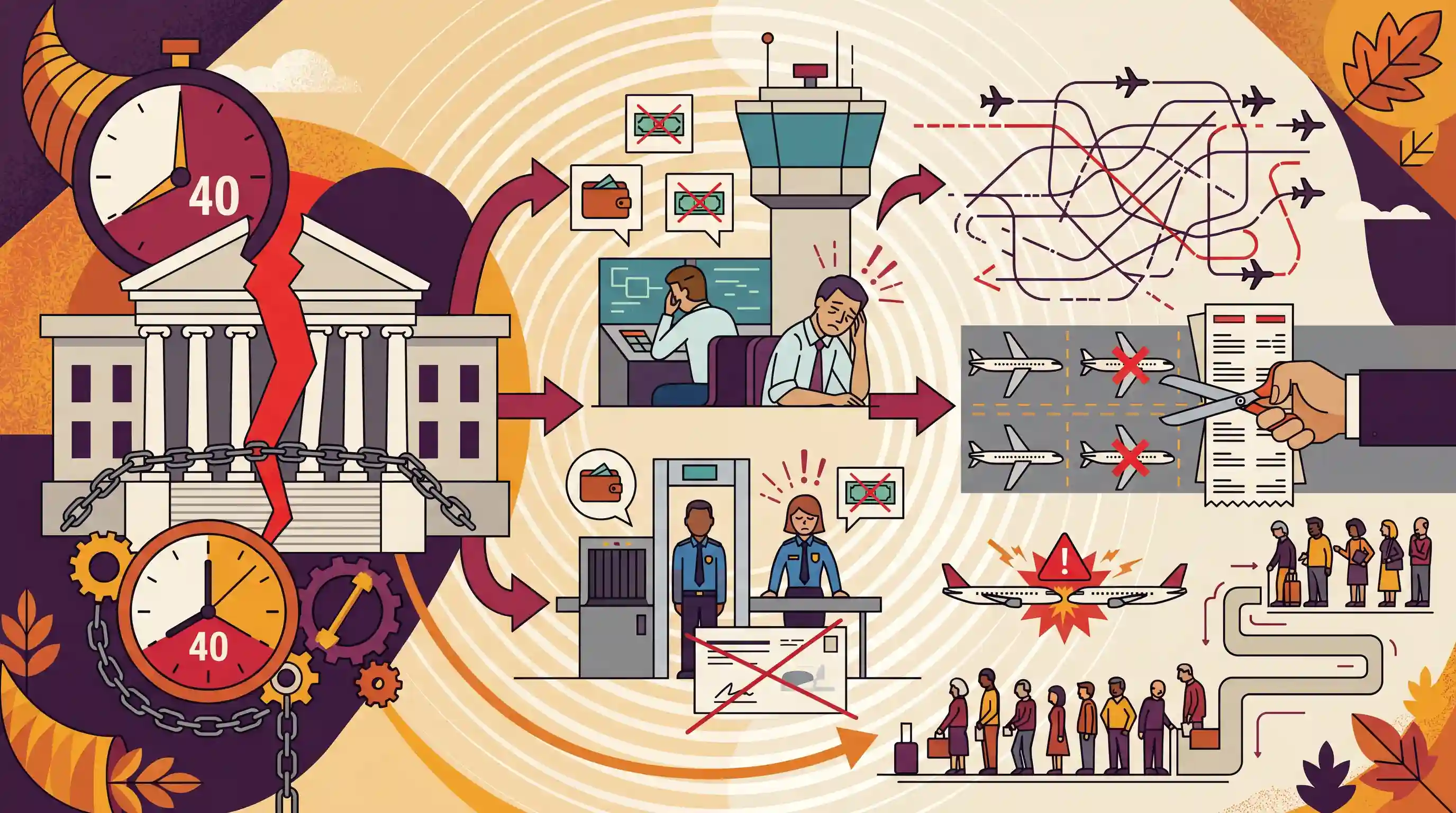
A prolonged 40-day US federal government shutdown has severely disrupted the nation's aviation infrastructure ahead of the busy Thanksgiving holiday. With tens of thousands of air traffic controllers and security screeners forced to work without pay, the system is facing acute staffing shortages, surging early retirements, and alarming fatigue levels among essential workers. Consequently, the Federal Aviation Administration (FAA) has mandated significant flight cuts to mitigate safety risks following over 500 pilot reports of controller errors. The crisis underscores the cascading impact of political stalemates on critical economic infrastructure and public safety.
Key Points
- A record 40-day US federal government shutdown has forced 13,000 air traffic controllers and 50,000 security screeners to work without pay, precipitating a crisis in the aviation sector.
- The Federal Aviation Administration (FAA) was forced to mandate staggered daily flight cuts (reaching up to 10%) to manage acute staffing shortages and maintain air safety.
- The crisis has triggered a surge in early retirements among controllers (jumping from 4 to 15-20 per day), severely depleting institutional capacity.
- Extreme fatigue and low morale among unpaid essential workers have led to over 500 safety reports from pilots citing controller errors, posing significant public safety risks.
- The situation exemplifies how political gridlocks and governance failures can cripple critical national infrastructure and economic arteries.
Important Terms
Federal Aviation Administration (FAA)

The U.S. government agency responsible for regulating all aspects of civil aviation, including safety standards, pilot certification, and air traffic management.
UPSC context
GS Paper 2 & 3; relevant for studying international regulatory models and civil aviation safety (comparable to India's DGCA).
Government Shutdown
A situation in the U.S. where federal agencies must suspend non-essential operations because Congress has failed to pass appropriation bills to fund them.
UPSC context
GS Paper 2 (Governance/Polity); tested via comparative analysis of budgetary processes and the impact of political deadlock on administration.
Critical Infrastructure
Physical and cyber systems and assets so vital to a nation that their incapacity would have a debilitating impact on national security or economic stability.
UPSC context
GS Paper 3; central to topics on infrastructure, security, and the economic impact of service disruptions in key sectors.
Air Traffic Control (ATC)
A service provided by ground-based personnel to direct aircraft in flight and on the ground to prevent collisions and manage the flow of air traffic.
UPSC context
GS Paper 3; falls under infrastructure and technology, specifically safety management in the aviation industry.
Essential Services
Functions of the state deemed so critical that they must continue even during funding lapses to ensure public safety, health, and national security.
UPSC context
GS Paper 2 & 4; relates to the legal and ethical obligations of the state and public servants during crises.
Public Service Ethics
The moral principles and standards that guide the conduct of government employees, particularly during administrative crises such as working without pay or resource shortages.
UPSC context
GS Paper 4 (Ethics); tests the balance between professional duty, personal hardship, and public safety during political stalemates.
Prelims Trap
"Failure to pass the Union Budget in India leads to a temporary 'government shutdown' until parliamentary consensus is reached."
In India's parliamentary system, the defeat of the Budget in the Lok Sabha signifies a loss of majority, forcing the resignation of the Council of Ministers, not a temporary administrative 'shutdown'.
Static Concepts Connected
How does executive accountability differ between India and the US regarding budget passage?
- Strict Separation: The US executive is independent of the legislature; budget gridlock causes administrative shutdowns but the President does not fall.
- Collective Responsibility: In India, the executive is drawn from and responsible to the legislature. Defeating a budget amounts to a no-confidence vote.
- Government Collapse: If the Appropriation Bill is defeated in the Lok Sabha, the Prime Minister and Council of Ministers must resign.
How does the Indian Constitution prevent funding gaps pending budget approval?
- Constitutional Mandate: Article 114 mandates that no money can be withdrawn from the Consolidated Fund without parliamentary approval.
- Vote on Account: Article 116 allows the Lok Sabha to grant advance money for estimated government expenses for a part of the financial year.
- Prevention of Shutdowns: This mechanism ensures essential administrative services never halt due to pending legislative procedures, preventing US-style shutdowns.
Cross-Topic Patterns
Government Gridlock & Public Service Ethics
The US crisis highlights the GS4 theme of "dedication to public service," examining the ethical dilemma civil servants face when forced to maintain critical public safety infrastructure without remuneration.
Political Systems Impacting Infrastructure
Demonstrates how rigid separation of powers (US model) can lead to legislative paralysis, cascading directly into critical infrastructure vulnerabilities—a contrast highly useful for GS2 comparative constitution answers.

Expect a GS2 Mains question comparing the US strict separation of powers (causing shutdowns) with India's parliamentary accountability.
Linked PYQs · 3
Linked PYQs · 3
- 2021MainsGS3
“Investment in infrastructure is essential for more rapid and inclusive economic growth.” Discuss in the light of India's experience.
- 2020MainsGS2
Institutional quality is a crucial driver of economic performance". In this context suggest reforms in Civil Service for strengthening democracy.
- 2021MainsGS4
Identify ten essential values that are needed to be an effective public servant. Describe the ways and means to prevent non-ethical behaviour in the public servants.
