India US Agricultural Trade Agreement and Market Access
Source:Indian Express ↗
Why It Matters
Helps understand the economic dimensions of the India-US strategic partnership. Trade agreements directly impact domestic sectors (like agriculture) and require a balance between international diplomacy and local interests, making it highly relevant for GS2 (Bilateral Relations) and GS3 (Agriculture & Economy).
Summary
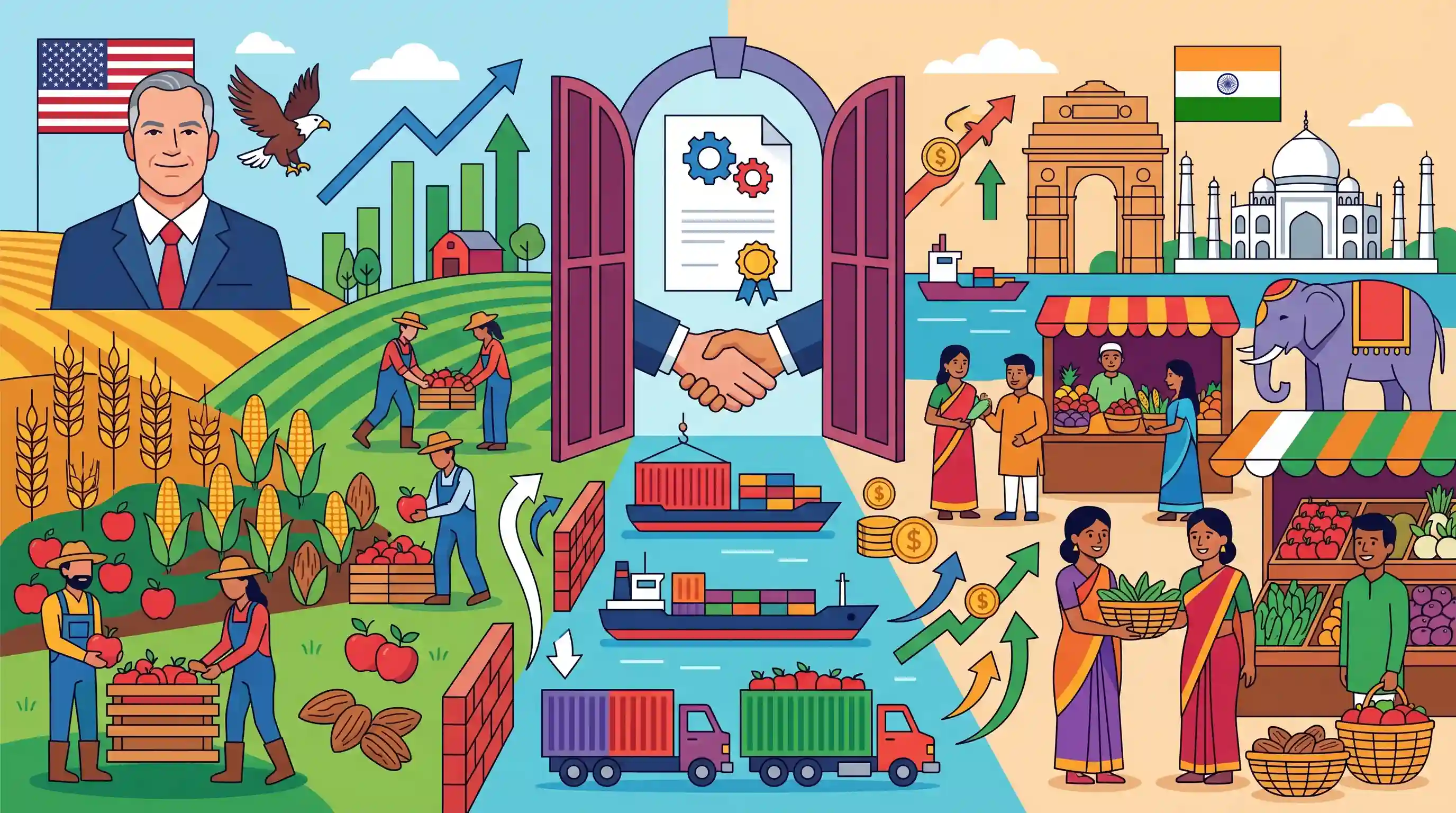
US Agriculture Secretary Brooke Rollins lauded a new trade agreement that provides enhanced market access for American agricultural products in India. The deal aims to boost economic gains for rural America, reflecting significant progress in easing trade frictions and strengthening India-US bilateral trade relations.
Key Points
- The US and India have reached a trade understanding aimed at improving market access for US agricultural exports to India.
- US Agriculture Secretary Brooke Rollins highlighted the economic benefits of this deal for rural American communities, framing it as bringing 'cash into rural America.'
- The agreement signifies a positive step in resolving bilateral trade frictions, which have historically included disputes over agricultural tariffs and non-tariff barriers.
- The development underscores the role of agricultural diplomacy in the broader strategic and economic partnership between the United States and India.
Important Terms
India-US Bilateral Trade Relations

The exchange of goods and services between India and the United States, currently a strategic partnership aimed at reaching a $500 billion trade volume by 2030.
UPSC context
GS Paper II (International Relations); tests understanding of bilateral groupings and trade-related impacts on India's interests.
Market Access
The ability of a nation to sell products in foreign markets, determined by the reduction of tariffs and removal of non-tariff barriers like quotas and technical standards.
UPSC context
GS Paper III (Economy); tests knowledge of trade liberalization and its effect on domestic sectors like agriculture.
World Trade Organization (WTO)
An international body governing global trade rules between nations, facilitating negotiations, and settling disputes to ensure commerce remains stable, predictable, and fair.
UPSC context
GS Paper III (External Sector); tests knowledge of international institutions and their impact on India’s economic sovereignty.
Agreement on Agriculture (AoA)
A WTO treaty establishing rules for agricultural trade through three pillars: market access, domestic support (subsidies), and export competition to ensure a fairer global market.
UPSC context
GS Paper III (Agriculture); essential for understanding "box" subsidies (Amber, Blue, Green) and food security debates.
Non-Tariff Barriers (NTBs)
Trade restrictions other than taxes, such as sanitary and phytosanitary (SPS) standards, technical regulations, or licensing requirements that can hinder foreign market entry.
UPSC context
GS Paper III (Trade); tests understanding of subtle trade protectionism and its impact on Indian agricultural exports.
Economic Diplomacy
The use of economic resources and tools, such as trade agreements and investment promotion, to achieve national interests and influence international relations.
UPSC context
GS Paper II (IR); focuses on how trade agreements serve broader strategic and geopolitical national interests.
US Department of Agriculture (USDA)
The US federal department responsible for farming and food laws, which leads agribusiness trade missions to expand market opportunities for American producers globally.
UPSC context
GS Paper II (Bilateral Relations); identifies the key executive agency negotiating farm market access in India.
Prelims Trap
"Recent US-India agricultural trade disputes were resolved through rulings by the WTO Appellate Body."
India and the US mutually terminated their outstanding WTO disputes through bilateral negotiations (Trade Policy Forum), bypassing the currently paralyzed WTO Appellate Body.
Static Concepts Connected
What are Sanitary and Phytosanitary (SPS) measures under the WTO?
- Core Purpose: Regulations designed to protect human, animal, or plant life from risks arising from additives, toxins, or pests in agricultural imports.
- Non-Tariff Barrier: Often utilized as non-tariff barriers, SPS measures must be based on verified scientific principles to prevent disguised protectionism.
- WTO Framework: Governed by the WTO’s specific Agreement on the Application of Sanitary and Phytosanitary Measures, which encourages adherence to international standards.
What is the India-US Trade Policy Forum (TPF)?
- Institutional Mechanism: It is the premier bilateral institutional mechanism tasked with resolving mutual trade and investment issues between India and the United States.
- Working Groups: It operates through specific working groups covering agriculture, non-tariff barriers, services, investment, and innovation.
- Strategic Significance: It has become the primary vehicle for negotiating market access deals and bypassing protracted multilateral litigation at the WTO.
Cross-Topic Patterns
WTO Paralysis & shift to Bilateralism
The mutual termination of WTO disputes to secure this market access deal highlights how nations are actively shifting to bilateral mechanisms (like the TPF) due to the ongoing paralysis of the WTO Appellate Body.
Agri-diplomacy vs Domestic supply chains
Easing tariffs on competitive US farm products (like apples and almonds) directly links international diplomacy to domestic pressures, requiring India to rapidly strengthen cold-storage infrastructure to protect local farmer competitiveness.

Expect a 2026 Prelims question contrasting WTO's Sanitary & Phytosanitary (SPS) measures with Technical Barriers to Trade (TBT).
Linked PYQs · 3
Linked PYQs · 3
- 2019MainsGS2
‘What introduces friction into the ties between India and the United States is that Washington is still unable to find for India a position in its global strategy, which would satisfy India's national self-esteem and ambitions.’ Explain with suitable examples.
- 2023MainsGS3
What are the direct and indirect subsidies provided to farm sector in India? Discuss the issues raised by the World Trade Organization (WTO) in relation to agricultural subsidies.
- 2015PrelimsGS1
The terms 'Agreement on Agriculture', 'Agreement on the Application of Sanitary and Phytosanitary Measures' and 'Peace Clause' appear in the news frequently in the context of the affairs of the
