Global Nuclear Non Proliferation and CTBT Compliance
Source:The Hindu ↗
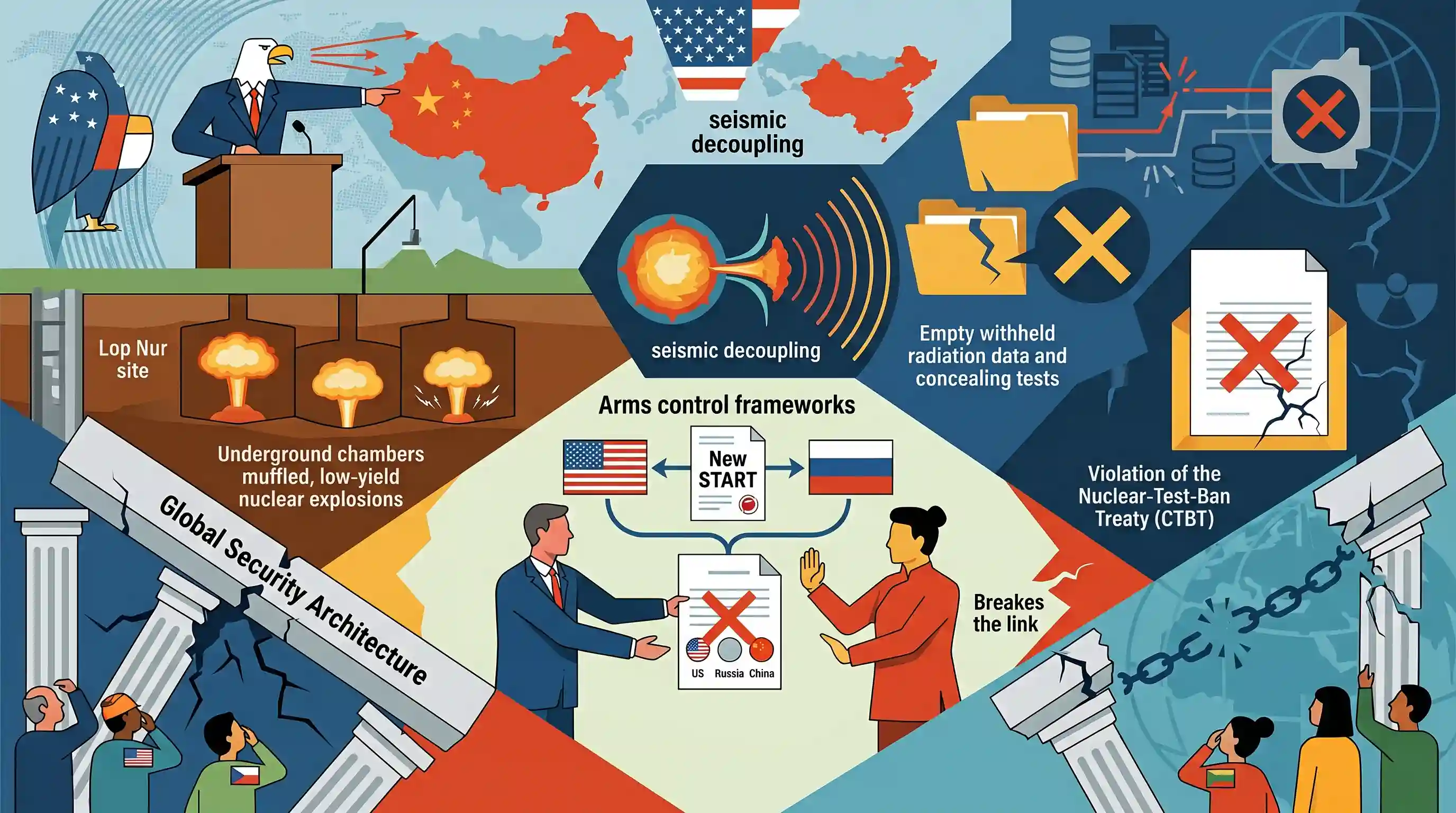
Why It Matters
Demonstrates the evolving fragility of global arms control treaties (like New START and CTBT) as bipolar US-Russia frameworks struggle to accommodate a rising, nuclear-armed China. This changing balance of power and treaty enforcement directly impacts India's strategic environment and non-proliferation stance.
Summary
The US has formally accused China of conducting secret, low-yield nuclear explosive tests throughout 2020, claiming it violated international commitments under the Comprehensive Nuclear-Test-Ban Treaty (CTBT). Speaking at the UN Conference on Disarmament, US representatives alleged that China used seismic decoupling techniques and withheld radiation data to conceal tests at its Lop Nur site. Beyond the test ban violations, the US highlighted the need to replace the US-Russia New START treaty with a new trilateral arms control framework that includes Beijing. However, China has refused to join these multi-party disarmament talks, highlighting the growing complexity and fracturing trust within global nuclear non-proliferation regimes.
Key Points
- The US accused China of conducting secret, low-yield nuclear tests on June 22, 2020, violating the 'zero yield' standard of the CTBT.
- China allegedly utilized 'decoupling' techniques to obscure the seismic data of these explosions and withheld information from international monitoring stations.
- The US has urged replacing the expiring bilateral New START treaty with a trilateral arms control agreement that includes China.
- China continues to refuse participation in three-way nuclear disarmament talks, emphasizing structural shifts in US-China-Russia arms control dynamics.
Important Terms
Comprehensive Nuclear-Test-Ban Treaty (CTBT)

A multilateral treaty banning all nuclear explosions for civilian or military purposes in all environments. Adopted in 1996, it remains "not in force" as key nations (including India) haven't ratified it.
UPSC context
GS Paper-II (International Treaties); tests knowledge of India's principled opposition to discriminatory treaties and global security architecture.
New START Treaty
A bilateral arms control treaty between the US and Russia limiting deployed strategic nuclear warheads (1,550) and launchers. It is the last remaining binding nuclear pact between them, expiring in 2026.
UPSC context
GS Paper-II (International Relations); relevant for bilateral relations between major powers and their impact on global strategic stability.
Non-Proliferation Treaty (NPT)
A landmark treaty aimed at preventing nuclear weapons spread, promoting peaceful nuclear energy, and achieving disarmament. It distinguishes between five "nuclear-weapon states" (pre-1967) and "non-nuclear-weapon states."
UPSC context
GS Paper-II (Bilateral & Global Groupings); critical for understanding India’s "nuclear-haves vs have-nots" stance and its energy security.
Conference on Disarmament (CD)
The world's single multilateral disarmament negotiating forum, established in 1979 and based in Geneva. It negotiated major treaties like the NPT, CTBT, and Chemical Weapons Convention.
UPSC context
GS Paper-II (International Institutions); focuses on the mandate and functioning of global forums for peace and security.
Lop Nur
A former salt lake in Xinjiang, China, serving as the nation's primary nuclear weapons testing site. It has been the focus of international monitoring for potential treaty violations.
UPSC context
GS Paper-II (India and Neighborhood); geography-linked security awareness regarding China's military modernization and regional stability.
Seismic Decoupling
A technique to conceal underground nuclear tests by detonating the device in a large cavity. This reduces the seismic signal, making the explosion appear much smaller or non-existent to monitoring stations.
UPSC context
GS Paper-III (Science & Tech); technical knowledge of verification challenges in global non-proliferation regimes and nuclear forensics.
Prelims Trap
"China's tests violate the legally binding CTBT, which entered into force globally after P5 ratification."
The CTBT has NEVER actually entered into force. It requires ratification by 44 specific "Annex 2" states, 8 of which—including the US, China, and India—have yet to ratify it.
Static Concepts Connected
What is the CTBT and its 'Annex 2' hurdle?
- Zero-Yield Ban: It establishes a "zero yield" standard, prohibiting all nuclear test explosions for military or peaceful purposes globally.
- Annex 2 Condition: The treaty cannot enter into force until it is signed and ratified by 44 specific states that possessed nuclear technology in 1996.
- Key Holdouts: 8 Annex 2 states remain: India, Pakistan, North Korea (non-signatories); and the US, China, Israel, Iran, Egypt (signed but not ratified).
What is the New START treaty?
- Bilateral Scope: The last remaining bilateral nuclear arms control pact between the US and Russia, capping deployed strategic nuclear warheads and delivery systems.
- Verification Crisis: It mandates rigorous on-site inspections, though Russia suspended participation in 2023 amidst broader geopolitical fallout.
- Trilateral Push: As the treaty nears expiration, the US is demanding China be integrated into a successor framework, which Beijing strongly rejects.
Cross-Topic Patterns
CTBT loopholes & India's nuclear stance
India rejected the CTBT as discriminatory and unverifiable. P5 nations allegedly exploiting 'decoupling' techniques for secretive tests conceptually validates India's historic skepticism regarding the treaty's effectiveness.
NSG blockades & P5 non-proliferation hypocrisy
China routinely blocks India's Nuclear Suppliers Group (NSG) entry by citing India's non-NPT status. This contrasts sharply with China's own alleged violations of global test bans and disarmament norms.

Expect a 2026 Prelims question pairing New START with CTBT, testing 'Annex 2' ratification holdouts like the US, China, and India.
Linked PYQs · 4
Linked PYQs · 4
- 2025MainsGS2
"The reform process in the United Nations remains unresolved, because of the delicate imbalance of East and West and entanglement of the USA vs. Russo-Chinese alliance.” Examine and critically evaluate the East-West policy confrontations in this regard.
- 2021MainsGS2
“The USA is facing an existential threat in the form of a China, that is much more challenging than the erstwhile Soviet Union.” Explain.
- 2018PrelimsGS1
What is/are the consequence/consequences of a country becoming the member of the 'Nuclear Suppliers Group'? 1. It will have access to the latest and most efficient nuclear technologies. 2. It automatically becomes a member of "The Treaty on the Non-Proliferation of Nuclear Weapons (NPT)". Which of the statements given above is/are correct?
- 2015PrelimsGS1
Consider the following countries: 1. China 2. France 3. India 4. Israel 5. Pakistan Which among the above are Nuclear Weapons States as recognized by the Treaty on the Non-Proliferation of Nuclear Weapons, commonly known as Nuclear Non-Proliferation Treaty (NPT)?
