Urdu Press Highlights Constitutional Amendments and Electoral Rolls
Source:Indian Express ↗
Why It Matters
The article connects contemporary events to core UPSC themes, illustrating how demographic shifts threaten fiscal and political federalism (delimitation), how institutional mechanisms handle voter rights (ECI), and how the lack of proper wage structures impacts industrial labour (inclusive growth).
Summary
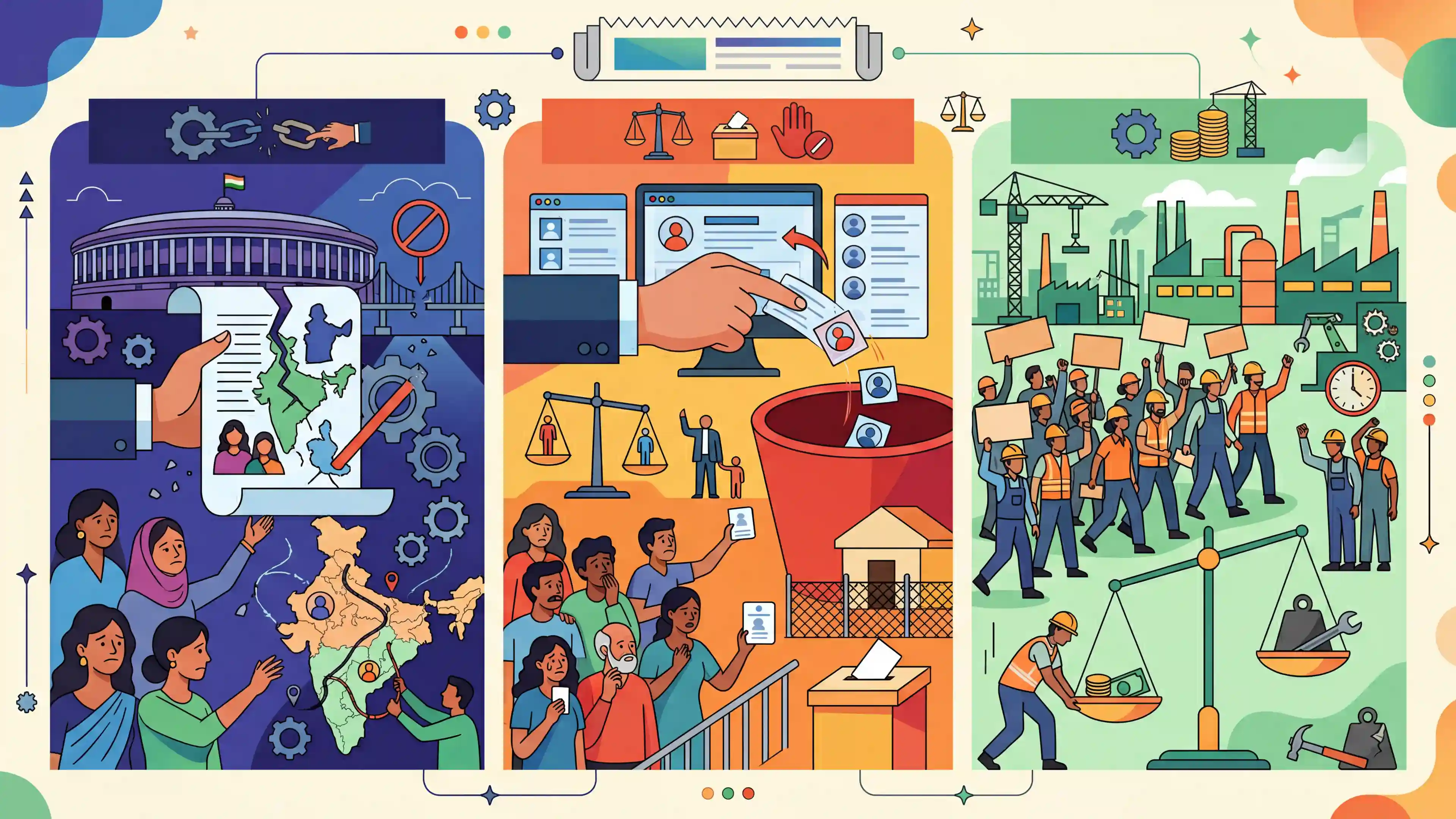
An analysis of the Urdu press highlights three major socio-political developments: the contentious failure of the Constitution (131st Amendment) Bill regarding women's reservation and delimitation, massive voter deletions in West Bengal raising fears of disenfranchisement, and widespread labour protests in Noida over stagnant minimum wages and poor working conditions.
Key Points
- The failure to pass the Constitution (131st Amendment) Bill highlights the complexities of linking the 33% women's reservation with delimitation, sparking federal anxieties over political representation between North and South India.
- The Election Commission's Special Intensive Revision exercise in West Bengal resulted in the deletion of a large number of voters, raising concerns over voter disenfranchisement and fair electoral processes.
- Labour unrest in Noida exposes the disparity between macro-economic growth and ground realities for factory workers who face stagnant minimum wages, long shifts, and a severe cost-of-living crisis.
Important Terms
Constitution (131st Amendment) Bill

A failed legislative proposal to expand Lok Sabha seats to 850 and implement women's reservation using 2011 Census data, bypassing the post-2026 census requirement.
UPSC context
GS Paper II: Constitutional Amendments. Tests Article 368 procedures and federal tensions regarding seat allocation between states.
Constitution (106th Amendment) Act
Legislation reserving 33% of seats for women in the Lok Sabha and state assemblies, mandated to take effect after the first delimitation following a new census.
UPSC context
GS Paper II: Governance/Social Justice. Tests knowledge of Article 334A and mandates for gender-inclusive political representation.
Delimitation
The process of redrawing boundaries for territorial constituencies in a country or a province having a legislative body to reflect population changes.
UPSC context
GS Paper II: Electoral Reforms. Relevant for Article 82 and the freezing of seats until the post-2026 census.
Special Intensive Revision (SIR)
A rigorous Election Commission process involving house-to-house verification to purify electoral rolls by removing dead, duplicate, or shifted voters.
UPSC context
GS Paper II: Role of Constitutional Bodies. Tests the Election Commission’s mandate to ensure accurate voter lists.
Code on Wages, 2019
A central law consolidating four earlier labor acts to standardize minimum wages and bonus payments for all employees across India.
UPSC context
GS Paper III: Indian Economy/Labour Issues. Relevant for debates on inclusive growth and worker social security.
Prelims Trap
The Delimitation Commission is empowered to increase the total number of Lok Sabha seats based on the latest population census.
The Commission only readjusts territorial boundaries. Altering the total number of Lok Sabha seats requires amending Article 81 via a Constitutional Amendment with a special majority.
Static Concepts Connected
How does the Constitution govern the delimitation and freezing of Lok Sabha constituencies?
- Article 82: Parliament enacts a Delimitation Act post-census. The Commission's orders carry the force of law and cannot be challenged in any court.
- 84th Amendment Act: Froze the total number of Lok Sabha seats based on the 1971 census data until the relevant figures for the first census post-2026 are published.
- 87th Amendment Act: Permitted the internal territorial readjustment of constituencies within states based on the 2001 census, without altering the overall seat count.
What is the statutory framework governing minimum wages for industrial workers?
- Minimum Wages Act: The 1948 Act empowers Central and State governments to fix and revise wages for scheduled employments, typically including basic pay and a Variable Dearness Allowance.
- Article 23 link: The Supreme Court ruled in the PUDR case (1982) that paying workers less than the statutory minimum wage amounts to forced labour, violating fundamental rights.
- Code on Wages: The 2019 Code (pending enforcement) aims to universalize minimum wages across all sectors, replacing the old fragmented framework to cover unorganized and contractual workers.
Cross-Topic Patterns
Delimitation + Federalism friction
The push to expand Lok Sabha seats ties women's reservation directly to delimitation, sparking federal anxieties where Southern states fear electoral penalization for successful population control.
Tech in Elections + Statutory Remedies
ECI's AI-driven voter roll purges connect technological governance with the Representation of the People Act, 1950. Disputes require statutory appellate tribunals, not direct Supreme Court writ petitions.
Inflation + Stagnant Real Wages
Urban labour unrest over living costs highlights the socio-economic friction between macroeconomic growth figures and the stagnant real wages of contractual workers, pressing the need for the Labour Codes.

The 2026 delimitation freeze, federal representation, and women's quota are prime for a multi-layered GS2 mains question.
Linked PYQs · 4
Linked PYQs · 4
- 2025MainsGS2
Indian Constitution has conferred the amending power on the ordinary legislative institutions with a few procedural hurdles. In view of this statement, examine the procedural and substantive limitations on the amending power of the Parliament to change the Constitution.
- 2023MainsGS2
Discuss the contribution of civil society groups for women's effective and meaningful participation and representation in state legislatures in India.
- 2022MainsGS2
Discuss the role of the Election Commission of India in the light of the evolution of the Model Code of Conduct.
- 2024MainsGS3
Discuss the merits and demerits of the four 'Labour Codes' in the context of labour market reforms in India. What has been the progress so far in this regard?
