Outdated urban planning and digital tech overhaul for Indian cities
Source:Indian Express ↗
Why It Matters
Urbanization is a recurring and highly cross-disciplinary theme in UPSC, impacting GS1 (social issues), GS2 (local governance), and GS3 (infrastructure). Understanding the technological deficits in India's master planning and ULB capacity provides essential analytical points for Mains answers regarding Smart Cities, urban governance reforms, and sustainable development challenges.
Summary
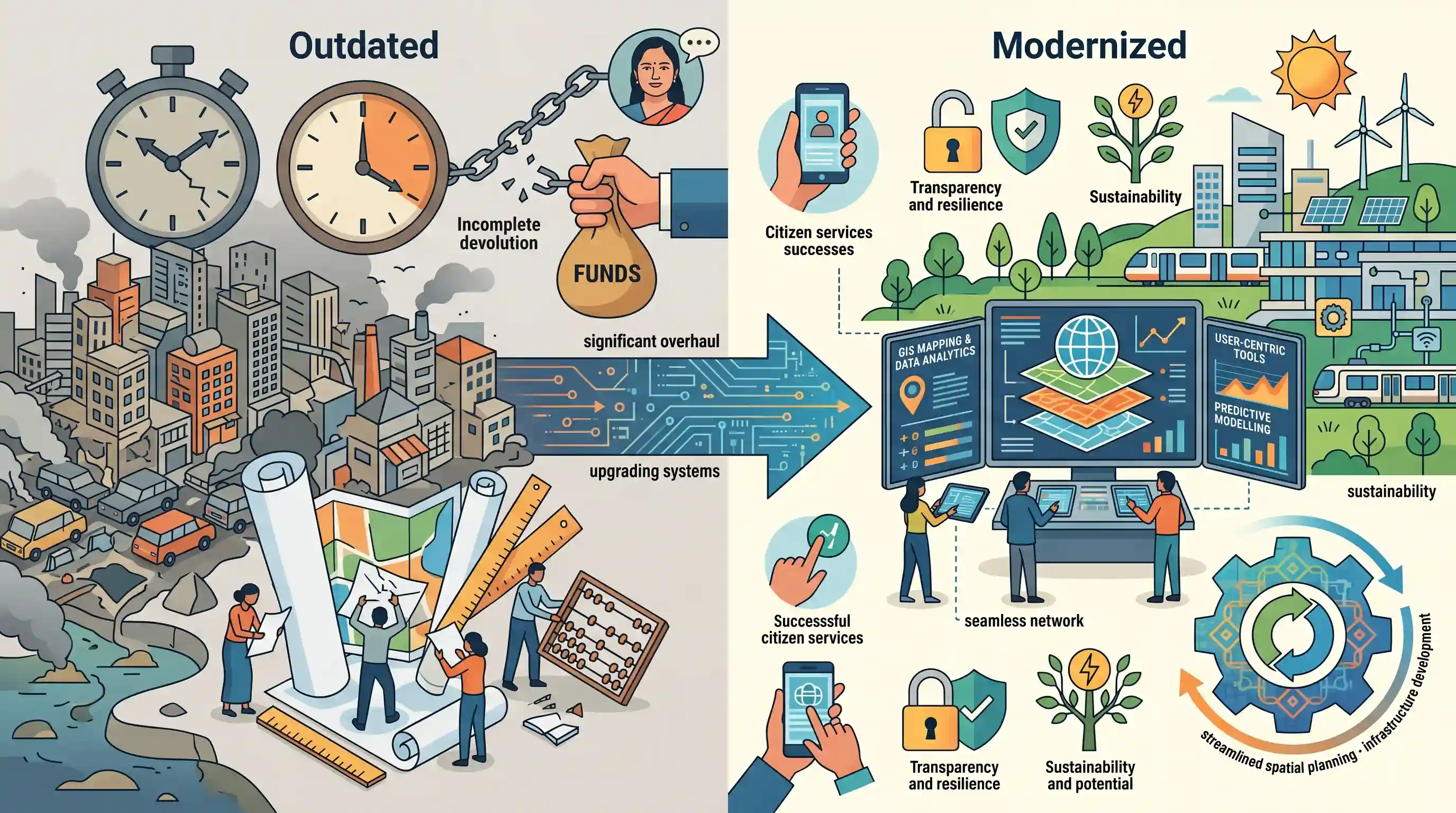
India's urban planning and design technologies are currently outdated and require a significant overhaul to address the complex challenges of rapid urbanization. According to Nithya Ramesh, Director of Jana Urban Space, the traditional methods used for statutory town planning and master plans are insufficient for modern urban realities. The integration of advanced tech-driven models—such as GIS mapping, data analytics, and user-centric digital tools—is essential to empower Urban Local Bodies (ULBs). Upgrading these systems will not only streamline spatial planning and infrastructure development but also ensure better governance, sustainability, and resilience in the development of future smart cities.
Key Points
- India's current urban planning and design methodologies are largely outdated and struggle to accommodate the pace of rapid urbanization.
- There is a critical need to overhaul statutory town planning and traditional master plans by integrating modern technologies such as GIS, AI, and digital twins.
- Empowering Urban Local Bodies (ULBs) with upgraded technical capacity and modern digital tools is essential for effective city governance and decentralized planning.
- Bridging the gap between existing urban planning practices and future tech-driven models will facilitate sustainable infrastructure, better resource allocation, and improved citizen-centric services.
Important Terms
Urban Local Bodies (ULBs)

Constitutional third tier of government (like Municipal Corporations) responsible for providing public services and managing urban development within cities and towns.
UPSC context
GS Paper 2 (Governance/Polity); tests understanding of democratic decentralization and the structural challenges of local self-governance.
74th Constitutional Amendment Act, 1992
A landmark constitutional reform that granted statutory status to municipalities and introduced the Twelfth Schedule, listing 18 functional responsibilities of urban local governments.
UPSC context
GS Paper 2 (Polity); essential for understanding the legal framework and mandatory devolution of powers to urban local bodies.
Smart Cities Mission
A central government initiative launched in 2015 to transform cities by integrating technology, improving core infrastructure, and creating replicable models for sustainable urban development.
UPSC context
GS Paper 3 (Infrastructure); tests knowledge of technology-driven urban transformation and e-governance models in modern India.
AMRUT 2.0
A mission focusing on making Indian cities 'water secure' through universal water supply, rejuvenation of water bodies, and the implementation of a circular economy for water.
UPSC context
GS Paper 3 (Infrastructure/Environment); relevant to urban water management, basic civic amenities, and sustainable city planning.
Master Plan
A statutory document that serves as a spatial vision for city growth, regulating land use and infrastructure for roughly a 20-year period.
UPSC context
GS Paper 1 (Urbanization); key for discussing planning tools used to manage rapid urban growth and prevent haphazard development.
Geographic Information System (GIS)
A technology used to capture and analyze spatial data, increasingly integrated into urban planning for land-use mapping, resource allocation, and real-time governance.
UPSC context
GS Paper 3 (S&T/Infrastructure); tests applications of digital tools in improving administrative efficiency and resilience in urban design.
Prelims Trap
"The 74th Constitutional Amendment legally mandates every Urban Local Body to prepare a statutory master plan."
Urban planning is in the 12th Schedule, but Art 243W leaves devolution to State legislatures. There is no absolute constitutional mandate; hence 65% of cities lack one.
Static Concepts Connected
What are the constitutional planning bodies under the 74th CAA?
- District Planning Committee (DPC): Mandated under Article 243ZD to consolidate plans prepared by panchayats and municipalities within the district.
- Metropolitan Planning Committee (MPC): Mandated under Article 243ZE to prepare development plans for metropolitan areas (population of 10 lakh or more), coordinating investments and infrastructure.
- 12th Schedule: Lists 18 functional items for municipalities, including "urban planning including town planning" and "regulation of land-use".
How do Digital Twins differ from traditional GIS in urban planning?
- GIS Mapping: Maps spatial data (like roads, water lines, topography) for geographical analysis. It is generally static and used as a baseline for planning.
- Digital Twins: Dynamic virtual replicas of physical city infrastructure updated with real-time IoT data (e.g., live traffic, water flow) for predictive modeling.
- Simulation Capability: Unlike static maps, digital twins can simulate 'what-if' scenarios, such as the impact of a sudden cloudburst on the city's stormwater drainage network.
Cross-Topic Patterns
Tech deficit & ULB fiscal autonomy
Using GIS to map urban utilities isn't just about planning; it directly boosts municipal revenue. Better spatial mapping allows for accurate property tax assessment, addressing a core GS2 fiscal devolution issue.
Digital Twins & Urban Disaster Management
Digital twins and IoT sensors are critical for GS3 disaster management. They simulate urban flooding scenarios (like in Chennai or Bengaluru) to design climate-resilient drainage systems.

Expect a GS2 mains question linking the technical/fiscal deficit of ULBs (74th CAA) to the failure of statutory urban master plans.
Linked PYQs · 5
Linked PYQs · 5
- 2016MainsGS3
What are 'Smart Cities'? Examine their relevance for urban development in India. Will it increase rural-urban differences? Give arguments for 'Smart Villages' in the light of PURA and RURBAN Mission.
- 2013MainsGS1
Discuss the various social problems which originated out of the speedy process of urbanization in India.
- 2023MainsGS2
“The states in India seem reluctant to empower urban local bodies both functionally as well as financially.” Comment.
- 2025MainsGS1
How does smart city in India, address the issues of urban poverty and distributive justice?
- 2025MainsGS2
e-governance projects have a built-in bias towards technology and back-end integration than user-centric designs. Examine.
