Meghalaya Uranium Mining Protest and Strategic Mineral EIA Exemptions
Source:The Hindu ↗
Why It Matters
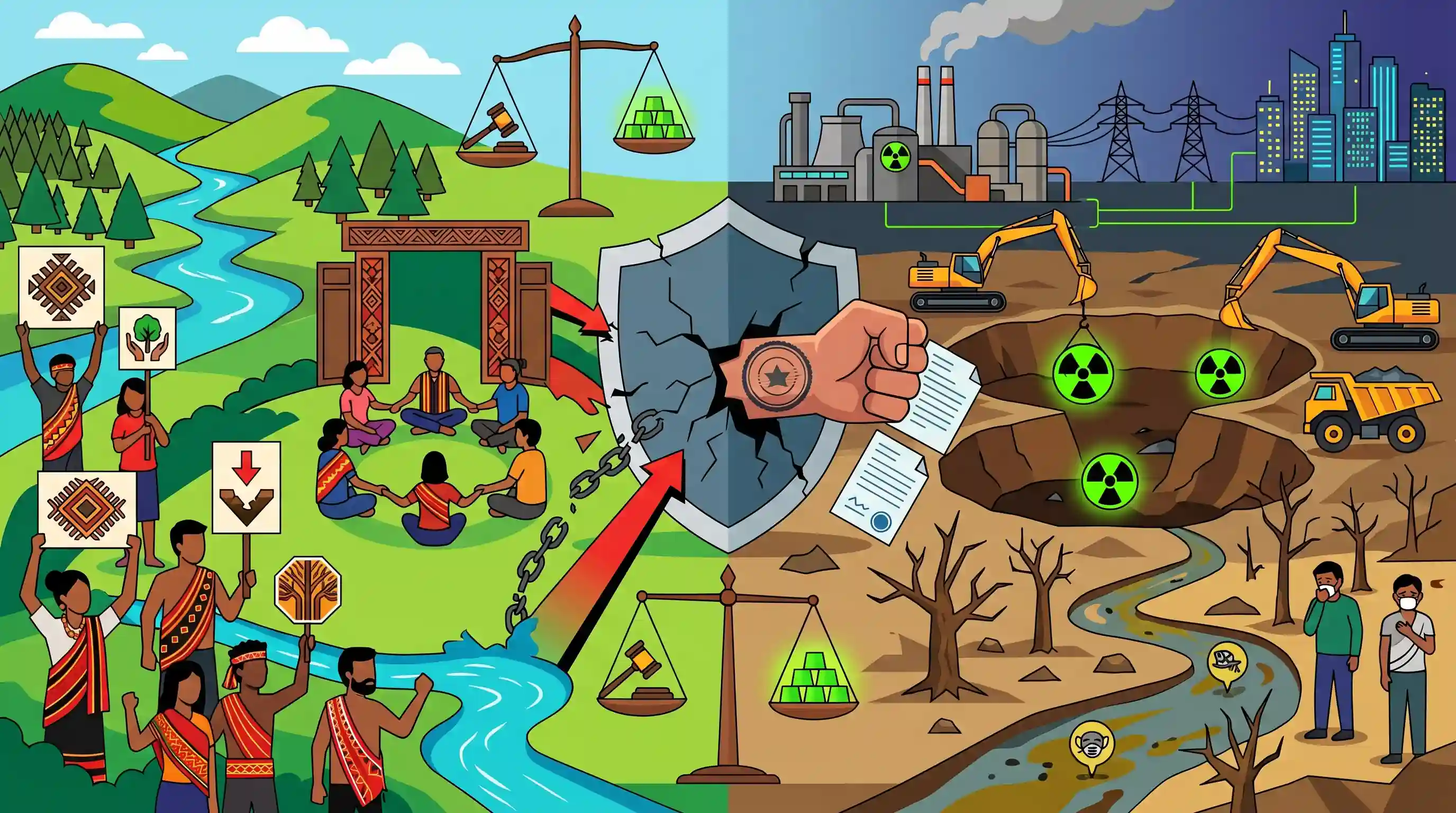
The article connects the intersection of strategic resource extraction (uranium), environmental governance (EIA processes), and constitutional protections for tribal communities (Sixth Schedule, FRA). This multidimensional issue is crucial for UPSC candidates preparing for GS2 (Governance/Constitution) and GS3 (Environment/Energy).
Summary
The article analyzes the growing unrest in Meghalaya over proposed uranium mining following the Union Environment Ministry's decision to exempt strategic and atomic minerals from public consultation during the Environmental Impact Assessment (EIA) process. Khasi organizations are protesting exploration in areas like Domiasiat and Wahkaji, citing severe environmental and health concerns. The dispute highlights a clash between India's strategic energy needs and the constitutional rights of indigenous peoples. Bypassing free, prior, and informed consent in Sixth Schedule areas contradicts democratic safeguards and landmark legal precedents like the Niyamgiri judgment, potentially leading to prolonged conflict and alienation of tribal communities.
Key Points
- Khasi groups in Meghalaya are strongly opposing uranium mining in the South West Khasi Hills due to fears of environmental degradation and radiation hazards, drawing parallels with issues in Jharkhand.
- The Union Environment Ministry recently issued an office memorandum exempting the mining of atomic, critical, and strategic minerals from public consultation requirements.
- The exemption bypasses the democratic process of Environmental Impact Assessment (EIA), angering local communities who claim community ownership over their lands under the Sixth Schedule.
- The Supreme Court's 2013 Niyamgiri judgment affirmed that mining projects in tribal areas require the free, prior, and informed consent of the Gram Sabha, a principle threatened by the new exemption.
- While India requires uranium for its national energy security, overriding constitutional protections and local autonomy risks deepening alienation and conflict in the Northeast.
Important Terms
Sixth Schedule

A constitutional provision (Articles 244(2) and 275(1)) granting autonomous administrative powers to tribal areas in Assam, Meghalaya, Tripura, and Mizoram through Autonomous District Councils (ADCs) to protect indigenous culture and land.
UPSC context
GS II: Indian Polity. Tests understanding of asymmetric federalism, tribal autonomy, and special constitutional safeguards for Northeast India.
Environmental Impact Assessment (EIA) Notification 2006
A regulatory framework under the Environment (Protection) Act, 1986, that mandates assessing a project's potential environmental and socio-economic impacts before granting clearance; recent amendments exempt strategic minerals from public consultation.
UPSC context
GS III: Environment. Evaluates environmental governance, democratic participation, and the balance between development and conservation.
Uranium Corporation of India Limited (UCIL)
A Public Sector Enterprise under the Department of Atomic Energy (DAE) tasked with the commercial mining and processing of uranium ore for India's nuclear power program.
UPSC context
GS III: Energy/Infrastructure. Relevant for nuclear energy security and the role of State-run entities in strategic sectors.
Mines and Minerals (Development and Regulation) Act
The primary legislation governing the mining sector in India, regulating the granting of leases, conservation of minerals, and the protection of environment during mining operations.
UPSC context
GS III: Economy/Resources. Focuses on legal frameworks for resource management and recent amendments affecting critical and strategic minerals.
Atomic Minerals Directorate (AMD)
A constituent unit of the Department of Atomic Energy (DAE) responsible for the exploration, identification, and evaluation of atomic mineral resources like uranium and thorium.
UPSC context
GS III: Science & Technology. Important for questions on indigenous fuel exploration and nuclear self-reliance.
Khasi Students' Union (KSU)
A powerful student-led regional pressure group in Meghalaya that advocates for the rights of the indigenous Khasi community, particularly opposing projects perceived as threats to their land and health.
UPSC context
GS II/III: Governance/Internal Security. Relevant for studying civil society, regionalism, and internal security challenges in the Northeast.
Prelims Trap
Strategic and atomic minerals are entirely exempt from the Environmental Impact Assessment (EIA) clearance process.
The recent Union Environment Ministry memorandum exempts these projects only from the public consultation (hearing) phase, not from the overall EIA appraisal and clearance mandate.
Static Concepts Connected
How does resource governance function under the Sixth Schedule?
- Autonomous Councils: Autonomous District Councils (ADCs) hold legislative and administrative powers over land, forest, and water management under Article 244(2) of the Constitution.
- Customary Rights: Land is primarily owned by the community, clans, or individuals according to customary laws, heavily restricting arbitrary land acquisition by the state.
- Mineral Extraction: Mining requires state government licenses, but operations fundamentally depend on the consent of the ADCs and agreements on royalty sharing.
What is the core precedent of the 2013 Niyamgiri Judgment?
- Gram Sabha Consent: The Supreme Court ruled that Gram Sabhas have the statutory power to safeguard cultural and religious rights under the Forest Rights Act (FRA).
- Veto Power: Mining projects in scheduled areas cannot proceed without the free, prior, and informed consent (FPIC) of the affected Gram Sabhas.
Cross-Topic Patterns
Nuclear security vs Sixth Schedule
India's drive to secure domestic uranium to reduce import reliance directly collides with the constitutional autonomy of Northeast tribal councils, testing the limits of federalism.
MMDR amendments and critical minerals
Bypassing EIA public hearings for atomic minerals parallels recent MMDR Act amendments that opened deep-seated critical minerals to private exploration, prioritizing supply chains over local ecology.

Expect a 2026 Prelims question linking Sixth Schedule ADC powers over mineral extraction with EIA exemptions.
Linked PYQs · 5
Linked PYQs · 5
- 2019PrelimsGS1
Under which Schedule of the Constitution of India can the transfer of tribal land to private parties for mining be declared null and void?
- 2022PrelimsGS1
If a particular area is brought under the Fifth Schedule of the Constitution of India, which one of the following statements best reflects the consequence of it ?
- 2015PrelimsGS1
The provisions in Fifth Schedule and Sixth Schedule in the Constitution of India are made in order to
- 2023PrelimsGS1
Consider the following statements: Statement-I: India, despite having uranium deposits, depends on coal for most of its electricity production. Statement-II: Uranium, enriched to the extent of at least 60%, is required for the production of electricity. Which one of the following is correct in respect of the above statements?
- 2014MainsGS3
Environmental Impact Assessment studies are increasingly undertaken before a project is cleared by the Government. Discuss the environmental impacts of coal-fired thermal plants located at coal pitheads.
