UPESSC releases admit cards for teacher eligibility test examinations
Source:times-of-india ↗
Why It Matters
The UPTET recruitment process is a direct implementation of the Right to Education (RTE) Act, 2009, which mandates qualifying examinations to maintain standard quality benchmarks for elementary teaching. From a UPPSC GS perspective, understanding state regulatory and recruitment bodies (like UPESSC), the division of legislative powers over education (Concurrent List via the 42nd Amendment), and education-related constitutional articles (Article 21A, 86th Amendment) is crucial.
Summary
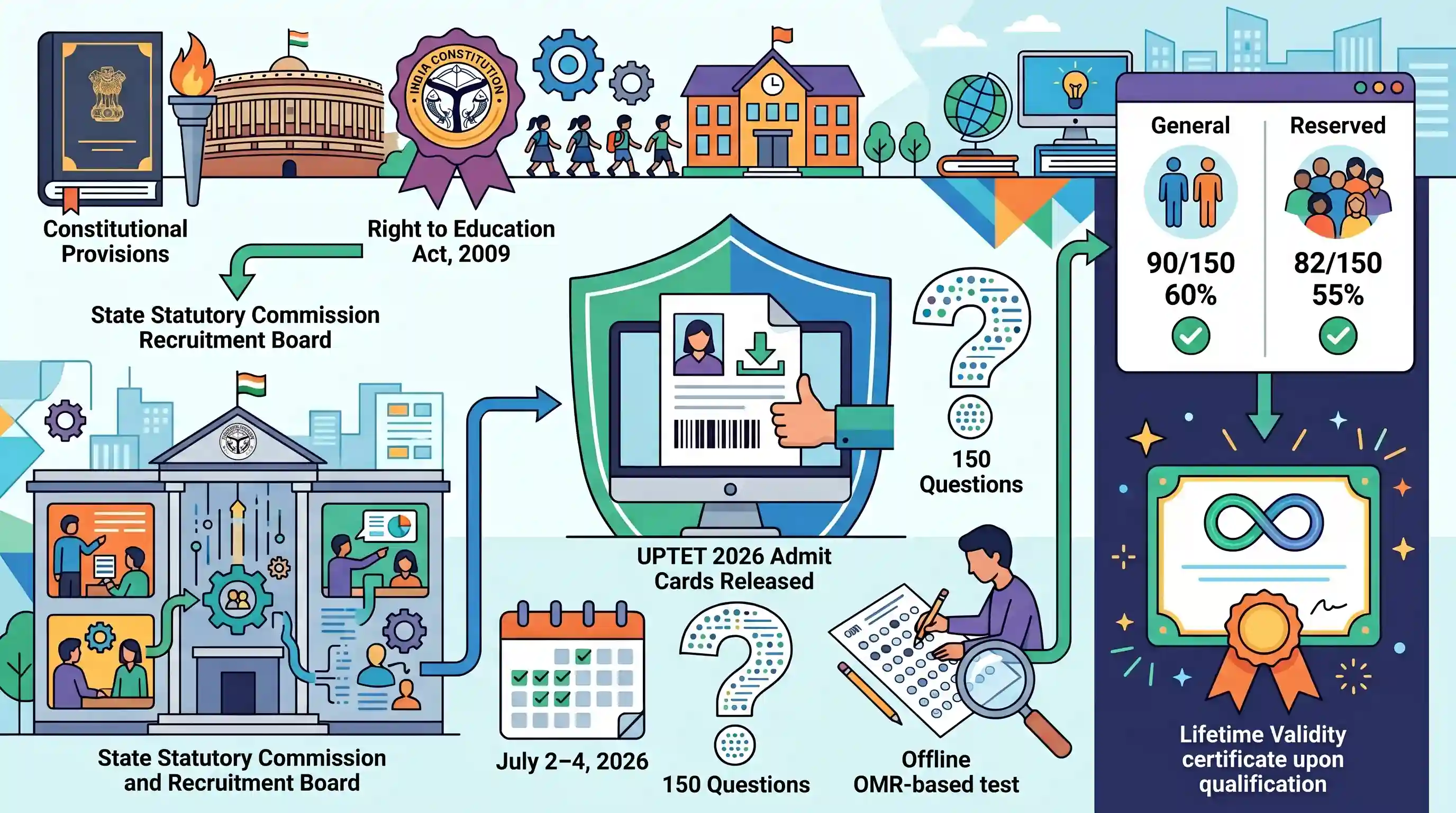
The Uttar Pradesh Education Service Selection Commission (UPESSC) has released the admit cards for the UPTET 2026 exam, scheduled for July 2–4, 2026. This offline OMR-based test with 150 questions provides a lifetime validity certificate upon qualification, requiring a minimum of 90 marks (60%) for General and 82 marks (55%) for reserved categories.
Key Points
- The Uttar Pradesh Education Service Selection Commission (UPESSC) released the admit cards for the Uttar Pradesh Teacher Eligibility Test (UPTET) 2026 on June 30, 2026.
- The UPTET 2026 examination is scheduled to be held in offline (OMR-sheet) mode from July 2 to July 4, 2026, across multiple shifts, with a normalisation process applied to balance difficulty levels.
- The exam features 150 multiple-choice questions carrying 150 marks, with a duration of 150 minutes and no negative marking.
- The qualification requirement is 60% (90 marks) for General category candidates and 55% (82 marks) for reserved category candidates (SC, ST, OBC, EWS, Ex-Servicemen, Freedom Fighter Dependents, and PwD).
- Successful candidates receive a UPTET eligibility certificate which holds lifetime validity.
Important Terms
Right of Children to Free and Compulsory Education (RTE) Act 2009

A landmark central legislation enacted under Article 21A that guarantees free, compulsory, and quality elementary education for children aged 6–14 years, mandating a 25% reservation for economically weaker sections in private schools.
UPSC context
Relevant for GS Paper II (Social Justice and Governance), testing statutory provisions for inclusive development and educational equity.
Constitution (86th Amendment) Act, 2002
A landmark constitutional amendment that inserted Article 21A, making elementary education a justiciable fundamental right for children aged 6–14, while substituting Article 45 for early childhood care and adding Article 51A(k).
UPSC context
Relevant for GS Paper II (Constitutional Amendments & Fundamental Rights), testing the legal progression of educational rights.
Constitution (42nd Amendment) Act, 1976
Commonly known as the 'Mini-Constitution', this comprehensive amendment enacted sweeping changes, notably transferring 'Education' (along with forests, weights/measures, wild animal protection, and administration of justice) from the State List to the Concurrent List.
UPSC context
Relevant for GS Paper II (Federalism & Amendments), testing the distribution of legislative power between Centre and States.
Uttar Pradesh Education Service Selection Commission (UPESSC)
A unified autonomous statutory recruitment body established under the UPESSC Act, 2023, responsible for selecting teachers across basic, secondary, higher, and technical educational institutions and organizing the state's Teacher Eligibility Test.
UPSC context
Relevant for GS Paper II (State Statutory Bodies & Governance), testing state-level recruitment mechanisms and educational administrative machinery.
UP State Government
The subnational governing executive of Uttar Pradesh, headed by the Governor (titular head) and Chief Minister (real head), responsible for executing state laws, policy formulation, and administrative oversight.
UPSC context
Relevant for GS Paper II (State Executive & Federalism), testing state-level governance structures and federal center-state dynamics.
Prelims Trap
The guidelines and minimum qualifications for conducting the Teacher Eligibility Test (TET) are laid down by the NCERT.
Aspirants confuse NCERT (curriculum framework) with NCTE (National Council for Teacher Education), which is the statutory body empowered to lay down minimum teacher qualifications.
Static Concepts Connected
What is the constitutional and statutory mandate of the National Council for Teacher Education (NCTE)?
- Statutory status: Established under the NCTE Act, 1993, to oversee planned development and regulate the standards of the teacher education system.
- RTE role: Designated as the academic authority to lay down minimum qualifications for teacher appointments under Section 23 of the RTE Act, 2009.
How does the RTE Act, 2009 regulate teacher standards?
- Mandatory TET: Section 23 makes clearing the Teacher Eligibility Test (TET) a compulsory prerequisite for any primary or upper-primary teaching appointment.
- State execution: While standards are set centrally by NCTE, state boards execute exams and conduct recruitments, reflecting the Concurrent List nature of education.
Cross-Topic Patterns
Cooperative federalism in school education
The dual control where Center (NCTE) sets standard eligibility and States (UPESSC) execute recruitments tests the limits of legislative balance under the Concurrent List.
Article 21A and learning outcomes
Enforcing quality standards via TET shifts the policy focus from mere school enrollment (quantitative access) to qualitative learning outcomes (human capital development).

Statutory mandates of NCTE under RTE Act, 2009 and the division of regulatory powers with NCERT are key targets for CSE 2026.
Linked PYQs · 3
Linked PYQs · 3
- 2022UPPSC_PRELIMSGS1
Right to Education has been included into the Fundamental Rights by the
- 2015UPPSC_PRELIMSGS1
The Right to Education Act, 2009 aims at making a free and compulsory education a right for children upto
- 2021UPPSC_PRELIMSGS1
The functions of the State Public Service Commission of Uttar Pradesh can be extended by
