Ajay Kumar assumes charge as UPSC chairperson
Source:Indian Express ↗
Why It Matters
The appointment of the UPSC Chairperson is a direct syllabus point under Constitutional Bodies (GS2). Additionally, Dr Kumar's background provides a crucial review of major recent defence reforms (GS3), including the CDS, Agniveer, and iDEX, making this highly relevant for questions on military modernization and indigenisation of the defence sector.
Summary
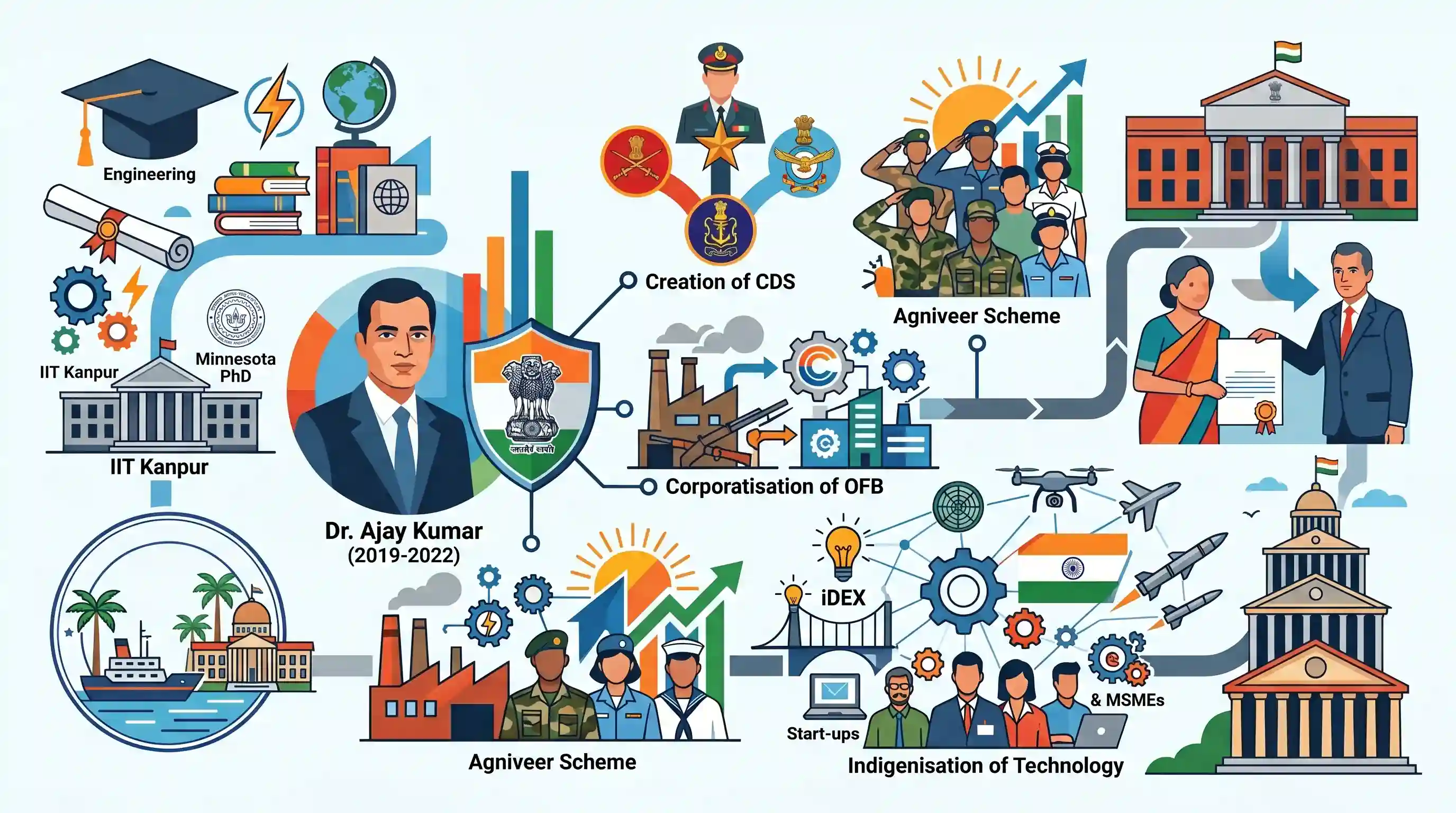
Dr Ajay Kumar, a 1985-batch IAS officer of the Kerala cadre, has been appointed as the new Chairperson of the Union Public Service Commission (UPSC), succeeding Preeti Sudan. He holds a BTech in Electrical Engineering from IIT Kanpur and a PhD in Business Administration from the University of Minnesota. Dr Kumar served as India's Defence Secretary from 2019 to 2022, a period marked by historic structural reforms in the military. His tenure saw the creation of the Chief of Defence Staff (CDS) position, the corporatisation of the Ordnance Factory Board, and the launch of the Agniveer scheme. Furthermore, he was a key architect of the Innovations for Defence Excellence (iDEX) initiative, which aimed to boost indigenisation by integrating start-ups and private MSMEs into India's defence manufacturing ecosystem.
Key Points
- Dr Ajay Kumar has been appointed as the new Chairperson of the Union Public Service Commission, succeeding Preeti Sudan.
- He is a 1985-batch IAS officer from the Kerala cadre and holds a BTech from IIT Kanpur and a PhD from the University of Minnesota.
- During his tenure as India's Defence Secretary (2019-2022), he played a pivotal role in major structural military reforms, including the creation of the Chief of Defence Staff (CDS) post.
- He was instrumental in executing the corporatisation of the Ordnance Factory Board and the implementation of the Agniveer (Agnipath) recruitment scheme.
- He aggressively promoted the Innovations for Defence Excellence (iDEX) initiative, successfully integrating private start-ups and MSMEs into the domestic defence manufacturing ecosystem.
Important Terms
Union Public Service Commission (UPSC)

India's premier independent constitutional body (Articles 315-323) responsible for recruiting officers for the All India Services and Central Civil Services through merit-based examinations and advising the government on personnel matters.
UPSC context
GS Paper-II (Constitutional Bodies); tests knowledge of independent institutions and the structure of Indian bureaucracy.
Chief of Defence Staff (CDS)
The principal military advisor to the Defence Minister and head of the Department of Military Affairs (DMA). This four-star officer fosters inter-service synergy and oversees tri-service commands and procurement planning.
UPSC context
GS Paper-III (Internal Security/Defence Reforms); relevant for questions on military integration and national security architecture.
Agniveer
Soldiers recruited under the Agnipath scheme for a four-year tenure. The model aims to reduce the military's age profile and long-term pension liabilities while creating a tech-savvy, 'fire-warrior' force for modern warfare.
UPSC context
GS Paper-II (Government Policies) and GS Paper-III (Security); examines personnel reforms and their strategic implications.
Innovations for Defence Excellence (iDEX)
An ecosystem launched in 2018 to foster innovation and technology development in defence and aerospace. It provides grants to startups, MSMEs, and individual innovators to achieve indigenisation and self-reliance.
UPSC context
GS Paper-III (Science & Technology/Indigenisation); focuses on self-reliance (Atmanirbhar Bharat) and private sector participation in defence.
Ordnance Factory Board (OFB) Corporatisation
The 2021 restructuring of 41 government ordnance factories into seven 100% state-owned corporate entities. This reform aims to improve operational autonomy, accountability, efficiency, and export competitiveness in military manufacturing.
UPSC context
GS Paper-III (Economic Development/Security); relevant for public sector reforms and domestic defence production capacity.
Prelims Trap
The UPSC Chairperson is eligible for reappointment to the same office for a second term.
Under Article 319 of the Constitution, the Chairman of the UPSC is strictly ineligible for reappointment to the same office or any further employment under the Union or State governments.
Static Concepts Connected
What are the constitutional provisions for the tenure and removal of UPSC members?
- Appointment & Term: Appointed by the President under Article 316; holds office for a term of 6 years or until the age of 65 years, whichever is earlier.
- Removal Process: Removed by the President under Article 317 only on grounds of misbehavior, but strictly following a binding inquiry report by the Supreme Court.
- Post-retirement Ban: To ensure independence, the Chairman is ineligible for any further employment under the Government of India or any State (Article 319).
How does the Innovations for Defence Excellence (iDEX) framework operate?
- Executing Body: Funded and managed by the Defence Innovation Organisation (DIO), a not-for-profit company created under the Ministry of Defence.
- Core Objective: Encourages startups, MSMEs, and academia to co-develop defense technologies with grants, accelerating the indigenisation and self-reliance of the military ecosystem.
Cross-Topic Patterns
Constitutional Bodies + Security Reforms
Ajay Kumar's profile uniquely merges GS2 Polity (Article 316 appointments) with major GS3 internal security milestones (CDS creation, iDEX, Agnipath), linking statutory bodies with defence indigenisation.
Governance: Departmental to Corporate shift
The Ordnance Factory Board's dissolution into 7 DPSUs exemplifies a major governance reform: transitioning from rigid government departments to agile corporate entities to boost accountability.

Expect a multi-statement Prelims question testing Article 316 (UPSC tenure/removal) mixed with Article 319 (post-retirement bans).
Linked PYQs · 3
Linked PYQs · 3
- 2024PrelimsGS1
What are the duties of the Chief of Defence Staff (CDS) as Head of the Department of Military Affairs? 1. Permanent Chairman of Chiefs of Staff Committee 2. Exercise military command over the three Service Chiefs 3. Principal Military Advisor to Defence Minister on all tri-service matters Select the correct answer using the code given below:
- 2022MainsGS2
Discuss the role of the National Commission for Backward Classes in the wake of its transformation from a statutory body to a constitutional body.
- 2023MainsGS3
Faster economic growth requires increased share of the manufacturing sector in GDP, particularly of MSMEs. Comment on the present policies of the Government in this regard.
