Sustainable Aviation Fuel and Economic Integration Stages
Source:Indian Express ↗
Why It Matters
The article provides high-yield factual and conceptual clarity on biofuels (SAF), international trade agreements, and earth system science (Planetary Boundaries). These are core syllabus areas for Prelims and offer vital analytical fodder for Mains GS3 (Environment, S&T, and Economy).
Summary
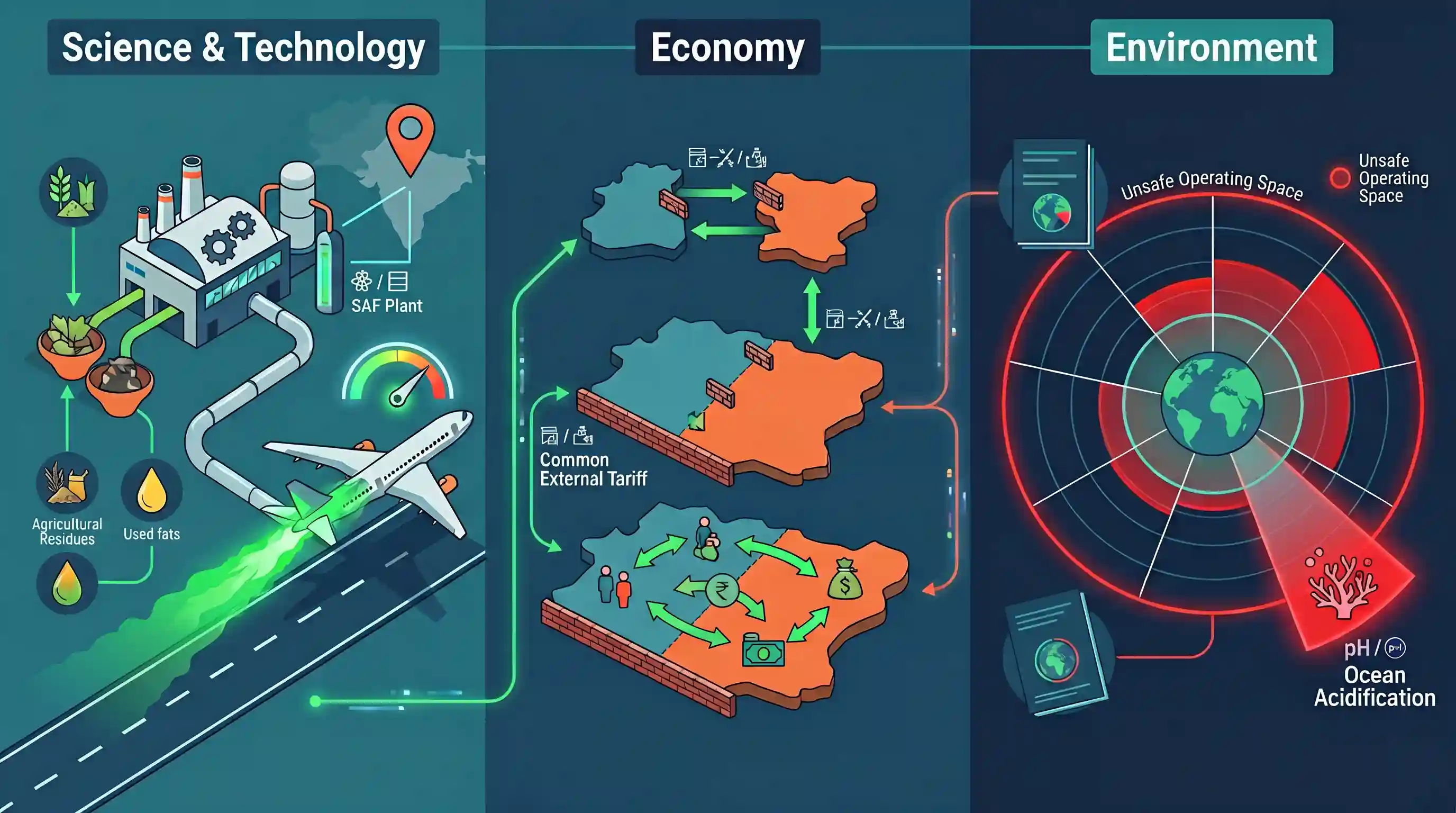
This article provides a brief overview of three distinct and highly relevant UPSC Prelims topics: Sustainable Aviation Fuel (SAF), Stages of Economic Integration, and Planetary Boundaries. It outlines the upcoming commercial SAF plant in Panipat and India's biofuel blending targets, helping decarbonize aviation. It also breaks down international trade terminology, differentiating between FTAs, Customs Unions, and Common Markets. Finally, it highlights the alarming 'Planetary Health Check 2025' report, which notes that seven of the nine crucial Earth system boundaries have now been crossed, emphasizing the recent breach of the Ocean Acidification boundary.
Key Points
- India's first commercial-scale Sustainable Aviation Fuel (SAF) plant is being built by IOC in Panipat, utilizing agricultural residues and used cooking oil.
- The National Biofuels Coordination Committee (NBCC) has set indicative SAF blending targets for international flights: 1% by 2027 and 2% by 2028.
- Economic integration progresses through six stages: Preferential Trade Agreement (PTA), Free Trade Agreement (FTA), Customs Union, Common Market, Economic and Monetary Union (EMU), and Complete Economic Integration.
- A Customs Union eliminates internal tariffs and imposes a common external tariff, while a Common Market adds the free movement of labor and capital.
- The Planetary Boundaries Science (PBScience) 'Planetary Health Check 2025' reveals that seven out of nine critical Earth boundaries have been breached, including Ocean Acidification for the first time.
Important Terms
CORSIA (Carbon Offsetting and Reduction Scheme for International Aviation)

Global market-based mechanism by ICAO to offset CO2 emissions from international flights. It uses a phased approach; India will join the mandatory phase in 2027 to support carbon-neutral aviation growth.
UPSC context
GS Paper 3 (Environment/Economy). Tests knowledge of international climate mitigation frameworks and aviation's decarbonization pathway.
International Civil Aviation Organisation (ICAO)
A specialized United Nations agency (HQ: Montreal) that coordinates international air navigation and establishes environmental standards, including the Long-Term Aspirational Goal (LTAG) of net-zero aviation emissions by 2050.
UPSC context
GS Paper 2 (International Institutions). Tests understanding of UN agencies and global regulatory governance.
National Biofuels Coordination Committee (NBCC)
India's high-level committee, chaired by the Petroleum Minister, that directs biofuel policy. It recently approved indicative SAF blending targets: 1% by 2027, 2% by 2028, and 5% by 2030.
UPSC context
GS Paper 3 (Energy/Environment). Tests awareness of India's institutional framework for biofuel mandates and energy transition.
Planetary Boundaries
A scientific framework identifying nine Earth system processes (e.g., climate change, biosphere integrity) that regulate planetary stability. The 2025 report confirms seven are breached, including Ocean Acidification for the first time.
UPSC context
GS Paper 3 (Environment). Tests conceptual understanding of ecological thresholds and global environmental health status.
Comprehensive Economic Partnership Agreement (CEPA)
A deep trade agreement covering goods, services, investment, intellectual property, and regulatory cooperation. It offers more comprehensive economic integration than a standard FTA (e.g., India-UAE CEPA).
UPSC context
GS Paper 3 (Economy). Tests knowledge of trade integration levels and India’s bilateral economic strategies.
Free Trade Agreement (FTA)
An agreement between countries to reduce or eliminate tariffs and trade barriers on a substantial volume of goods and services, typically using a "negative list" for sensitive items.
UPSC context
GS Paper 3 (Economy). Fundamental concept regarding the mechanics of international trade and domestic industry protection.
Preferential Trade Agreement (PTA)
The most basic form of trade agreement where partners reduce tariffs on a specific "positive list" of products, rather than eliminating barriers across most trade lines.
UPSC context
GS Paper 3 (Economy). Tests understanding of the hierarchy of economic integration.
Prelims Trap
India has mandated a 1% Sustainable Aviation Fuel (SAF) blending target for all domestic and international flights by 2027.
The indicative 1% (2027) and 2% (2028) SAF blending targets set by the NBCC apply strictly to international flights, not domestic flights.
Static Concepts Connected
What differentiates a Customs Union from a Common Market?
- Customs Union: Eliminates internal tariffs among member nations and adopts a unified, common external tariff against non-members.
- Common Market: Incorporates all features of a Customs Union but additionally allows the free movement of factors of production (labor and capital) across member borders.
What is the Planetary Boundaries framework?
- Definition: A scientific framework identifying 9 critical Earth system processes whose limits humanity must not cross to maintain a stable, habitable environment.
- Current Status: Seven of the nine boundaries (including climate change, biodiversity loss, and newly ocean acidification) are now breached, risking irreversible environmental shifts.
Cross-Topic Patterns
SAF as Stubble Burning Mitigation
The Panipat SAF plant utilizes agricultural residues, directly linking international aviation decarbonization with regional solutions for North India's winter air pollution and crop residue management (stubble burning).
SAF, ICAO and CORSIA Obligations
India's domestic SAF blending targets prepare the aviation sector for its upcoming international obligations under ICAO's Carbon Offsetting and Reduction Scheme for International Aviation (CORSIA).
CEPA/CECA vs Standard FTAs
UPSC frequently tests trade integration depth. Unlike standard FTAs limited to goods, India's recent CEPAs (e.g., with UAE) represent deeper integration encompassing services, investments, and regulatory cooperation.

Planetary boundaries (focusing on the new ocean acidification breach) and SAF drop-in fuel traits are prime targets for 2026 MCQs.
Linked PYQs · 5
Linked PYQs · 5
- 2024PrelimsGS1
Consider the following materials: 1. Agricultural residues 2. Corn grain 3. Wastewater treatment sludge 4. Wood mill waste Which of the above can be used as feedstock for producing Sustainable Aviation Fuel?
- 2025PrelimsGS1
With reference to 'Direct Air Capture', an emerging technology, which of the following statements is/are correct? I. It can be used as a way of carbon sequestration. II. It can be a valuable approach for plastic production and in food processing. III. In aviation, it can be a source of carbon for combining with hydrogen to create synthetic low-carbon fuel. Select the correct answer using the code given below.
- 2016PrelimsGS1
The term 'Regional Comprehensive Economic Partnership' often appears in the news in the context of the affairs of a group of countries known as
- 2018PrelimsGS1
Which of the following statements best describes "carbon fertilization"?
- 2025PrelimsGS1
Consider the following statements : Statement I: Scientific studies suggest that a shift is taking place in the Earth's rotation and axis. Statement II: Solar flares and associated coronal mass ejections bombarded the Earth's outermost atmosphere with tremendous amount of energy. Statement III : As the Earth's polar ice melts, the water tends to move towards the equator. Which one of the following is correct in respect of the above statements?
