Sustainable aviation fuel economic integration and planetary limits
Source:Indian Express ↗
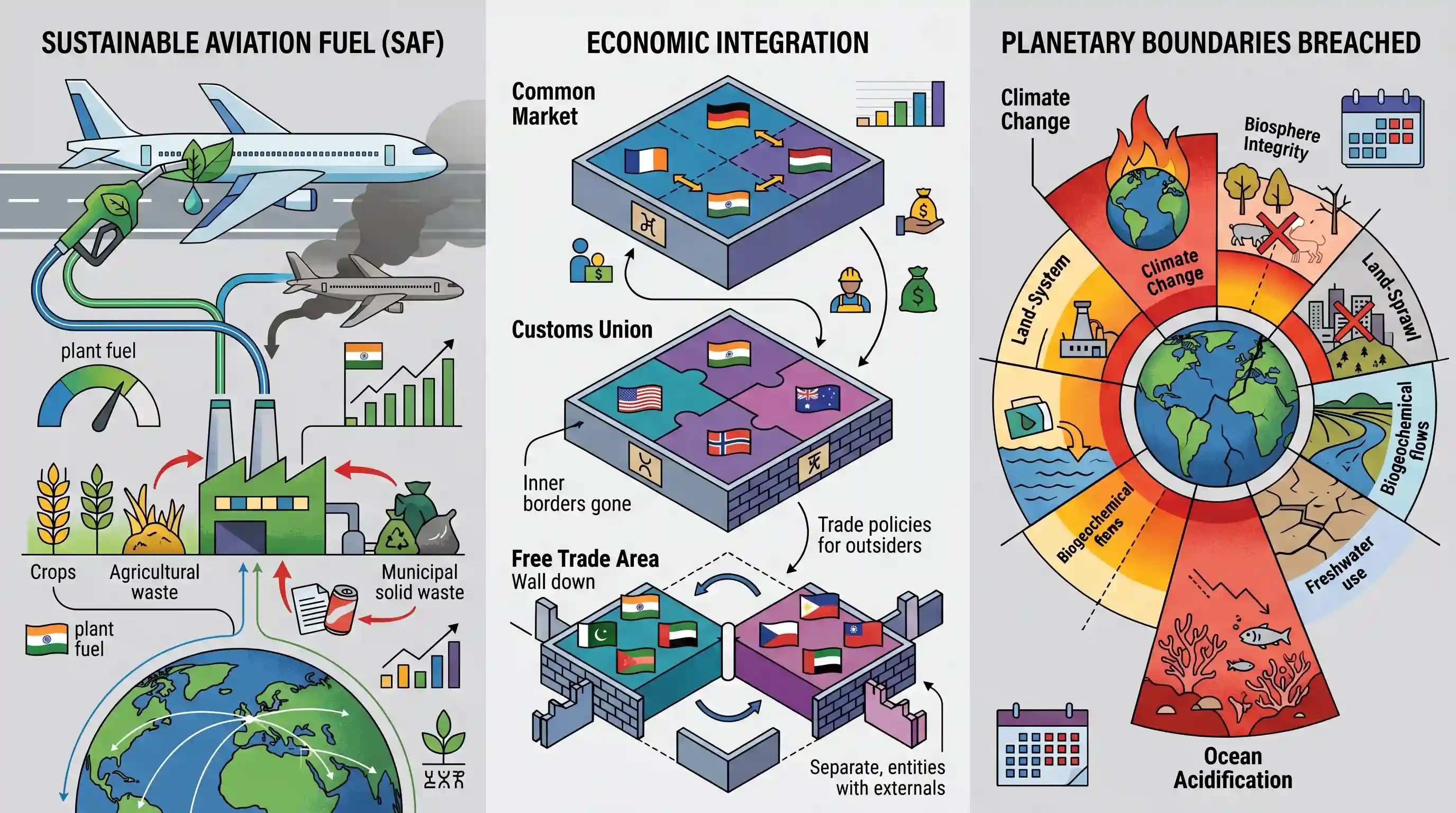
Why It Matters
The article synthesizes three highly testable topics for the UPSC examination: decarbonization technologies (SAF), core macroeconomic concepts (trade agreements and economic unions), and global environmental benchmarks (planetary boundaries). These areas frequently appear in both Prelims and GS3 Mains.
Summary
The article provides a three-part snapshot spanning Science, Economy, and Environment. It details the mechanics and feedstocks of Sustainable Aviation Fuel (SAF), an essential tool for decarbonizing aviation under CORSIA, noting India's 1% blending target by 2027. Second, it breaks down the stages of Economic Integration, clarifying the differences between FTAs, Customs Unions, and Common Markets. Finally, it discusses the alarming findings of the Planetary Health Check 2025, which confirms that Earth has breached seven out of nine critical planetary boundaries, including a new breach in Ocean Acidification, threatening the planet's ecological stability.
Key Points
- Sustainable Aviation Fuel (SAF) acts as a 'drop-in' substitute for jet fuel, produced from sources like Used Cooking Oil (UCO) and agricultural residue, reducing aviation emissions by up to 80%.
- India is pushing for SAF adoption, targeting a 1% blending mandate for international flights by 2027, supported by projects like the IOC's upcoming Panipat refinery.
- Economic integration follows a hierarchy from Preferential Trade Agreements (PTAs) and Free Trade Areas (FTAs) to Customs Unions (which add common external tariffs) and Common Markets (allowing free movement of labor and capital).
- The Planetary Health Check 2025 reveals that seven out of nine planetary boundaries have been breached, with Ocean Acidification being the latest boundary crossed.
- Stratospheric ozone depletion and atmospheric aerosol loading are the only two planetary boundaries still within the safe operating space.
Important Terms
Carbon Offsetting and Reduction Scheme for International Aviation (CORSIA)

An ICAO-led global market-based measure aimed at stabilizing net CO2 emissions from international aviation at 2019-2020 levels through carbon offsetting and credits.
UPSC context
GS3 (Environment/Economy). Tests knowledge of global climate mitigation frameworks and India's 2027 mandatory compliance timeline.
Sustainable Aviation Fuel (SAF)
A 'drop-in' biofuel derived from sustainable feedstocks like used cooking oil or agricultural waste, reducing aviation lifecycle CO2 emissions by up to 80%.
UPSC context
GS3 (Science & Tech/Environment). Crucial for decarbonization strategies and India's 1% blending target for 2027.
Planetary Boundaries
Nine critical Earth system processes, defined by the Stockholm Resilience Centre, that delineate the 'safe operating space' for humanity to remain stable.
UPSC context
GS3 (Environment). Key for ecology topics; the 2025 update confirms seven boundaries breached, including ocean acidification.
International Civil Aviation Organization (ICAO)
A UN specialized agency established in 1944 to coordinate international air navigation principles and foster safe, orderly growth of global civil aviation.
UPSC context
GS2 (International Institutions). Tests understanding of UN agencies and India’s founding role in global aviation governance.
Free Trade Agreement (FTA)
A trade agreement between countries that eliminates tariffs and trade barriers on a comprehensive range of goods and services while maintaining independent external policies.
UPSC context
GS3 (Economy) / GS2 (IR). Essential for understanding trade liberalization, 'rules of origin,' and India’s regional integration.
Preferential Trade Agreement (PTA)
The most basic level of economic integration where member countries selectively reduce tariffs on a limited list of products rather than comprehensive elimination.
UPSC context
GS3 (Economy). Tests conceptual clarity on the hierarchy of trade integration and initial stages of market access.
Prelims Trap
"Sustainable Aviation Fuel (SAF) requires specialized engine modifications before blending with conventional jet fuel."
SAF is a 'drop-in' substitute, meaning it is chemically identical to conventional jet fuel and can be blended directly without requiring any modifications to existing aircraft engines or infrastructure.
Static Concepts Connected
What are the 9 Planetary Boundaries proposed by the Stockholm Resilience Centre?
- Breached (7): Climate change, biosphere integrity, land-system change, freshwater use, biogeochemical flows, novel entities, and newly added ocean acidification.
- Safe (2): Stratospheric ozone depletion and atmospheric aerosol loading are the only two boundaries still within the safe space.
How do Customs Unions differ from Free Trade Areas and Common Markets?
- Free Trade Area: Eliminates internal tariffs among member nations but allows each country to maintain independent external tariffs against non-members.
- Customs Union: Builds on an FTA by additionally establishing a common external tariff applied uniformly to all non-member countries.
- Common Market: Extends a Customs Union by permitting the free, unrestricted movement of labor and capital among member nations.
Cross-Topic Patterns
Biofuels & Circular Economy
Used Cooking Oil (UCO) links SAF production directly to the FSSAI's RUCO (Repurpose Used Cooking Oil) initiative, converting urban waste into strategic energy and lowering crude import dependence.
Acidification & Marine Biodiversity
As the Ocean Acidification planetary boundary is breached, the aragonite saturation state drops, directly threatening calcifying organisms, marine food webs, and accelerating coral reef degradation worldwide.

Expect a 2026 Prelims question asking to identify the two 'safe' planetary boundaries, or a paired question on SAF feedstocks and CORSIA.
Linked PYQs · 3
Linked PYQs · 3
- 2024PrelimsGS1
Consider the following materials: 1. Agricultural residues 2. Corn grain 3. Wastewater treatment sludge 4. Wood mill waste Which of the above can be used as feedstock for producing Sustainable Aviation Fuel?
- 2025PrelimsGS1
With reference to 'Direct Air Capture', an emerging technology, which of the following statements is/are correct? I. It can be used as a way of carbon sequestration. II. It can be a valuable approach for plastic production and in food processing. III. In aviation, it can be a source of carbon for combining with hydrogen to create synthetic low-carbon fuel. Select the correct answer using the code given below.
- 2018PrelimsGS1
Consider the following countries: 1. Australia 2. Canada 3. China 4. India 5. Japan 6. USA Which of the above are among the 'free-trade partners' of ASEAN?
