Dimethyl Ether and Consumer Price Index Base Year
Source:Indian Express ↗
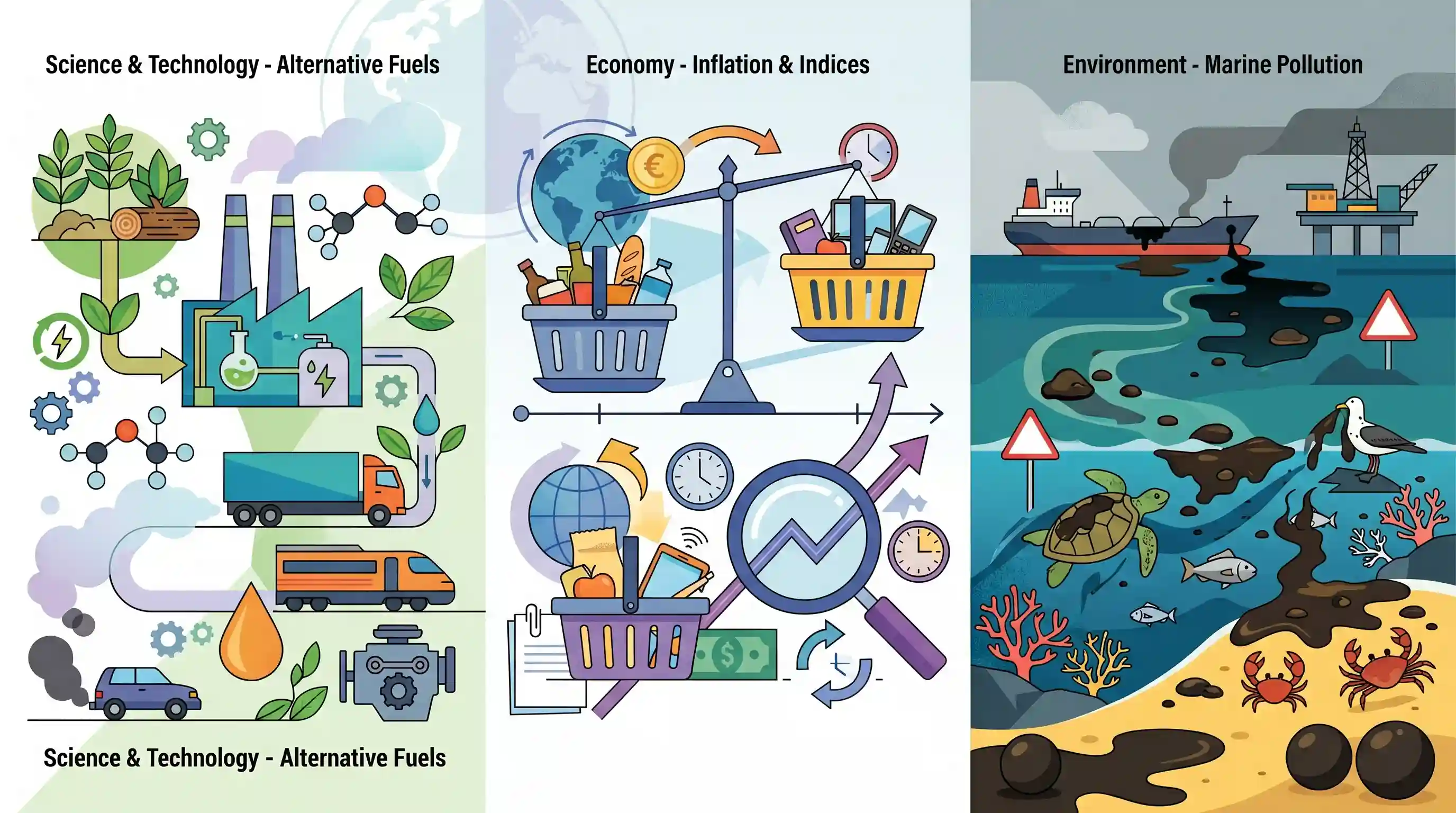
Why It Matters
These topics directly align with recurring UPSC Prelims themes. Understanding alternative fuels (like DME) is critical for questions on India's energy transition; CPI and base year concepts form the bedrock of macroeconomic inflation targeting by the RBI; and tar balls represent a specific, observable phenomenon related to the broader topic of marine conservation and oil spills.
Summary
This UPSC Prelims snapshot highlights three crucial topics across different subjects: Dimethyl Ether (DME) as a sustainable and clean alternative fuel, the significance of revising the Consumer Price Index (CPI) base year for accurate inflation tracking, and the environmental threat posed by tar balls to marine and coastal ecosystems.
Key Points
- Dimethyl Ether (DME) is a synthetically produced, clean-burning alternative fuel that can be blended with LPG or used as a substitute for diesel, producing zero soot and significantly lower emissions.
- The Consumer Price Index (CPI) base year is periodically revised by the government to accurately reflect changing consumer expenditure patterns and provide a realistic measure of retail inflation.
- Tar balls are dark, sticky blobs formed by the weathering of crude oil in the ocean; they frequently wash up on beaches, serving as a prominent indicator of marine oil pollution and posing a threat to coastal ecosystems.
Important Terms
Dimethyl Ether (DME)

A clean-burning, non-toxic synthetic fuel with a high cetane number, used as a sustainable alternative to diesel and LPG. It is produced from natural gas, biomass, or coal.
UPSC context
GS Paper 3 (Energy/Science); relates to alternative fuels and NITI Aayog’s Methanol Economy initiative.
Tar Balls
Sticky, dark blobs of weathered crude oil formed by spills or natural seepage. They carry toxins like heavy metals to shores, severely impacting marine biodiversity and coastal tourism.
UPSC context
GS Paper 3 (Environment); covers marine pollution and ecological hazards of offshore oil activities.
Base Year
A reference period (newly revised to 2024 for CPI) used for comparing economic indices. Regular updates ensure that the weight of items reflects current household consumption and economic reality.
UPSC context
GS Paper 3 (Economy); essential for inflation tracking and accurately measuring India's GDP growth.
Reserve Bank of India (RBI)
India’s central bank, established in 1935, responsible for monetary policy, banking regulation, and maintaining price stability via a flexible inflation targeting framework (currently 4% +/- 2%).
UPSC context
GS Paper 3 (Economy); core topic for monetary policy and macroeconomic management.
Ministry of Statistics and Programme Implementation (MoSPI)
The nodal ministry for official statistics in India. It manages the National Statistical Office (NSO), compiles GDP and CPI, and monitors large-scale government infrastructure projects.
UPSC context
GS Paper 2 & 3 (Governance/Economy); involves institutional data governance and economic planning.
Prelims Trap
Blending Dimethyl Ether (DME) with LPG requires significant modifications to existing household cylinders.
While higher blends might require adjustments, blending DME with conventional LPG up to 8% requires absolutely zero modifications to existing LPG cylinders or stoves.
Static Concepts Connected
What are the core differences between CPI and WPI in India's inflation targeting?
- Goods vs Services: CPI covers both goods and services consumed at the retail level, whereas WPI covers only goods tracked at the wholesale/producer level.
- Nodal Agencies: CPI is compiled by the NSO (MoSPI), while WPI is published by the Office of the Economic Adviser (Ministry of Commerce and Industry).
- Policy Anchor: The RBI exclusively uses CPI (Combined) as the nominal anchor for its Flexible Inflation Targeting (FIT) framework, making it the primary policy metric.
How is marine oil pollution (like tar balls) naturally and artificially remediated?
- Weathering Process: Physical and chemical breakdown in oceans leads to evaporation, emulsification, and the eventual formation of highly persistent tar balls.
- Bioremediation: Techniques like 'Oilzapper' (a bacterial consortium developed by TERI) actively degrade hydrocarbon compounds in oil spills into harmless CO2 and water.
Cross-Topic Patterns
CPI Revision & HCES Data Link
The 2024 CPI base year revision is heavily anchored by the recent Household Consumption Expenditure Survey (HCES 2022-23), reflecting a historic dip in rural and urban food expenditure shares.
DME & Coal Gasification Mission
DME synthesis from syngas links directly to India's National Coal Gasification Mission, offering a strategic pathway to transform high-ash domestic coal into clean-burning alternative fuels.

Expect a multi-statement 2026 prelims question contrasting DME's properties with Green Hydrogen, alongside CPI weightage shifts.
Linked PYQs · 4
Linked PYQs · 4
- 2020PrelimsGS1
Consider the following statements: 1. The weightage of food in Consumer Price Index (CPI) is higher than that in Wholesale Price Index (WPI). 2. The WPI does not capture changes in the prices of services, which CPI does. 3. Reserve Bank of India has now adopted WPI as its key measure of inflation and to decide on changing the key policy rates. Which of the statements given above is/are correct?
- 2022PrelimsGS1
In India, which one of the following is responsible for maintaining price stability by controlling inflation?
- 2025PrelimsGS1
Consider the following types of vehicles : I. Full battery electric vehicles II. Hydrogen fuel cell vehicles III. Fuel cell-electric hybrid vehicles How many of the above are considered as alternative powertrain vehicles?
- 2019PrelimsGS1
Why is there a great concern about the 'microbeads' that are released into environment?
