Sanchar Saathi Portal and SIM-Binding Cybersecurity Framework
Source:Indian Express ↗
Why It Matters
As India rapidly digitizes, telecom fraud and cyber financial crimes are significant internal security challenges. Concepts like the Sanchar Saathi portal and SIM-binding are highly relevant for GS Paper 3 (Internal Security & Cyber Challenges) and GS Paper 2 (E-Governance initiatives), giving aspirants a technological understanding of how the state seeks to protect its digital economy.
Summary
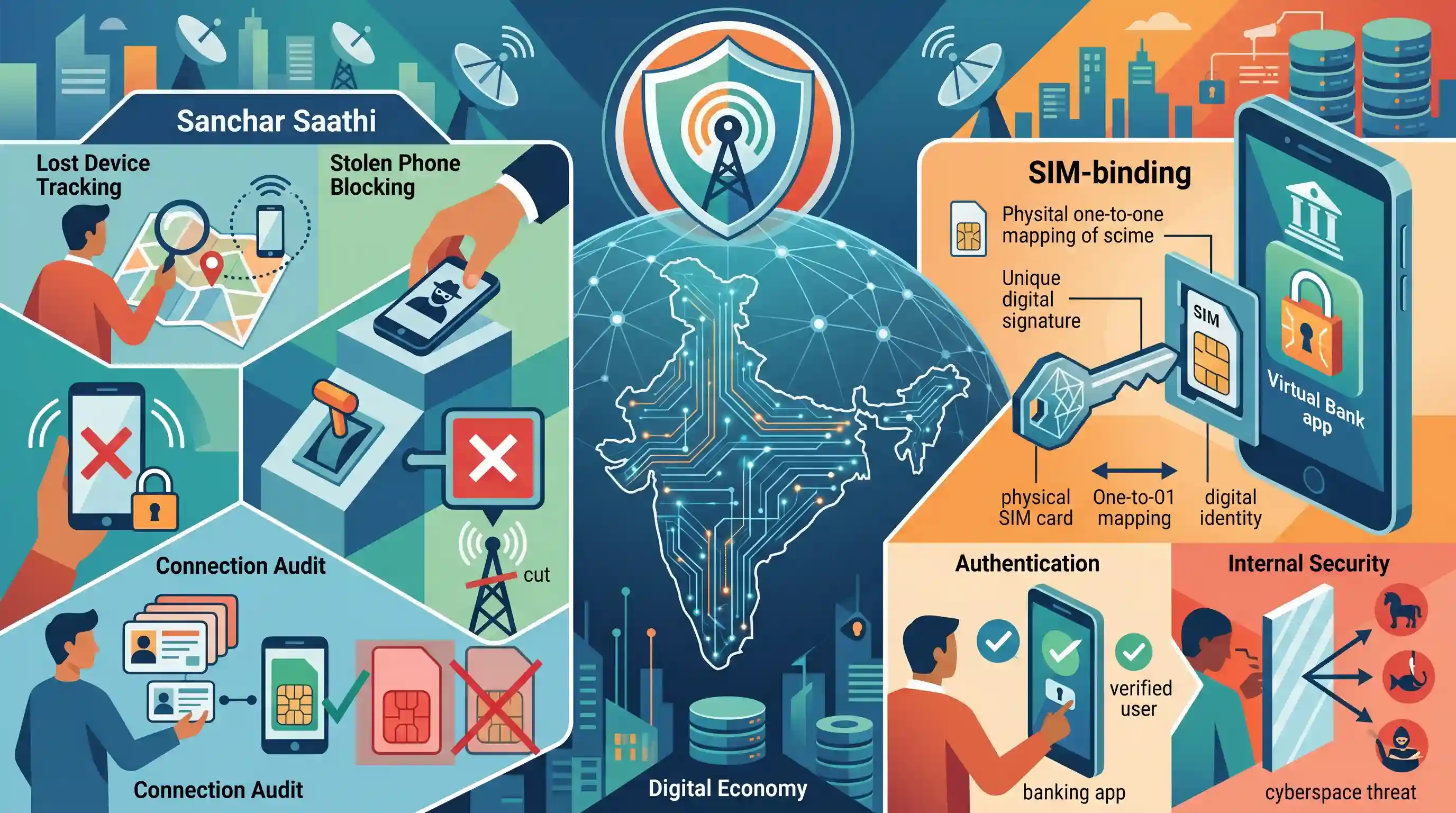
The article examines India's proactive cybersecurity measures, specifically focusing on the Sanchar Saathi portal and SIM-binding technologies. The Sanchar Saathi portal, developed by the Department of Telecommunications (DoT), provides citizens with essential tools (like CEIR and TAFCOP) to track lost devices, block stolen phones, and audit mobile connections registered to their identity, effectively curbing telecom-related frauds. Additionally, SIM-binding is highlighted as a fundamental security layer utilized by banking and payment apps to authenticate users by mapping their digital identity to the physical SIM card in their device. Together, these technological and administrative interventions highlight the government's rigorous push to secure India's expanding digital economy, protect user privacy, and neutralize internal security threats emanating from cyberspace.
Key Points
- The Sanchar Saathi portal is an initiative by the Department of Telecommunications (DoT) aimed at empowering citizens to track and block lost or stolen mobile phones and manage connections registered under their name.
- Key tools within Sanchar Saathi include the Central Equipment Identity Register (CEIR) and Telecom Analytics for Fraud Management and Consumer Protection (TAFCOP).
- SIM-binding is a crucial cybersecurity mechanism, predominantly used in mobile banking and digital payment applications, which directly links user credentials to a specific SIM card to prevent unauthorized access, spoofing, and cloning.
- These initiatives form a cornerstone of India's broader cybersecurity push to mitigate rising financial frauds, cybercrimes, and identity thefts linked to the misuse of telecommunication networks.
- Strengthening digital payment security and telecom infrastructure is vital for building trust in the Digital India vision, securing financial inclusion efforts, and protecting citizens' privacy.
Important Terms
Sanchar Saathi Portal

A citizen-centric web portal developed by the Department of Telecommunications to empower mobile users, track lost devices, and manage mobile connections to curb telecom-related identity theft and fraud.
UPSC context
GS Paper 3: Science & Tech / Internal Security. Focus on e-governance initiatives and cybersecurity measures in India.
SIM-binding
A security mechanism that links a digital account (e.g., banking or messaging app) to a specific physical SIM card, preventing access if the registered SIM is absent from the device.
UPSC context
GS Paper 3: Cybersecurity. Essential for understanding financial fraud prevention and two-factor authentication (2FA) technologies.
Central Equipment Identity Register (CEIR)
A central database of IMEI numbers used to block and trace lost or stolen mobile phones across all Indian telecom networks, rendering stolen devices unusable.
UPSC context
GS Paper 3: Internal Security. Relates to curbing mobile theft and neutralizing security threats from unauthorized devices.
TAFCOP (Telecom Analytics for Fraud management and Consumer Protection)
A portal module enabling subscribers to check the number of mobile connections registered in their name and report fraudulent or unauthorized SIMs for deactivation.
UPSC context
GS Paper 2/3: Governance / Security. Tests awareness of citizen-centric tools to prevent identity theft and fraud.
Department of Telecommunications (DoT)
The executive body under the Ministry of Communications responsible for telecom policy, licensing, and national cybersecurity initiatives like the Sanchar Saathi portal.
UPSC context
GS Paper 2: Statutory/Executive Bodies. Key entity for infrastructure, regulation, and digital sovereignty.
Telecom Regulatory Authority of India (TRAI)
The independent statutory regulator of India’s telecom sector, tasked with ensuring fair competition, setting quality-of-service standards, and protecting consumer interests against spam and fraud.
UPSC context
GS Paper 2: Statutory Bodies. Tests understanding of regulatory frameworks in the telecommunications and digital communication sectors.
Prelims Trap
"The Sanchar Saathi portal is a flagship initiative of the Ministry of Electronics and Information Technology (MeitY)."
Sanchar Saathi was developed and launched by the Department of Telecommunications (DoT) under the Ministry of Communications, not MeitY.
Static Concepts Connected
How do IMEI, IMSI, and MAC addresses differ?
- IMEI: Identifies the physical mobile device globally. The CEIR module uses this 15-digit number to block stolen phones across all networks.
- IMSI: Identifies the individual subscriber profile securely stored on the SIM card to authenticate them to the mobile network.
- MAC Address: A unique identifier assigned to network interfaces (Wi-Fi/Bluetooth) for communications on a local network segment.
What is SIM-binding in the context of digital authentication?
- Hardware locking: It algorithmically links a specific digital application (like UPI or banking apps) to the physical SIM card currently residing in the device.
- Fraud mitigation: If the SIM is swapped, removed, or cloned to another device, the app instantly revokes access, thereby preventing unauthorized spoofing.
Cross-Topic Patterns
Telecom Regulation + Digital Arrests
Expanding SIM-binding to OTT messaging apps (WhatsApp, Telegram) intersects with the new Telecommunications Act 2023's push to curb cross-border 'digital arrest' and impersonation scams.
Fake SIMs + Money Laundering
TAFCOP's ability to audit SIM registrations tackles the root of mule accounts, linking telecom fraud directly to PMLA and organized terror financing investigations.

Expect a 2026 Prelims question on Sanchar Saathi (CEIR/TAFCOP) paired with SIM-binding, testing the difference between device and SIM IDs.
Linked PYQs · 5
Linked PYQs · 5
- 2020PrelimsGS1
In India, under cyber insurance for individuals, which of the following benefits are generally covered, in addition to payment for the loss of funds and other benefits? 1. Cost of restoration of the computer system in case of malware disrupting access to one's computer 2. Cost of a new computer if some miscreant wilfully damages it, if proved so 3. Cost of hiring a specialized consultant to minimize the loss in case of cyber extortion 4. Cost of defence in the Court of Law if any third party files a suit Select the correct answer using the code given below:
- 2020PrelimsGS1
In India, the term "Public Key Infrastructure" is used in the context of
- 2024PrelimsGS1
Under which of the following Articles of the Constitution of India, has the Supreme Court of India placed the Right to Privacy ?
- 2020MainsGS3
Discuss different types of cyber crimes and measures required to be taken to fight the menace.
- 2017MainsGS3
Discuss the potential threats of Cyber attack and the security framework to prevent it.
