डब्ल्यूटीओ सुधार, झारखंड राज्य गठन और एसईजेड की चुनौतियां
स्रोत:इंडियन एक्सप्रेस ↗
क्यों मायने रखता है
Understanding WTO reforms is crucial for India's international trade strategy and protecting domestic agriculture. Analyzing Jharkhand's 25-year journey provides critical insights into the success of smaller states and tribal welfare policies. Evaluating SEZs is vital for addressing India's manufacturing deficits and boosting export competitiveness.
सारांश
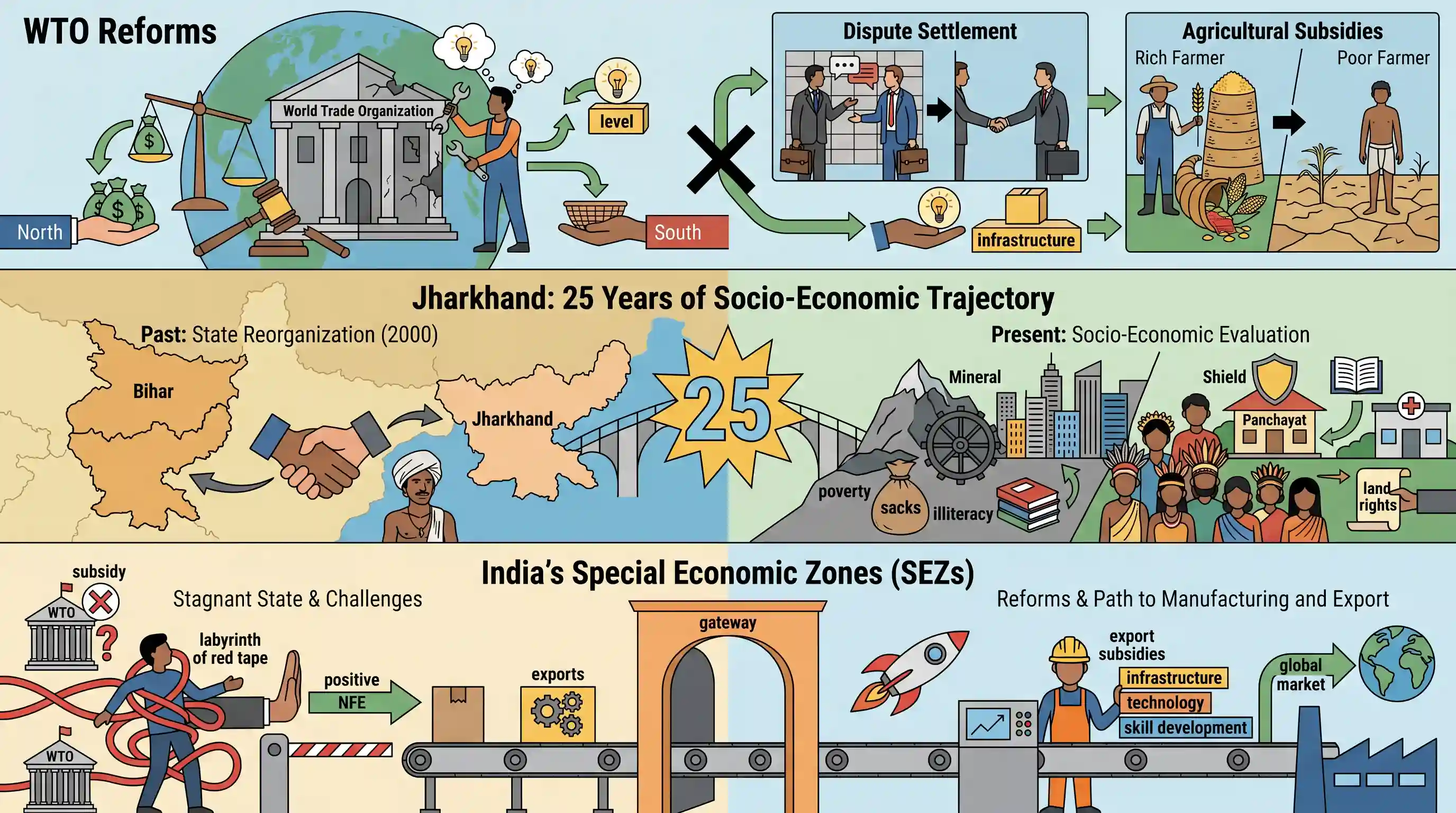
The article provides a UPSC-oriented analysis of three critical topics: the pressing need for World Trade Organization (WTO) reforms (particularly dispute settlement and agricultural subsidies), an evaluation of Jharkhand's socio-economic trajectory and tribal development 25 years after its formation, and the structural challenges and reform requirements for India's Special Economic Zones (SEZs) to effectively drive manufacturing and exports.
मुख्य बिंदु
- WTO सुधार: WTO विवाद समाधान तंत्र और अपीलीय निकाय (Appellate Body) को ठीक करने की तात्कालिकता के साथ-साथ, कृषि सब्सिडी और विकासशील देश के दर्जे के संबंध में भारत की जारी वार्ताओं पर जोर देता है।
- Jharkhand's Statehood Anniversary: Assesses the progress of Jharkhand at 25 years, analyzing the outcomes of state reorganization, persistent challenges in tribal development and rehabilitation, and the management of Left-Wing Extremism.
- SEZ Performance and Revitalization: Examines the role of Special Economic Zones in boosting manufacturing, exports, and FDI, while highlighting administrative and taxation bottlenecks that require policy overhauls (such as those recommended by the Baba Kalyani Committee).
महत्वपूर्ण शब्द
Special Economic Zones Act, 2005

A 2005 legislation providing the legal framework for SEZs—duty-free enclaves treated as foreign territory for trade—aimed at boosting exports, attracting FDI, and developing infrastructure.
UPSC context
GS Paper III (Economy/Industrial Policy); relevant for understanding export promotion and regulatory frameworks for manufacturing.
World Trade Organization (WTO)
राष्ट्रों के बीच व्यापार को विनियमित करने वाला एकमात्र वैश्विक अंतरराष्ट्रीय संगठन (स्थापना 1995)। यह व्यापार समझौतों का प्रबंधन करता है, विवाद समाधान तंत्र प्रदान करता है और एक नियम-आधारित वैश्विक व्यापार प्रणाली सुनिश्चित करता है।
UPSC context
GS पेपर II (अंतर्राष्ट्रीय संस्थान) और पेपर III (आर्थिक संबंध); वैश्विक शासन और व्यापार मुद्दों के लिए अनिवार्य।
बाबा कल्याणी समिति
A 2018 committee formed to reform SEZ policy. It recommended shifting from an export-centric focus to broader "Employment and Economic Enclaves" (3Es) to ensure WTO compliance.
UPSC context
GS पेपर III (औद्योगिक सुधार); आर्थिक विकास और व्यापार नीति अपडेट से संबंधित समितियों/आयोगों के तहत परीक्षण किया गया।
प्रारंभिक ट्रैप
The WTO Peace Clause provides a permanent, unconditional exemption from subsidy limits for India's public stockholding.
पीस क्लॉज़ (Peace Clause) 2013 के बाली मंत्रिस्तरीय सम्मेलन में सहमत एक अंतरिम उपाय है, न कि कोई स्थायी समाधान। यह अधिसूचना और पारदर्शिता की कठिन आवश्यकताओं को पूरा करने पर पूरी तरह निर्भर है।
संबंधित अवधारणाएँ
What are the three primary 'Boxes' of agricultural subsidies under the WTO?
- Amber Box: व्यापार-विकृत करने वाली सब्सिडी (जैसे, MSP, उर्वरक सहायता) जो कटौती की प्रतिबद्धताओं और 'De Minimis' सीमाओं के अधीन हैं।
- ब्लू बॉक्स (Blue Box): Amber Box subsidies with conditions designed to limit production. Currently, there are no limits on spending in this box.
- Green Box: Non-trade-distorting support (e.g., R&D, environmental protection, decoupled income support) that are permitted without any spending limits.
How does the Indian Constitution govern the creation of new states?
- अनुच्छेद 3: संसद को साधारण बहुमत से नए राज्यों के गठन की शक्ति देता है, जिसके लिए राष्ट्रपति की पूर्व सिफारिश आवश्यक है।
- State Consultation: The President must refer the reorganization bill to the concerned state legislature for its views, though these views are not binding on Parliament.
- अनुच्छेद 4: Explicitly states that laws made for state reorganization under Articles 2 and 3 are not considered constitutional amendments under Article 368.
अंतर-विषय पैटर्न
SEZ evolution to the DESH Bill
The evolution from the SEZ Act (2005) to the proposed DESH Bill reflects the Baba Kalyani Committee's recommendation to shift from strict export-centric enclaves to inclusive domestic manufacturing hubs.
Statehood outcomes vs. 5th Schedule realities
झारखंड का 25 वर्षों का सफर राजनीतिक राज्य का दर्जा प्राप्त करने और पांचवीं अनुसूची के अधिदेशों (जैसे PESA) को लागू करने के बीच के निरंतर अंतराल को रेखांकित करता है, ताकि जनजातीय भूमि हस्तांतरण और वामपंथी उग्रवाद पर सार्थक रूप से अंकुश लगाया जा सके।

WTO's Appellate body crisis and India's 'Peace Clause' conditions for public stockholding are prime candidates for 2026 Prelims.
संबद्ध PYQ · 5
संबद्ध PYQ · 5
- 2010PrelimsGS1
As regards the use of international food safety standards as reference point for the dispute settlements, which one of the following does WTO collaborate with?
- 2023MainsGS3
What are the direct and indirect subsidies provided to farm sector in India? Discuss the issues raised by the World Trade Organization (WTO) in relation to agricultural subsidies.
- 2025MainsGS1
Does tribal development in India centre around two axes, those of displacement and of rehabilitation? Give your opinion.
- 2022MainsGS1
The political and administrative reorganization of states and territories has been a continuous ongoing process since the mid-nineteenth century. Discuss with examples.
- 2015MainsGS3
There is a clear acknowledgement that Special Economic Zones (SEZs) are a tool of industrial development, manufacturing and exports. Recognizing this potential, the whole instrumentality of SEZs requires augmentation. Discuss the issues plaguing the success of SEZs with respect to taxation, governing laws and administration.
