WTO Reforms Jharkhand Statehood and SEZ Challenges
Source:Indian Express ↗
Why It Matters
Understanding WTO reforms is crucial for India's international trade strategy and protecting domestic agriculture. Analyzing Jharkhand's 25-year journey provides critical insights into the success of smaller states and tribal welfare policies. Evaluating SEZs is vital for addressing India's manufacturing deficits and boosting export competitiveness.
Summary
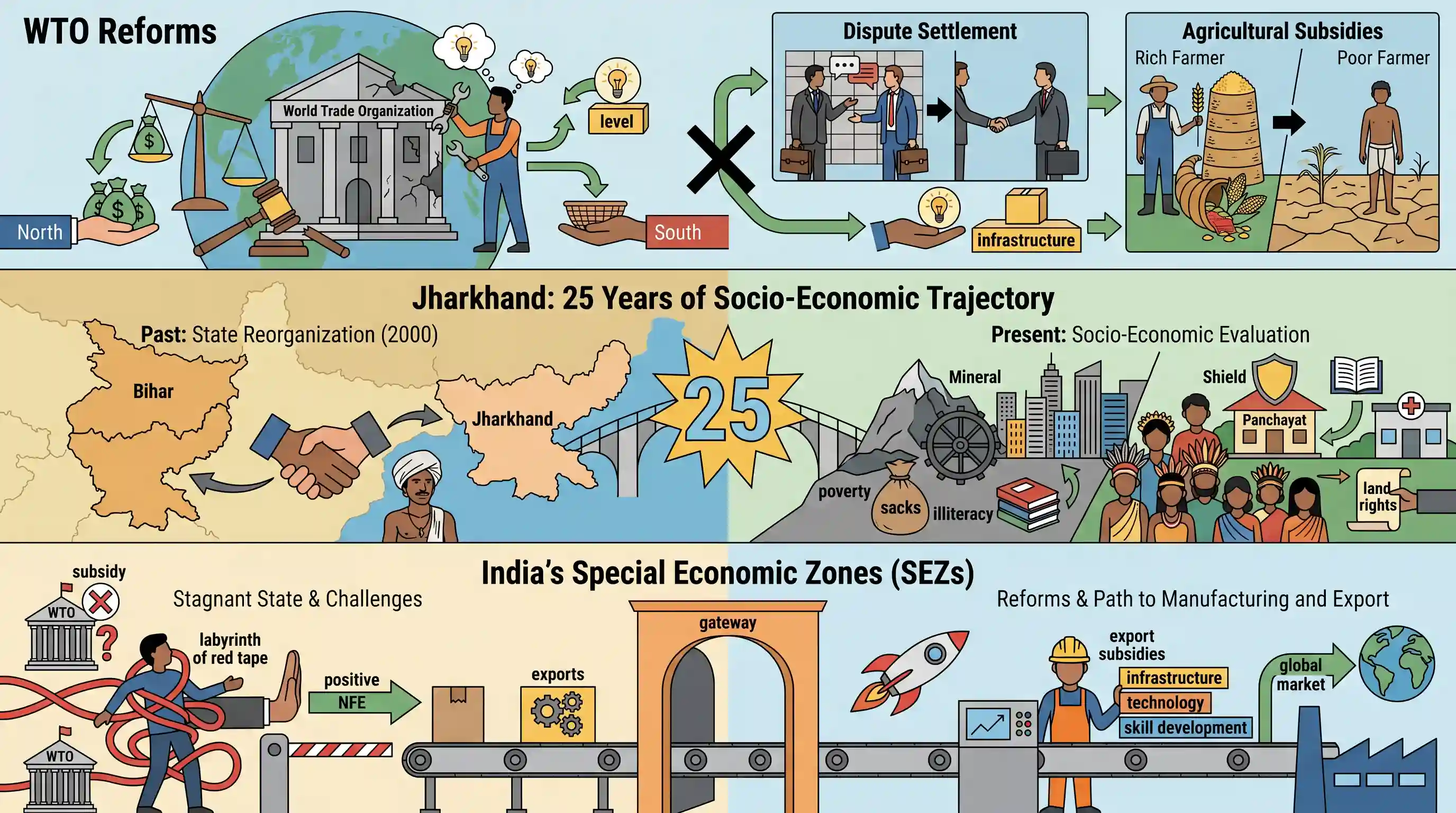
The article provides a UPSC-oriented analysis of three critical topics: the pressing need for World Trade Organization (WTO) reforms (particularly dispute settlement and agricultural subsidies), an evaluation of Jharkhand's socio-economic trajectory and tribal development 25 years after its formation, and the structural challenges and reform requirements for India's Special Economic Zones (SEZs) to effectively drive manufacturing and exports.
Key Points
- WTO Reforms: Emphasizes the urgency of fixing the WTO dispute settlement mechanism and Appellate Body, alongside India's ongoing negotiations regarding agricultural subsidies and developing country status.
- Jharkhand's Statehood Anniversary: Assesses the progress of Jharkhand at 25 years, analyzing the outcomes of state reorganization, persistent challenges in tribal development and rehabilitation, and the management of Left-Wing Extremism.
- SEZ Performance and Revitalization: Examines the role of Special Economic Zones in boosting manufacturing, exports, and FDI, while highlighting administrative and taxation bottlenecks that require policy overhauls (such as those recommended by the Baba Kalyani Committee).
Important Terms
Special Economic Zones Act, 2005

A 2005 legislation providing the legal framework for SEZs—duty-free enclaves treated as foreign territory for trade—aimed at boosting exports, attracting FDI, and developing infrastructure.
UPSC context
GS Paper III (Economy/Industrial Policy); relevant for understanding export promotion and regulatory frameworks for manufacturing.
World Trade Organization (WTO)
The sole global international organization (est. 1995) regulating trade between nations. It manages trade agreements, provides a dispute settlement mechanism, and ensures a rules-based global trading system.
UPSC context
GS Paper II (International Institutions) and Paper III (Economic Relations); essential for global governance and trade issues.
Baba Kalyani Committee
A 2018 committee formed to reform SEZ policy. It recommended shifting from an export-centric focus to broader "Employment and Economic Enclaves" (3Es) to ensure WTO compliance.
UPSC context
GS Paper III (Industrial Reforms); tested under committees/commissions related to economic growth and trade policy updates.
Prelims Trap
The WTO Peace Clause provides a permanent, unconditional exemption from subsidy limits for India's public stockholding.
The Peace Clause is an interim measure agreed upon at the 2013 Bali Ministerial, not a permanent solution. It is strictly contingent on fulfilling onerous notification and transparency requirements.
Static Concepts Connected
What are the three primary 'Boxes' of agricultural subsidies under the WTO?
- Amber Box: Trade-distorting subsidies (e.g., MSP, fertilizer support) that are subject to reduction commitments and 'De Minimis' limits.
- Blue Box: Amber Box subsidies with conditions designed to limit production. Currently, there are no limits on spending in this box.
- Green Box: Non-trade-distorting support (e.g., R&D, environmental protection, decoupled income support) that are permitted without any spending limits.
How does the Indian Constitution govern the creation of new states?
- Article 3: Empowers Parliament to form new states by a simple majority, requiring prior recommendation of the President.
- State Consultation: The President must refer the reorganization bill to the concerned state legislature for its views, though these views are not binding on Parliament.
- Article 4: Explicitly states that laws made for state reorganization under Articles 2 and 3 are not considered constitutional amendments under Article 368.
Cross-Topic Patterns
SEZ evolution to the DESH Bill
The evolution from the SEZ Act (2005) to the proposed DESH Bill reflects the Baba Kalyani Committee's recommendation to shift from strict export-centric enclaves to inclusive domestic manufacturing hubs.
Statehood outcomes vs. 5th Schedule realities
Jharkhand's 25-year trajectory highlights the persistent gap between achieving political statehood and implementing 5th Schedule mandates (like PESA) to meaningfully curb tribal land alienation and Left-Wing Extremism.

WTO's Appellate body crisis and India's 'Peace Clause' conditions for public stockholding are prime candidates for 2026 Prelims.
Linked PYQs · 5
Linked PYQs · 5
- 2010PrelimsGS1
As regards the use of international food safety standards as reference point for the dispute settlements, which one of the following does WTO collaborate with?
- 2023MainsGS3
What are the direct and indirect subsidies provided to farm sector in India? Discuss the issues raised by the World Trade Organization (WTO) in relation to agricultural subsidies.
- 2025MainsGS1
Does tribal development in India centre around two axes, those of displacement and of rehabilitation? Give your opinion.
- 2022MainsGS1
The political and administrative reorganization of states and territories has been a continuous ongoing process since the mid-nineteenth century. Discuss with examples.
- 2015MainsGS3
There is a clear acknowledgement that Special Economic Zones (SEZs) are a tool of industrial development, manufacturing and exports. Recognizing this potential, the whole instrumentality of SEZs requires augmentation. Discuss the issues plaguing the success of SEZs with respect to taxation, governing laws and administration.
