Vikram-1 Rocket and Tenkasi Archaeological Finds
Source:Indian Express ↗
આ શા માટે મહત્વનું છે
This article is highly relevant as it bridges static concepts in the UPSC syllabus with active current affairs. It provides critical perspectives on private participation in space (GS3), Megalithic/Iron Age archaeology in South India (GS1), and the intricacies of inflation targeting by the RBI (GS3).
સારાંશ
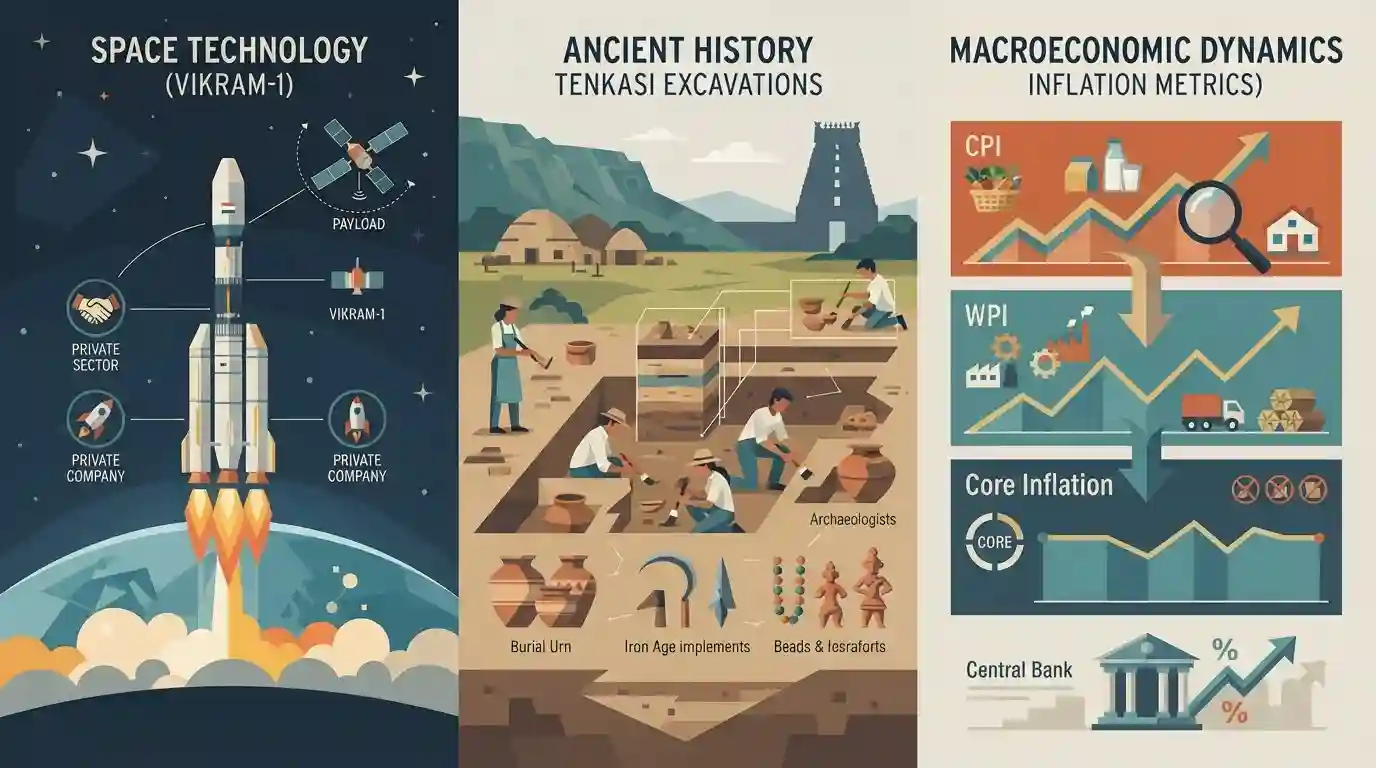
This article is a comprehensive UPSC-oriented analysis highlighting three major developments across the syllabus: the technological achievements of the privately developed Vikram-1 launch vehicle, the historical and cultural significance of the newly excavated Iron Age settlements in Tenkasi (Tamil Nadu), and the macroeconomic dynamics behind India's three major inflation metrics (CPI, WPI, and Core Inflation).
મુખ્ય મુદ્દા
- Vikram-1 Launch Vehicle: Developed by Hyderabad-based Skyroot Aerospace, Vikram-1 is a multi-stage rocket designed to deploy small satellites into Low Earth Orbit (LEO). It features advanced carbon composite structures, solid fuel stages, and 3D-printed liquid engines, showcasing India's growing private space sector capabilities under IN-SPACe reforms.
- Tenkasi Archaeological Settlement: Excavations in Tenkasi, Tamil Nadu, have unearthed crucial Iron Age/Megalithic burial-cum-habitation sites. These findings, including urn burials and iron implements, offer valuable insights into the socio-cultural, technological (metallurgy), and settlement patterns of ancient South India.
- India's Three Inflations: The article analyzes the divergence among three distinct inflation trends in India—Retail Inflation (CPI), Wholesale Inflation (WPI), and Core Inflation. CPI reflects household expenses and is heavily weighted toward volatile food items, WPI measures bulk transaction prices driven by global commodities, and Core Inflation excludes food and fuel to signal structural domestic demand.
- Policy Intersections: These three issues highlight the multifaceted nature of Indian governance—ranging from fostering private innovation in deep-tech sectors to implementing targeted monetary policies for macroeconomic stability, alongside documenting cultural heritage through scientific excavations.
મહત્વપૂર્ણ શબ્દો
Monetary Policy Framework Agreement

A 2015 accord between the Government of India and the RBI that institutionalized flexible inflation targeting, establishing a 4% CPI target with a ±2% tolerance band and paving the way for the Monetary Policy Committee.
UPSC context
GS Paper III (Indian Economy). Tests understanding of inflation management, institutional frameworks, and coordination between fiscal and monetary authorities.
IN-SPACe (Indian National Space Promotion and Authorization Center)
An autonomous, single-window nodal agency under India’s Department of Space established to promote, permit, and regulate space activities of private entities and facilitate their usage of ISRO infrastructure.
UPSC context
GS Paper III (Science and Technology). Tests knowledge of space sector reforms and private participation in India's space technologies.
Skyroot Aerospace
A Hyderabad-based private Indian space-tech startup that developed Vikram-1, becoming the first private company in India to successfully launch a multi-stage orbital rocket into space under Mission Aagaman.
UPSC context
GS Paper III (Science and Technology). Tests awareness of indigenous private space-tech innovations, start-up ecosystem, and commercial launch capabilities.
Tamil Nadu State Department of Archaeology (SDA)
A state government department established in 1961 responsible for conducting archaeological excavations, deciphering inscriptions, and preserving monuments, recently excavating significant Iron Age and Sangam-era sites in Tenkasi and Keeladi.
UPSC context
GS Paper I (Art & Culture / Ancient History). Tests understanding of regional archaeological excavations, ancient cultural horizons, and early South Indian urbanization.
Reserve Bank of India (RBI)
India's central bank and monetary authority, established under the RBI Act of 1934, responsible for regulating currency, managing money supply, supervising financial systems, and targeting inflation to ensure macroeconomic stability.
UPSC context
GS Paper III (Indian Economy). Tests grasp of central banking functions, monetary policy tools, and financial regulation.
Indian Space Research Organisation (ISRO)
India's national space agency under the Department of Space, mandated to develop space technology and execute space applications, exploration missions, and coordinate with private actors to expand India’s space economy.
UPSC context
GS Paper III (Science and Technology). Tests knowledge of national space missions, indigenous technological developments, and institutional space architecture.
પ્રિલિમ્સ ટ્રેપ
The Wholesale Price Index (WPI) captures inflation in both goods and services at the bulk-transaction level.
WPI excludes services entirely, tracking only primary articles, fuel and power, and manufactured products. CPI, however, covers both goods and services.
સંલગ્ન સ્થિર ખ્યાલો
What are the structural differences between CPI and WPI in India?
- Compilation Agency: CPI-Combined is published by the NSO (MoSPI); WPI is compiled by the Office of the Economic Adviser, DPIIT (Ministry of Commerce and Industry).
- Item Coverage: CPI covers both goods and services at the retail level; WPI covers only goods at the wholesale transaction level.
- Weightage Patterns: CPI-Combined is heavily weighted toward Food and Beverages (~45.86%), whereas WPI gives maximum weight to Manufactured Products (~64.2%).
What is the historical significance of Megalithic burial sites in South India?
- Burial Practices: Characterized by urn burials, stone circles, and dolmens, indicating complex post-death rituals, ancestor worship, and community-based settlements.
- Metallurgical Skills: Megalithic people possessed advanced iron smelting capabilities (weapons, agricultural tools) and produced high-tin bronze through precise copper-tin alloying.
- Trade Connectivity: Sites close to Western Ghats passes (like Shencottah) facilitated trans-peninsular trade connecting Pandyan core areas to Malabar ports and Roman trade networks.
આંતર-વિષય પેટર્ન
Sangam trade & Indo-Roman maritime commerce
Natural passes in the Western Ghats (like Shencottah) linked inland centers to the west coast, showing how local material culture directly intersected with ancient Indo-Roman maritime trade.
Private space tech + Strategic defense indigenization
Advanced composite manufacturing and 3D-printing techniques used by private space startups have strategic dual-use potentials, boosting domestic aerospace manufacturing capacity.

Ancient trade routes (Shencottah pass) and high-tin bronze site locations are prime candidates for 2026 archaeological matching questions.
સંલગ્ન PYQ · 4
સંલગ્ન PYQ · 4
- 2016MainsGS3
Discuss India's achievements in the field of Space Science and Technology. How the application of this technology has helped India in its socio-economic development?
- 2020PrelimsGS1
Consider the following statements: 1. The weightage of food in Consumer Price Index (CPI) is higher than that in Wholesale Price Index (WPI). 2. The WPI does not capture changes in the prices of services, which CPI does. 3. Reserve Bank of India has now adopted WPI as its key measure of inflation and to decide on changing the key policy rates. Which of the statements given above is/are correct?
- 2024MainsGS3
What are the causes of persistent high food inflation in India? Comment on the effectiveness of the monetary policy of the RBI to control this type of inflation.
- 2024PrelimsGS1
Consider the following information (Archaeological Site — State — Description): 1. Chandraketugarh — Odisha — Trading port town 2. Inamgaon — Maharashtra — Chalcolithic site 3. Mangadu — Kerala — Megalithic site 4. Salihundam — Andhra Pradesh — Rock-cut cave shrines In which of the above rows is the given information correctly matched?
