Census Delay and Public Debt Dynamics for UPSC Preparation
Source:Indian Express ↗
Why It Matters
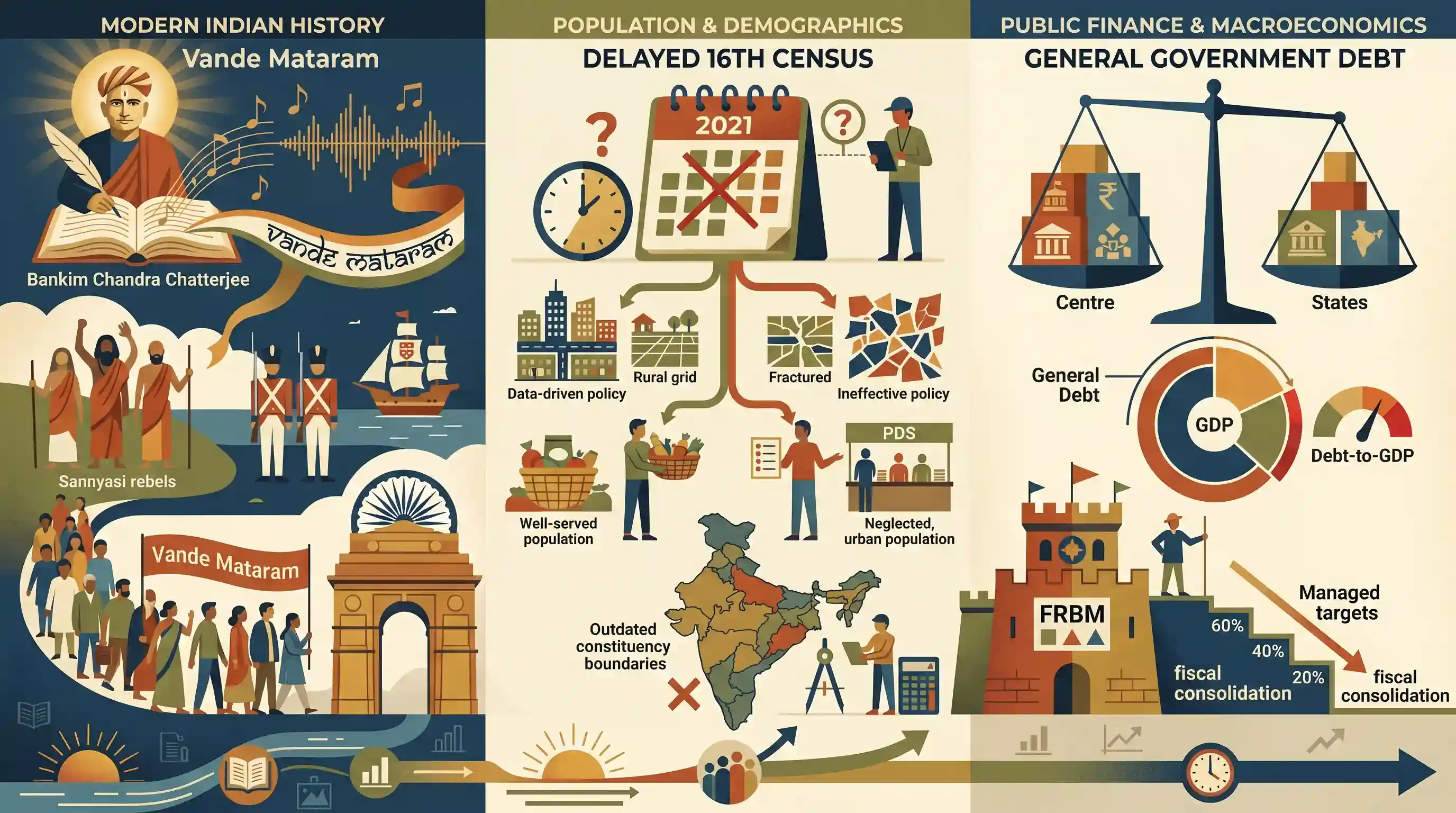
These topics straddle across multiple General Studies papers. 'Vande Mataram' is a recurring historical fact for Prelims. The Census delay poses a severe governance challenge for policy design (GS2) and demographics (GS1), while General Government Debt and the FRBM targets form the core of public finance and macroeconomic stability in GS3.
Summary
The article covers three diverse topics essential for UPSC preparation. First, it discusses the historical context of 'Vande Mataram', authored by Bankim Chandra Chatterjee, exploring its links to the Sannyasi Rebellion and the Indian National Movement. Second, it highlights the implications of the delayed 16th Census of India, emphasizing its necessity for effective policy-making, welfare distribution, and the impending delimitation exercise. Lastly, it explains General Government Debt, examining the combined debt burden of the Centre and States, debt-to-GDP ratios, and the fiscal consolidation targets outlined under the FRBM Act.
Key Points
- The national song 'Vande Mataram' was written by Bankim Chandra Chatterjee in his novel Anandamath, which was set against the backdrop of the Sannyasi Rebellion.
- The 16th Census of India (originally slated for 2021) has faced significant delays, which directly impacts welfare scheme targeting, demographic dividend analysis, and future political delimitation.
- General Government Debt refers to the combined consolidated liabilities of both the Central and State governments.
- The FRBM Review Committee (headed by N.K. Singh) recommended a ceiling for general government debt-to-GDP ratio at 60%, distributed as 40% for the Centre and 20% for the States.
Important Terms
Fiscal Responsibility and Budget Management (FRBM) Act

A 2003 law enacted to institutionalize fiscal discipline, requiring the government to reduce fiscal deficits and public debt to sustainable levels for long-term macroeconomic stability.
UPSC context
GS-III (Indian Economy); essential for questions on fiscal consolidation, deficit management, and inter-generational equity.
Finance Commission
A constitutional body formed under Article 280 that recommends the division of tax revenues between the Union and States (vertical) and among States (horizontal).
UPSC context
GS-II (Polity/Federalism); critical for understanding fiscal federalism, Centre-State financial relations, and devolution formulas.
Census Act 1948
The legal framework governing India's decennial population count; it mandates public participation while ensuring the confidentiality of individual data from legal inspection.
UPSC context
GS-I (Demographics) and GS-II (Governance); vital for discussions on delimitation, welfare targeting, and legal data protection.
General Government Debt
The total combined liabilities of both the Central and State governments, used as a key indicator of a nation's overall fiscal health and debt sustainability.
UPSC context
GS-III (Economy); tests knowledge of debt-to-GDP ratios, fiscal sustainability, and the broader impact of public borrowing.
FRBM Review Committee
A 2016 panel chaired by N.K. Singh that proposed moving toward a debt-to-GDP ratio as the primary fiscal target, recommending a 60% limit for the country.
UPSC context
GS-III (Economy); important for specific policy recommendations like the 'Escape Clause' and the shift to debt-based targets.
Prelims Trap
The N.K. Singh Committee recommended a 60% debt-to-GDP ceiling exclusively for the Central Government.
The 60% target applies to 'General Government Debt'—the combined consolidated liability. It is explicitly divided as 40% for the Centre and 20% for the States.
Static Concepts Connected
What are the key recommendations of the N.K. Singh FRBM Review Committee?
- Debt-to-GDP target: Proposed a combined General Government Debt ceiling of 60% (40% for the Centre, 20% for the States).
- Fiscal Deficit: Recommended a steady glide path to bring down the fiscal deficit to 2.5% of GDP.
- Escape Clause: Allowed up to 0.5% deviation in fiscal targets during unforeseen events like national security crises, severe economic downturns, or agricultural collapse.
What characterized the Sannyasi Rebellion (1763-1800)?
- Primary Causes: Triggered by the catastrophic Bengal Famine of 1770, harsh British revenue policies, and new restrictions placed on wandering ascetics visiting holy sites.
- Key Participants: Formed a united front of Hindu sannyasis, Muslim fakirs (Majnu Shah), displaced peasants, and disbanded soldiers of former Nawabs.
- Literary Legacy: Bankim Chandra Chattopadhyay immortalized the rebellion in his 1882 semi-historical Bengali novel Anandamath, which also introduced the national song 'Vande Mataram'.
Cross-Topic Patterns
Census delay + Delimitation + Women's Quota
The 106th Amendment (Women's Reservation Act) cannot be operationalized until the next delimitation exercise, which is strictly constitutionally contingent upon the final publication of the 16th Census data.
General Govt Debt + Sovereign Credit Ratings
High combined debt (Centre + States) pressures India's sovereign credit rating, impacting the cost of external borrowing and influencing the inclusion of Indian bonds in global debt indices.

Expect a 2026 multi-statement polity question linking the 16th Census delay directly to the operationalization of the 106th Amendment.
Linked PYQs · 5
Linked PYQs · 5
- 2003PrelimsGS1
Which one of the following statements is correct?
- 2021MainsGS1
Discuss the main objectives of Population Education and point out the measures to achieve them in India in detail.
- 2025MainsGS1
Discuss the distribution and density of population in the Ganga River Basin with special reference to land, soil and water resources.
- 2018PrelimsGS1
Consider the following statements: 1. The Fiscal Responsibility and Budget Management (FRBM) Review Committee Report has recommended a debt to GDP ratio of 60% for the general (combined) government by 2023, comprising 40% for the Central Government and 20% for the State Governments. 2. The Central Government has domestic liabilities of 21% of GDP as compared to that of 49% of GDP of the State Governments. 3. As per the Constitution of India, it is mandatory for a State to take the Central Government's consent for raising any loan if the former owes any outstanding liabilities to the latter. Which of the statements given above is/are correct?
- 2021PrelimsGS1
Which one of the following is likely to be the most inflationary in its effects?
