Piprahwa Relics and Social Security Code Labour Reforms
Source:Indian Express ↗
Why It Matters
These themes cover foundational areas of the UPSC syllabus: international geopolitics, India's ancient Buddhist heritage, and modern governance reforms addressing the welfare of the informal labour sector.
Summary
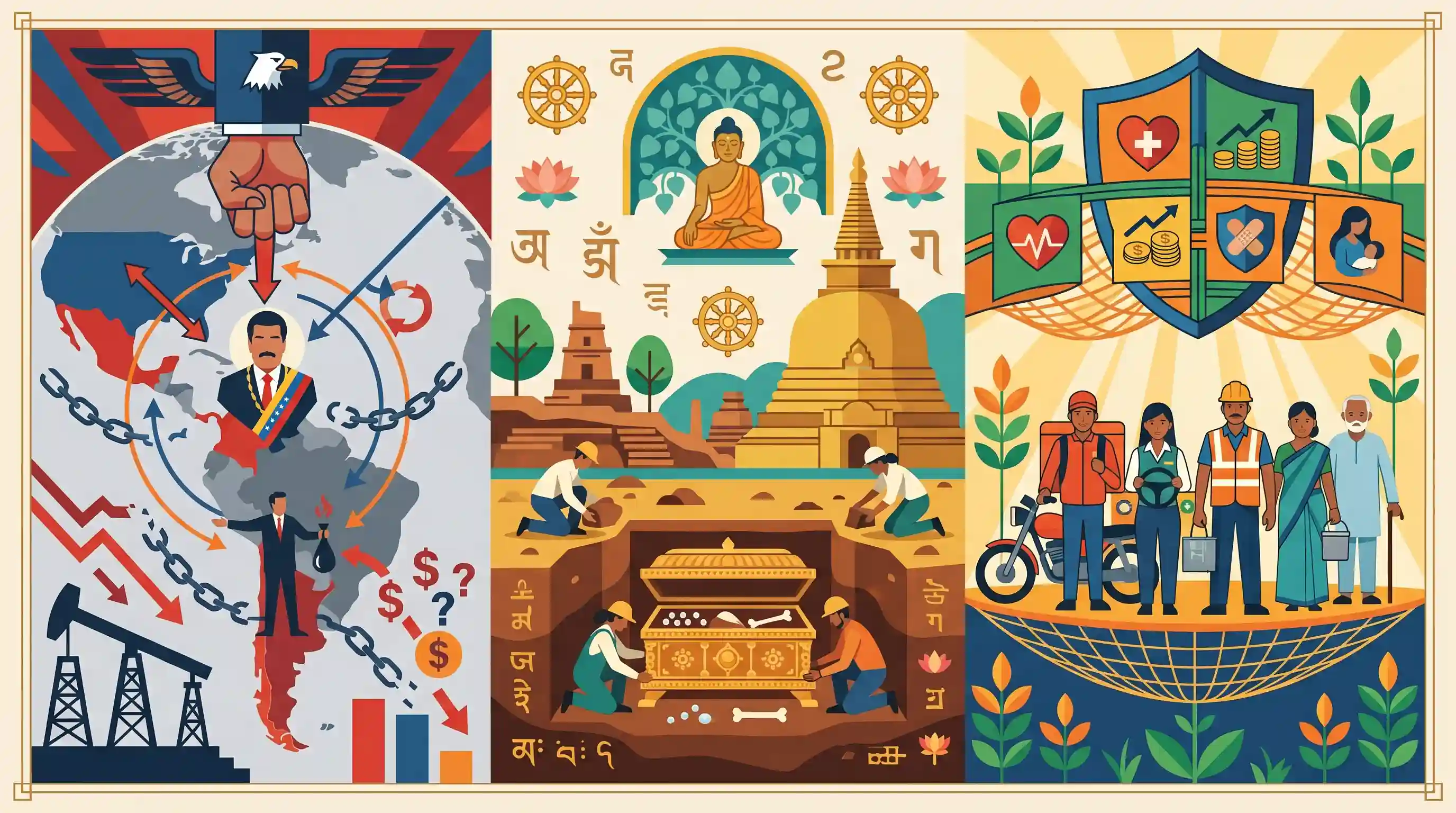
The article explores three distinct topics relevant to the UPSC examination. First, it delves into the international relations sphere by discussing the US efforts to capture Venezuelan President Nicolas Maduro amid an ongoing geopolitical and economic crisis. Second, it highlights the cultural and historical importance of the Piprahwa archaeological site, which houses significant relics of Gautama Buddha. Finally, it analyzes the Social Security Code, an essential legislative reform designed to provide a comprehensive social safety net for India's vast unorganized and gig economy workforce.
Key Points
- The geopolitical standoff between the US and Venezuela has escalated, with the US aggressively targeting Venezuelan President Nicolas Maduro to force a political transition.
- Piprahwa, an archaeological site in Uttar Pradesh, is historically significant as ancient Kapilavastu and is known for the discovery of caskets containing the sacred relics of Gautama Buddha.
- The Social Security Code is a major labour reform in India that consolidates multiple existing laws and aims to extend social security benefits to unorganized, gig, and platform workers.
Important Terms
Code on Social Security, 2020

A 2020 law consolidating nine central statutes to extend benefits like pensions and insurance to all workers, including unorganized, gig, and platform workers.
UPSC context
GS Paper II (Social Justice) & III (Indian Economy); tests inclusive growth and labor welfare reforms.
Labour Codes
Four unified laws (Wage, Industrial Relations, Social Security, OSH) replacing 29 central labor statutes to simplify compliance and modernize India’s labor regulatory framework.
UPSC context
GS Paper III (Indian Economy); crucial for understanding structural reforms and ease of doing business.
Piprahwa Relics
Sacred bone fragments and artifacts discovered in Uttar Pradesh, believed to be the Sakya clan's share of Gautama Buddha's relics; recently repatriated to India in 2025.
UPSC context
GS Paper I (Art and Culture); significant for Buddhism, ancient stupa architecture, and cultural diplomacy.
US Department of Justice (DOJ)
The US federal executive department responsible for law enforcement; it issued the narco-terrorism indictments that precipitated the 2026 capture of Nicolas Maduro.
UPSC context
GS Paper II (International Relations); relevant for extraterritorial jurisdiction and US foreign policy.
Nicolas Maduro
The Venezuelan leader whose 2026 capture by US forces triggered international debates on state sovereignty, non-intervention principles, and global energy geopolitics.
UPSC context
GS Paper II (International Relations); tests understanding of international law and global power dynamics.
Prelims Trap
"Under the Social Security Code, gig worker welfare funds are entirely financed by the Central Government."
The Code does not rely solely on government funds; it mandates digital aggregators to contribute 1% to 2% of their annual turnover toward a dedicated social security fund.
Static Concepts Connected
What is the historical and archaeological significance of Piprahwa in Buddhism?
- Kapilavastu Identification: Extensively identified as the site of ancient Kapilavastu, the capital city of the Sakya clan and the childhood home of Siddhartha Gautama.
- Corporeal Relics: Excavations revealed an early mud stupa containing steatite caskets with Brahmi inscriptions, holding the original corporeal bone relics of Gautama Buddha.
- Eight-fold Distribution: The relics represent the Sakya clan's original share of the Buddha's ashes, which were distributed among eight kingdoms following his Mahaparinirvana at Kushinagar.
How does the Social Security Code structure gig economy welfare?
- Definitional Clarity: Legally separates 'gig workers' (non-traditional arrangements) and 'platform workers' (online algorithmic matching) from traditional employer-employee relationships for the first time.
- Aggregator Funding: Mandates platform aggregators (e.g., ride-hailing or delivery apps) to contribute 1-2% of their annual turnover to a dedicated social security fund for these workers.
- Legislative Consolidation: Subsumes nine central labour laws, including the EPF Act (1952) and Maternity Benefit Act (1961), utilizing the Constitution's Concurrent List jurisdiction over labour.
Cross-Topic Patterns
Extraterritoriality & State Sovereignty
The US operation against Maduro highlights tensions in international law regarding extraterritorial jurisdiction, regime change interventions, and the modern geopolitical application of the Monroe Doctrine.
Relic Diplomacy & Act East
India increasingly leverages the Kapilavastu relics as a soft-power tool, sending them for exposition in Southeast Asian nations to strengthen cultural ties and reinforce its Act East Policy.
Urbanization & Gig Formalization
Integrating platform workers into formal social safety nets tackles urban economic vulnerability, addressing a core GS3 theme of inclusive growth amidst the rapid expansion of India's digital economy.

Platform aggregator funding rules (1-2% turnover) paired with Piprahwa's Sakya clan relic history are prime candidates for 2026 Prelims.
Linked PYQs · 4
Linked PYQs · 4
- 2023PrelimsGS1
With reference to ancient India, consider the following statements: 1. The concept of Stupa is Buddhist in origin. 2. Stupa was generally a repository of relics. 3. Stupa was a votive and commemorative structure in Buddhist tradition. How many of the statements given above are correct?
- 2016MainsGS1
Early Buddhist Stupa-art, while depicting folk motifs and narratives successfully expounds Buddhist ideals. Elucidate.
- 2024PrelimsGS1
Consider the following statements : Statement-I : Recently, Venezuela has achieved a rapid recovery from its economic crisis and succeeded in preventing its people from fleeing/emigrating to other countries. Statement-II : Venezuela has the world's largest oil reserves. Which one of the following is correct in respect of the above statements?
- 2024MainsGS3
Discuss the merits and demerits of the four 'Labour Codes' in the context of labour market reforms in India. What has been the progress so far in this regard?
