Renewable Energy Supply Chains and Defense Budget Indigenisation Push
Source:Indian Express ↗
Why It Matters
These topics intersect with core UPSC themes such as the global shift away from free trade affecting climate goals (GS3 Economy/Environment), the imperative of self-reliance in national security (GS3 Security), and critical healthcare interventions for women (GS2 Social Justice/Health).
Summary
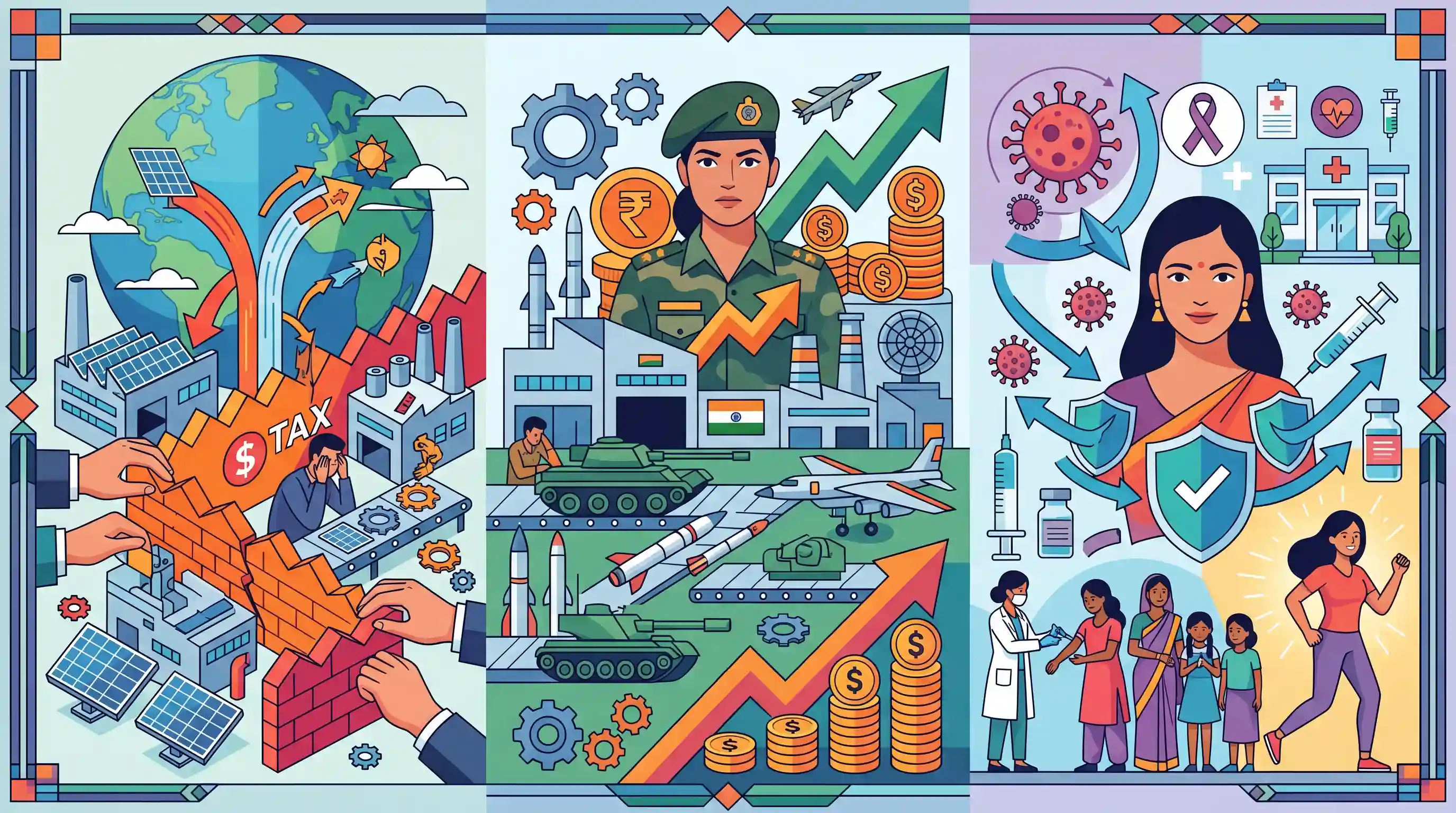
The article examines three diverse but significant developments: the impact of US tariffs on solar firms amid growing global trade protectionism, India's strategic push for defence indigenisation backed by budget surges, and the pressing public health issue of cervical cancer in India alongside the role of the HPV vaccine.
Key Points
- The US imposition of tariffs on solar firms underscores a rising trend of trade protectionism, which could disrupt global renewable energy supply chains and impact India's solar manufacturing sector.
- India's defence sector is experiencing a surge driven by increased budgetary support and a strong policy push towards indigenisation and self-reliance in military hardware.
- Cervical cancer continues to be a major public health challenge in India, highlighting the critical need for comprehensive HPV vaccination and women's health awareness programs.
Important Terms
HPV Vaccination Programme

A government initiative providing free, single-dose Human Papillomavirus vaccines to girls (primarily aged 14) to prevent cervical cancer, aiming for nationwide coverage through the U-WIN digital platform.
UPSC context
GS Paper 2: Social Justice and Health; relevant for public health interventions, vaccination strategies, and women's health.
Defence Indigenisation
A strategic policy aimed at achieving self-reliance in military equipment by developing domestic design, development, and manufacturing capabilities to reduce dependence on foreign imports.
UPSC context
GS Paper 3: Security and Indian Economy; tests knowledge of Atmanirbhar Bharat, strategic autonomy, and manufacturing growth.
Trade Protectionism
Economic policy of restricting imports from other countries through methods such as tariffs on imported goods, import quotas, and various other government regulations.
UPSC context
GS Paper 3: Economy and Global Trade; concerns global supply chains, WTO rules, and impact on India’s solar exports.
Countervailing Duty (CVD)
Specific tariffs imposed by a government to offset subsidies provided by the exporting country's government to its manufacturers, intended to level the playing field for domestic producers.
UPSC context
GS Paper 3: Economy; tests understanding of trade remedy measures and bilateral trade disputes (e.g., US-India solar trade).
Positive Indigenisation Lists
Schedules issued by India's Ministry of Defence identifying military equipment and systems that can no longer be imported and must be sourced from domestic manufacturers.
UPSC context
GS Paper 3: Security; a key mechanism for implementing Atmanirbharta in the defence sector.
Cervical Cancer
A common cancer in women, often caused by persistent infection with high-risk strains of Human Papillomavirus (HPV), which India is targeting through mass vaccination and screening.
UPSC context
GS Paper 2: Health; relates to disease burden, preventive healthcare, and Sustainable Development Goals (SDG 3).
Prelims Trap
"The HPV vaccine uses a live, attenuated strain of the Human Papillomavirus to trigger long-term immunity."
HPV vaccines are recombinant vaccines utilizing Virus-Like Particles (VLPs). They do not contain any live or killed viral genetic material, making them entirely incapable of causing infection.
Static Concepts Connected
What are Countervailing Duties (CVD) under WTO rules?
- Purpose: Tariffs levied to neutralize the negative effects of specific subsidies provided by a foreign government to its exporting companies.
- Versus Anti-dumping: While CVD targets state subsidies, Anti-Dumping Duties (ADD) target private companies selling goods abroad below fair market value.
- WTO Compliance: Permitted under the WTO's Subsidies and Countervailing Measures (SCM) Agreement if a country can prove material injury to its domestic industry.
How does the Human Papillomavirus (HPV) vaccine function?
- Viral Nature: HPV is a DNA virus. High-risk strains, specifically types 16 and 18, are responsible for about 70% of all cervical cancer cases globally.
- Recombinant Tech: The vaccine relies on recombinant technology, using Virus-Like Particles (VLPs) made from proteins that mimic the virus's outer shell but lack viral DNA.
Cross-Topic Patterns
Green Protectionism vs Climate Goals
US solar tariffs highlight the growing friction between WTO trade remedies (like CVDs) and global UNFCCC climate commitments, as "green protectionism" disrupts clean-energy supply chains.
Indigenisation & FDI Defense Rules
Defence import embargoes (Positive Indigenisation Lists) intersect closely with the revised FDI limits in defence manufacturing, shifting India's strategy from foreign procurement to export-led growth.

Expect a 2026 multi-statement question linking HPV recombinant vaccine tech with India's indigenous CERVAVAC and Universal Immunization.
Linked PYQs · 3
Linked PYQs · 3
- 2025MainsGS3
What are the challenges before the Indian economy when the world is moving away from free trade and multilateralism to protectionism and bilateralism? How can these challenges be met?
- 2014MainsGS3
Foreign Direct Investment (FDI) in the defence sector is now set to be liberalized. What influence this is expected to have on Indian defence and economy in the short and long run?
- 2019PrelimsGS1
Which one of the following statements is not correct?
