Artemis II Mission and West Asia Geopolitics
Source:Indian Express ↗
Why It Matters
Understanding the shifting US-Iran dynamics is vital for analyzing global energy security and India's Middle East policy, while the Artemis II mission represents a foundational leap in human spaceflight relevant to Science & Technology syllabi.
Summary
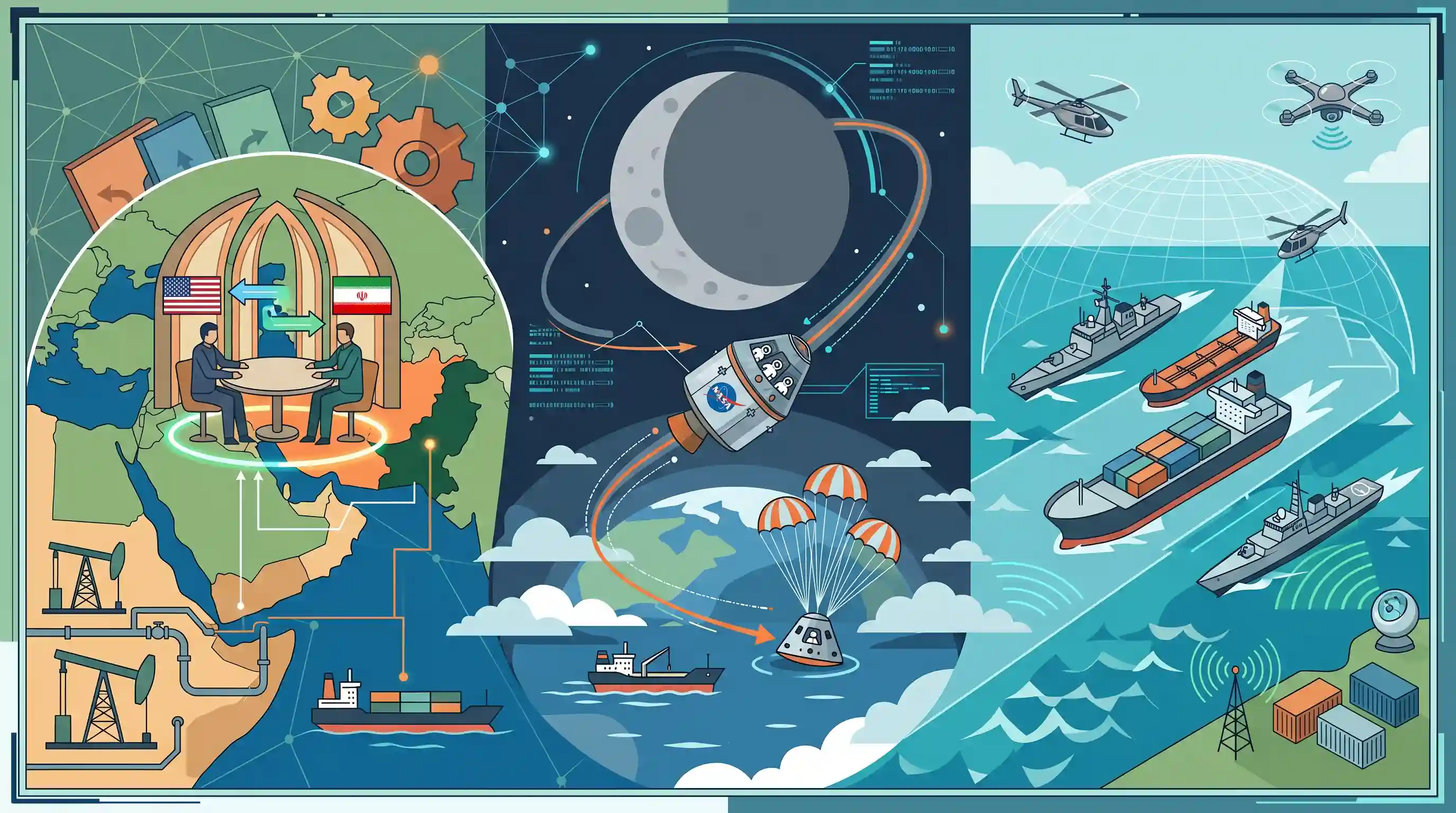
The article discusses three key developments: the initiation of crucial US-Iran diplomatic talks hosted in Islamabad with wide-ranging geopolitical and energy security implications; the successful return of NASA's Artemis II crewed lunar flyby mission, marking a historic milestone in human space exploration; and recent updates concerning the maritime vessel 'Jag Vikram', which highlights aspects of maritime security and commercial shipping.
Key Points
- Islamabad hosts significant backchannel diplomatic talks between the US and Iran, signaling a potential shift in Middle Eastern geopolitics.
- The US-Iran dialogue carries crucial implications for regional stability, global energy security, and India's strategic interests, including the Chabahar port.
- NASA's Artemis II mission successfully returned to Earth, completing the first crewed lunar flyby in over 50 years.
- The Artemis II success validates deep space exploration technologies (like the Orion capsule) and sets the foundation for future lunar landings under the Artemis program.
- Developments surrounding the maritime vessel 'Jag Vikram' underscore the importance of shipping and maritime security in India's strategic and commercial domain.
Important Terms
Artemis Accords

A US-led, non-binding international framework established in 2020 for peaceful and transparent lunar exploration. It builds on the 1967 Outer Space Treaty to establish norms for space activities.
UPSC context
GS2 (IR) and GS3 (S&T); tests knowledge of space governance, international treaties, and India's strategic space partnerships.
Artemis II
The first crewed mission of NASA's Artemis program, involving a lunar flyby with four astronauts. Completed in April 2026, it tested the SLS rocket and Orion spacecraft for deep-space travel.
UPSC context
GS3 (S&T); crucial for questions on human spaceflight milestones and deep-space exploration technologies.
Islamabad Talks (2026)
High-stakes diplomatic negotiations hosted by Pakistan in April 2026 between the US and Iran. They aimed to de-escalate regional conflict and reopen the blocked Strait of Hormuz.
UPSC context
GS2 (IR); tests understanding of West Asian geopolitics, third-party mediation, and conflict resolution mechanisms.
Strait of Hormuz
A strategic maritime chokepoint between the Persian Gulf and Gulf of Oman. It handles approximately 20% of global oil and LNG supply, making it vital for international energy security.
UPSC context
GS1 (Geography) and GS2 (IR); relevant to global trade routes and geopolitical leverage in energy-rich regions.
Jag Vikram
An India-flagged LPG tanker that successfully transited the Strait of Hormuz in April 2026. Its voyage highlighted India's proactive maritime diplomacy and energy security during regional crises.
UPSC context
GS3 (Security/Energy); illustrates maritime security challenges and India’s strategies to protect commercial assets in volatile waters.
NASA
The independent US federal agency responsible for the civil space program and aeronautics research. It leads the Artemis lunar missions and various international space collaborations.
UPSC context
GS3 (S&T); tests knowledge of major global space agencies and their collaborative missions with India (ISRO).
Prelims Trap
"NASA's Artemis II mission successfully landed astronauts near the lunar south pole."
Artemis II is only a crewed lunar flyby to test life support systems. The actual lunar landing is slated for the subsequent Artemis III mission.
Static Concepts Connected
What are the key geographical features of the Strait of Hormuz?
- Location: Situated between Iran to the north and the Musandam Peninsula of Oman to the south.
- Connectivity: Connects the Persian Gulf to the Gulf of Oman and the broader Arabian Sea.
- Strategic chokepoint: A crucial global transit route facilitating approximately 20% of the world's oil and gas flows.
How does the Artemis program structurally differ from the Apollo missions?
- Long-term presence: Aims to establish sustainable, long-term lunar infrastructure, unlike Apollo's brief Cold War-era exploratory focus.
- Lunar Gateway: Relies on the deployment of a space station (Gateway) in lunar orbit for mission staging.
- Stepping stone: Functions as an explicit testbed for deep-space technologies and life support needed for Mars missions.
Cross-Topic Patterns
Energy Security & Middle East Geopolitics
Disruptions in the Strait of Hormuz directly impact India's current account deficit and inflation, linking Middle Eastern foreign policy tightly to domestic macroeconomics.
Artemis Accords & Space Diplomacy
Artemis mission successes strengthen the US-led Artemis Accords (signed by India), setting space governance norms that counter the rival China-Russia International Lunar Research Station (ILRS) initiative.

Map-based questions linking Middle East chokepoints (Hormuz, Bab-el-Mandeb) with India's energy supply routes are highly likely in 2026.
Linked PYQs · 3
Linked PYQs · 3
- 2025MainsGS2
"Energy security constitutes the dominant kingpin of India's foreign policy, and is linked with India's overarching influence in Middle Eastern countries.” How would you integrate energy security with India's foreign policy trajectories in the coming years?
- 2023MainsGS3
What is the main task of India's third moon mission which could not be achieved in its earlier mission? List the countries that have achieved this task. Introduce the subsystems in the spacecraft launched and explain the role of the Virtual Launch Control Centre' at the Vikram Sarabhai Space Centre which contributed to the successful launch from Sriharikota.
- 2015PrelimsGS1
The area known as 'Golan Heights' sometimes appears in the news in the context of the events related to
