Global Trade Wars and Legal Immunity for Digital Intermediaries
Source:Indian Express ↗
Why It Matters
Understanding these diverse topics is crucial for analyzing shifting global trade policies (trade wars), the mechanisms of international law enforcement (extradition), and the evolving regulatory landscape for digital platforms in India (intermediary liability).
Summary
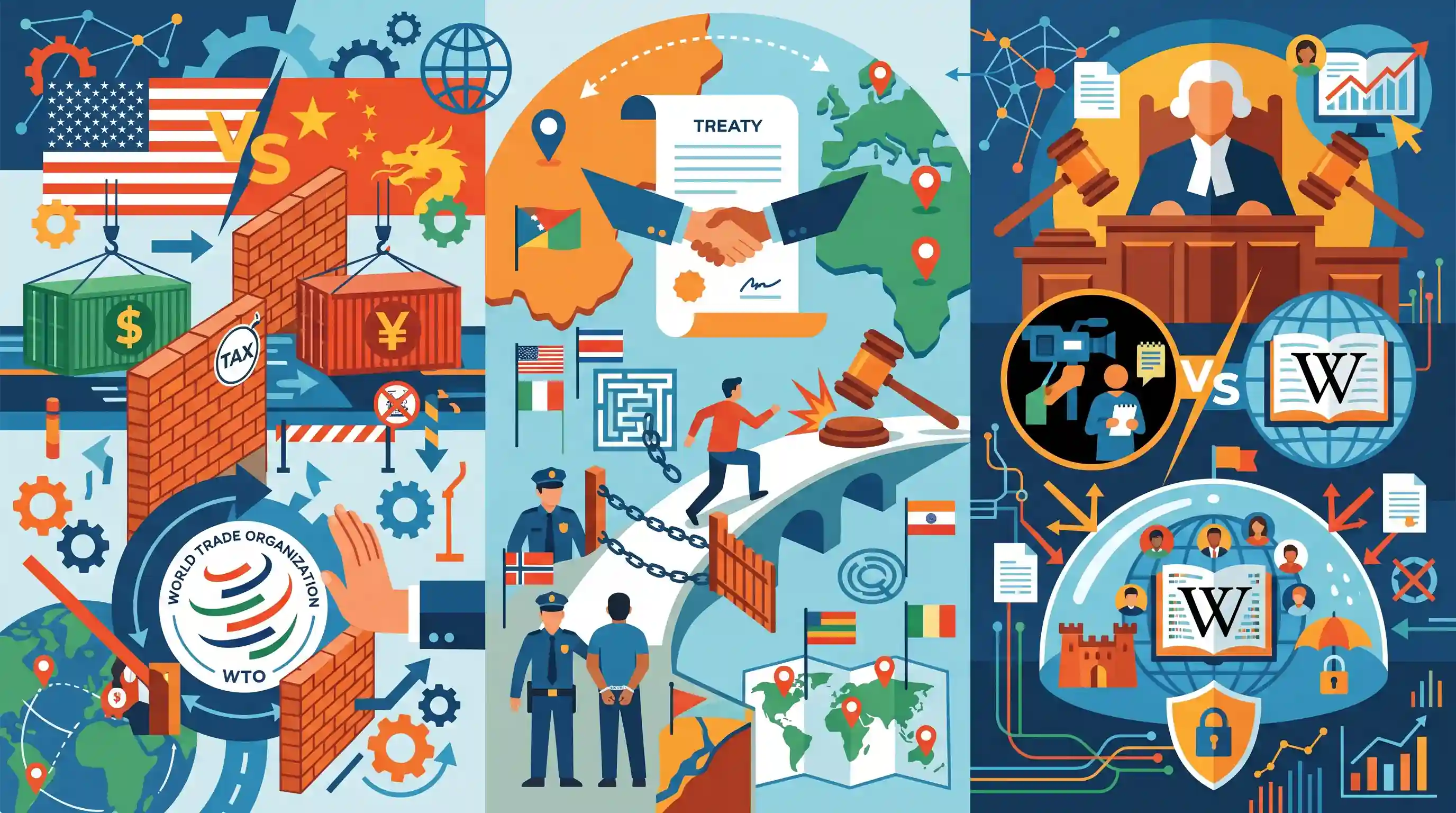
The article examines three major current affairs topics with significant legal, economic, and geopolitical implications. It explores the ongoing US-China tariff war, detailing its impact on global trade structures and the WTO. It also breaks down the intricacies of extradition in international law, highlighting the role of bilateral treaties and legal hurdles in repatriating fugitives. Furthermore, it analyzes the legal conflict between ANI and Wikipedia before the Delhi High Court, focusing on the 'safe harbour' immunity granted to digital intermediaries under Section 79 of the IT Act and the broader debate over online defamation and platform liability.
Key Points
- The US-China tariff war signifies a rising trend of protectionism, threatening global supply chains and the WTO-led multilateral trading framework.
- Extradition in international law relies primarily on bilateral treaties, subject to principles like dual criminality and exceptions for political offenses.
- The ANI vs Wikipedia defamation dispute brings scrutiny to the 'safe harbour' provisions protecting digital platforms.
- Under Section 79 of the Information Technology Act, intermediaries are shielded from liability for third-party content if they do not initiate or modify the transmission and observe due diligence.
- The case underscores the persistent tension between regulating digital intermediaries to prevent defamation and protecting freedom of information on the internet.
Important Terms
Information Technology Act, 2000

India's primary legislation governing cybercrime and electronic commerce. It provides legal recognition for electronic records and signatures while defining the conditional 'safe harbour' immunity for digital intermediaries.
UPSC context
GS Paper 3 (Security/S&T); crucial for understanding cyber law, data protection, and digital governance frameworks in India.
World Trade Organization (WTO)
The global intergovernmental organization regulating international trade. It manages a rules-based system, facilitates negotiations, and operates a Dispute Settlement Mechanism to resolve trade conflicts between member nations.
UPSC context
GS Paper 2 (International Institutions) and GS Paper 3 (Economy); tested for its role in global trade wars and multilateralism.
Extradition Treaties
Bilateral agreements providing the legal framework for transferring individuals accused or convicted of crimes from one state to another. These are governed in India by the Extradition Act, 1962.
UPSC context
GS Paper 2 (International Relations/Governance); involves issues of state sovereignty, dual criminality, and mutual legal assistance.
Intermediary Guidelines
Subordinate legislation under the IT Act that mandates 'due diligence' for platforms. They require intermediaries to appoint grievance officers and remove unlawful content to retain legal immunity.
UPSC context
GS Paper 2 (Governance) and GS Paper 3 (Digital Security); critical for debates on free speech vs. platform accountability.
Safe Harbour
A legal provision (Section 79 of the IT Act) that protects internet intermediaries from liability for third-party content, provided they follow due diligence and government take-down orders.
UPSC context
GS Paper 2 (Governance); central to recent judicial scrutiny of platforms like Wikipedia regarding defamation and content moderation.
Delhi High Court
A constitutional court with significant jurisdiction over the National Capital Territory. It serves as a key forum for high-profile cases involving intermediary liability and IT Act interpretations.
UPSC context
GS Paper 2 (Judiciary); important for studying judicial overreach, contempt of court, and the evolution of digital rights jurisprudence.
Prelims Trap
Digital intermediaries in India enjoy absolute immunity from liability for third-party content under Section 79 of the IT Act.
Safe harbour is strictly conditional, not absolute. It is revoked if a platform initiates/modifies the content, fails due diligence, or ignores official takedown orders.
Static Concepts Connected
What are the core principles governing international extradition?
- Dual Criminality: The accused's action must be recognized as a punishable criminal offense in both the requesting and requested countries.
- Rule of Specialty: An extradited fugitive can only be prosecuted for the specific crime for which their extradition was formally granted.
- Political Exception: Extradition is generally denied for political offenses, though modern treaties strictly exclude terrorism from this protective exception.
What conditions govern 'Safe Harbour' under the Information Technology Act?
- Conditional Immunity: Section 79 shields platforms from liability for user-generated content, provided they act strictly as neutral facilitators.
- No Modification: The intermediary must not initiate the transmission, select the receiver, or modify the information contained in the transmission.
- Notice and Takedown: Protection is lost if the platform fails to expeditiously remove unlawful content after receiving actual knowledge via a court or government order.
Cross-Topic Patterns
WTO Dispute Settlement Paralysis
US-China tariff wars increasingly bypass the WTO, exacerbating the crisis in its Appellate Body which remains paralyzed due to the deliberate blocking of judicial appointments.
Intermediary Rules vs Free Speech
The safe harbour debate connects directly to the IT (Intermediary Guidelines) Rules 2021, weighing digital platform accountability and grievance redressal against Article 19(1)(a) freedom of expression.

Expect a multi-statement Prelims question testing 'Dual Criminality' in extradition alongside Section 79 'Safe Harbour' exceptions.
Linked PYQs · 4
Linked PYQs · 4
- 2018MainsGS2
What are the key areas of reform if the WTO has to survive in the present context of "Trade War', especially keeping in mind the interest of India?
- 2024MainsGS3
Social media and encrypting messaging services pose a serious security challenge. What measures have been adopted at various levels to address the security implications of social media? Also suggest any other remedies to address the problem.
- 2016MainsGS3
Use of Internet and social media by non-state actors for subversive activities is a major security concern. How have these been misused in the recent past? Suggest effective guidelines to curb the above threat.
- 2021MainsGS3
Discuss how emerging technologies and globalisation contribute to money laundering. Elaborate measures to tackle the problem of money laundering both at national and international levels.
