Poverty Estimation Frameworks and Groundwater Contamination Crisis
Source:Indian Express ↗
Why It Matters
Understanding poverty estimation methodologies is crucial for the effective targeting of welfare schemes. Simultaneously, groundwater contamination presents a massive public health and environmental challenge that directly impacts water security and sustainable development, making both topics highly relevant for GS2 (Social Justice) and GS3 (Economy and Environment).
Summary
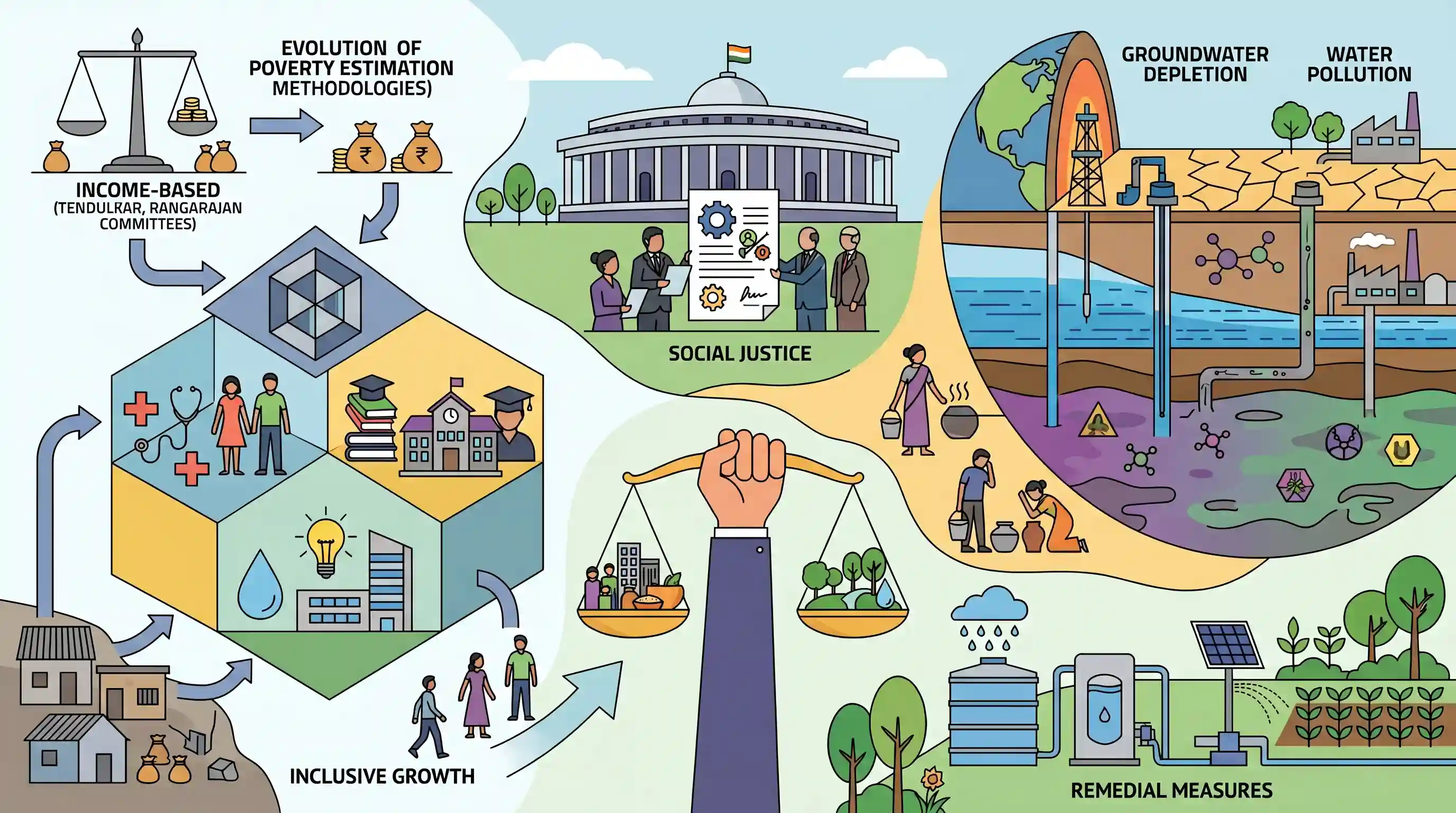
The article covers three critical areas relevant to Indian policy and environment: the proposed UMEED Bill, the evolution of poverty estimation frameworks in India, and the escalating challenge of groundwater contamination. It discusses how poverty measurement has evolved from the income-based methodologies of the Tendulkar and Rangarajan committees toward the broader Multidimensional Poverty Index (MPI). Furthermore, it highlights the pressing environmental crisis of groundwater pollution involving toxic elements like arsenic, fluoride, and uranium, emphasizing the urgent need for sustainable water management and robust remedial measures.
Key Points
- The UMEED Bill represents a key legislative or policy intervention aimed at addressing targeted socio-economic or developmental challenges.
- Poverty estimation in India has transitioned from purely consumption-based poverty lines (as recommended by the Tendulkar and Rangarajan committees) to capturing holistic deprivations via the Multidimensional Poverty Index (MPI).
- Groundwater contamination is a severe environmental and public health crisis in India, driven by natural and anthropogenic concentrations of arsenic, fluoride, uranium, and nitrates in aquifers.
- Mitigating groundwater pollution requires comprehensive mapping by bodies like the CGWB, regulating industrial effluents, and promoting sustainable aquifer management.
Important Terms
UMEED Bill

The Unified Waqf Management, Empowerment, Efficiency, and Development Bill aims to reform the Waqf Act 1995 by enhancing transparency, digital record-keeping, and mandating women's inclusion in Waqf boards.
UPSC context
GS Paper 2 (Governance); tests legislative reforms in religious property management, gender justice, and administrative accountability in minority institutions.
Multidimensional Poverty Index (MPI)
A composite measure capturing overlapping deprivations in health, education, and living standards. India's national version, led by NITI Aayog, tracks 12 indicators including maternal health and bank accounts.
UPSC context
GS Paper 2 & 3 (Social Justice/Economy); essential for understanding poverty measurement evolution beyond basic income-based methodologies.
NITI Aayog
India’s premier policy think tank that replaced the Planning Commission; it serves as the nodal agency for the National MPI and monitors Sustainable Development Goal (SDG) implementation.
UPSC context
GS Paper 2 (Governance); tests the role of cooperative federalism, evidence-based policymaking, and institutional shifts in development planning.
Central Ground Water Board (CGWB)
A subordinate office of the Ministry of Jal Shakti tasked with scientific exploration, monitoring, and management of India's groundwater, including reporting on toxic contamination like arsenic and uranium.
UPSC context
GS Paper 3 (Environment); tests knowledge of water resource management, geogenic contamination, and sustainable environmental governance.
United Nations Development Programme (UNDP)
The UN's development network that co-publishes the Global MPI and Human Development Report, monitoring international progress on extreme poverty and climate-induced vulnerabilities.
UPSC context
GS Paper 2 (International Relations); relevant for international indices, India's global development standing, and multilateral institutional frameworks.
Prelims Trap
The UMEED Bill ensures Waqf boards remain exclusively managed by Muslim members to preserve minority autonomy.
The UMEED (formerly Waqf Amendment) Bill explicitly mandates the inclusion of non-Muslim representatives and women, fundamentally shifting away from exclusive community management.
Static Concepts Connected
How do the Tendulkar and Rangarajan poverty methodologies differ?
- Tendulkar (2009): Shifted away from calorie-based norms to a broader consumption basket (health, education) using a Uniform Reference Period (URP).
- Rangarajan (2014): Reverted to normative calorie requirements but adopted the Modified Mixed Reference Period (MMRP) for more accurate calculation.
What are the primary geogenic groundwater contaminants in India?
- Arsenic: Prevalent in the Gangetic basin (UP, Bihar, WB); chronic exposure causes skin lesions and Blackfoot disease.
- Fluoride: Widespread in peninsular and arid India due to weathering of rocks; leads to debilitating skeletal and dental fluorosis.
- Uranium: Emerging threat in Punjab/Rajasthan aquifers; primarily causes severe kidney toxicity (chemical hazard) rather than radiation hazards.
Cross-Topic Patterns
Phosphate Fertilizers & Uranium Toxicity
Over-reliance on phosphate fertilizers under the nutrient-based subsidy (NBS) regime exacerbates groundwater uranium contamination, linking agricultural subsidies directly to public health crises.
Waqf Reforms vs Article 26
The UMEED Bill's mandate for non-Muslim board members will almost certainly be tested against Article 26 (freedom to manage religious affairs) and secularism debates.

A 2026 multi-statement prelims question will likely mix geogenic vs anthropogenic groundwater contaminants, focusing heavily on uranium.
Linked PYQs · 5
Linked PYQs · 5
- 2012PrelimsGS1
The Multi-dimensional Poverty Index developed by Oxford Poverty and Human Development Initiative with UNDP support covers which of the following? 1. Deprivation of education, health, assets and services at household level 2. Purchasing power parity at national level 3. Extent of budget deficit and GDP growth rate at national level Select the correct answer using the codes given below:
- 2020MainsGS2
The incedence and intensity of poverty are more important in determining poverty based on income alone". In this context analyse the latest United Nations Multidimensional Poverty Index Report.
- 2024MainsGS3
Industrial pollution of river water is a significant environmental issue in India. Discuss the various mitigation measures to deal with this problem and also the government's initiatives in this regard.
- 2025MainsGS3
Examine the factors responsible for depleting groundwater in India. What are the steps taken by the government to mitigate such depletion of groundwater?
- 2025MainsGS3
Seawater intrusion in the coastal aquifers is a major concern in India. What are the causes of seawater intrusion and the remedial measures to combat this hazard?
